

In a bid to shake things up, the 2026 Jeep Grand Wagoneer gets a mid-cycle refresh and is no longer underlined by the more-affordable Jeep Wagoneer. As a result, it might be one the best value propositions in the segment.
Stellantis likely had high hopes of making a dent in the full-size SUV segment by launching the Wagoneer sub-brand for the 2022 model year, with Wagoneer and Grand Wagoneer models to start things off. The automaker adjusted its focus, and this year, the 2026 Jeep Grand Wagoneer gets a slew of changes, while the Wagoneer was retired.

Meanwhile, the fully electric Jeep Wagoneer S launched for the 2025 model year. So far, there’s no 2026 edition, and the midsize five-passenger crossover’s future is unclear. Let’s now focus on the Grand Wagoneer.
For 2026, the body-on-frame SUV now wears the Jeep logo, something it should’ve done all along to avoid confusion with prospective customers, who had to visit Jeep dealerships to check out the vehicle anyway. The front end received new styling with slimmer headlights, separated by a faux-grille with illuminated slots, as the SUV is now a bottom-breather.

The side profile and rear section are the same as before, with the exception of new taillight lenses, and there are new paint colors and alloy wheel designs as well. Another non-negligible change is the elimination of all exterior chrome trim, which Stellantis says is a more eco-friendly approach.
Inside, the overall design hasn’t changed, but there are fewer interior colors, accenting and seat upholstery textures to choose from, though open-pore walnut wood trim and a suede headliner are available. In addition, a new and bigger head-up display is offered on the uplevel variants.

The 2026 Grand Wagoneer is now offered in base, Limited Altitude, Upland, 85th Anniversary Edition, Limited Reserve and Summit Obsidian trim levels. They’re all available on the regular-length variant, while the extended-length Grand Wagoneer L can be ordered with five out of six trim levels—Upland being the exception.
One powertrain choice is on deck, at least for the time being. It’s the familiar Hurricane twin-turbocharged 3.0L inline-six that develops 420 horsepower and 468 pound-feet of torque, managed by an eight-speed automatic transmission that feeds power to either the standard Quadra-Trac I single-speed four-wheel drivetrain, or the optional Quadra-Trac II system with a two-speed transfer case. While it doesn’t incorporate a cylinder deactivation system or any form of electric assistance, it includes automatic stop/start to save a few drops of fuel at stoplights.

Jeep also promised a range-extending electric powertrain for the 2026 model year, or what it calls the REEV, but it isn’t available yet, and will be pushed back to the 2027 model. It consists of a naturally aspirated 3.6L V6 engine, feeding a 130 kW on-board generator that replenishes the 92 kWh high-voltage battery. Two electric motors produce a combined 647 horsepower and 620 pound-feet of torque, which is said to propel the Grand Wagoneer from 0 to 96 km/h (0 to 60 mph) in five seconds. The REEV powertrain also offers a combined driving range of up to 800 kilometres, according to the manufacturer.
For now, the Hurricane engine is the only way to go, and here are its fuel economy ratings. We’ll point out here that regular 87-octane fuel can be used, though Stellantis recommends 89-octane mid-grade juice for best performance and efficiency.
| City/Highway/Combined (L/100 km) | CO2 Emissions (g/km) | |
| Grand Wagoneer | 14.2 / 10.4 / 12.5 | 714 |
| Grand Wagoneer L | 14.9 / 10.7 / 13.0 | 746 |

During our latest test of the 2026 Jeep Grand Wagoneer in Summit Obsidian trim, which included mostly highway driving in July, we managed a very decent 10.8 L/100 km. The trick here is simply to drive at the posted speed limit as well as anticipate upcoming traffic lights while coasting as you get to them. Any harsh braking to stop the vehicle was likely proceeded by unnecessary acceleration—and fuel consumption.
Now that the Wagoneer is gone, Jeep has realigned its direct competition from luxury-brand SUVs to mass-market models such as the Chevrolet Tahoe, the Chevrolet Suburban, the Ford Expedition, the GMC Yukon, the Nissan Armada and the Toyota Sequoia. The GM models are available with a diesel six-cylinder engine are represent the most fuel-efficient in the segment—though diesel fuel costs a lot more at the moment than regular gasoline. The Sequoia relies on a segment-exclusive hybrid powertrain.

The Grand Wagoneer’s Hurricane engine may not be a V8, but it’s smooth, refined and powerful. And it’s not a gas hog, either, with a better combined rating than with the Expedition, the gas-powered GMs and the Armada. In addition, towing capacity is class-leading at 4,535 kilograms or 10,000 pounds. As with the vast majority of body-on-frame utility vehicles, ride comfort is good, but we’ll still feel every lump, crack and pothole on the road, especially around town, and especially with the 22-inch wheels wrapped in low-profile 285/45R22 tires. It should be better given that our test vehicle was equipped with the air suspension.
In Canada, 2026 Jeep Grand Wagoneer pricing ranges from $92,585 to $135,428, which includes the $2,695 freight and delivery charges, the $100 A/C tax and factory options. Like the Yukon, the Grand Wagoneer costs less than the Cadillac Escalade and Lincoln Navigator, but offers a more premium look and feel than the Chevrolets, the Ford, the Nissan and the Toyota. Though it crosses the $100k mark with a few options, the Jeep offers good value.

Let’s compare some specifications with the Expedition, the Yukon, the Armada and the Sequoia:
| Specifications |  |  |  | 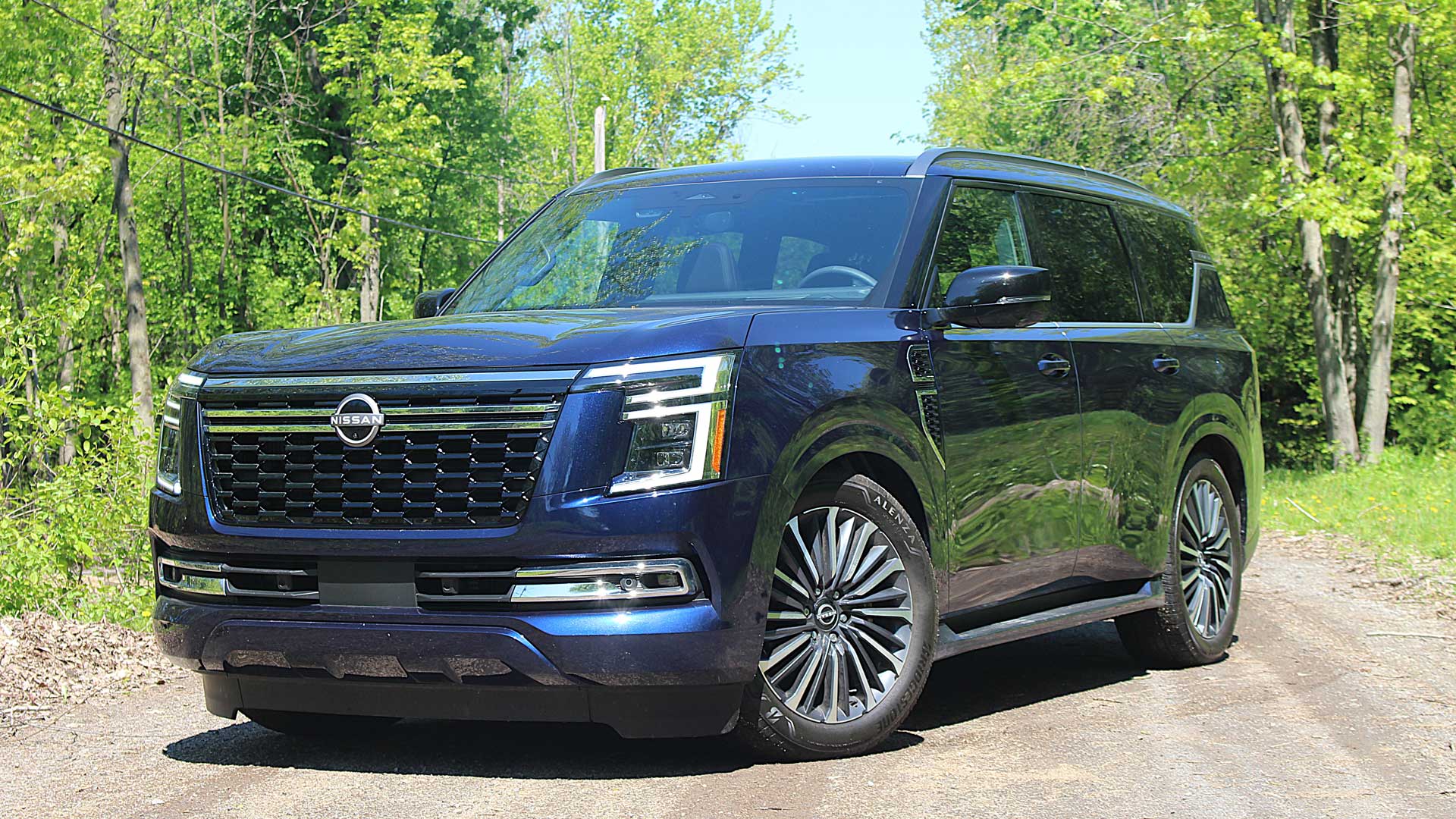 |  |
|---|---|---|---|---|---|
| 2026 Jeep Grand Wagoneer / L | 2026 Ford Expedition / MAX | 2026 GMC Yukon / XL | 2026 Nissan Armada | 2026 Toyota Sequoia | |
| Price Range Including Luxury Tax ($CAD) | $92,585 to $135,428 | $86,065 to $134,172 | $98,198 to $142,232 | $88,669 to $113,163 | $88,619 to $108,287 |
| Engines | Twin-Turbo 3.0L I6 | Twin-Turbo 3.5L V6 | 5.3L V8 6.2L V8 Turbo-Diesel 3.0L I6 | Twin-Turbo 3.5L V6 | Twin-Turbo 3.4L V6 HEV |
| Output (hp) | 420 | 400 to 440 | 305 to 420 | 425 to 460 | 437 |
| Torque (lb-ft) | 468 | 480 to 510 | 383 to 495 | 516 | 583 |
| Combined Fuel Economy (L/100 km) | 12.5 to 13.0 | 13.3 | 10.7 to 15.1 | 13.7 to 14.4 | 11.7 |
| Wheelbase (mm) | 3,124 to 3,302 | 3,112 to 3,341 | 3,071 to 3,406 | 3,075 to 3,076 | 3,099 |
| Length (mm) | 5,488 to 5,794 | 5,331 to 5,631 | 5,337 to 5,720 | 5,325 to 5,359 | 5,284 |
| Width (mm) | 2,124 | 2,070 | 2,057 | 2,029 | 2,022 |
| Height (mm) | 1,965 to 2,027 | 1,978 to 2,004 | 1,943 | 1,955 to 1,980 | 1,890 |
| Headroom 1st/2nd/3rd Rows (mm) | 998 to 1,049 / 975 to 1,016 / 977 to 991 | 1,005 to 1,061 / 1,005 to 1,015 / 950 | 1,026 to 1,074 / 952 to 988 / 970 | 993 / 960 / 919 | 996 / 953 to 975 / 904 |
| Legroom 1st/2nd/3rd Rows (mm) | 1,040 / 1,085 / 930 | 1,115 / 1,071 / 927 | 1,130 / 1,067 / 886 to 932 | 1,113 / 996 / 836 | 1,046 / 996 / 714 to 856 |
| Cargo Volume Behind 3rd/2nd/1st Rows (L) | 790 to 1,206 / 2,004 to 2,415 / 3,305 to 3,706 | 648 to 1,059 / 1,979 to 2,392 / 3,072 to 3,485 | 722 to 1,175 / 2,053 to 2,650 / 3,478 to 4,092 | 578 / 1,594 / 2,750 | 326 to 631 / 1,388 / 2,461 |
| Max Towing Capacity (kg) | 4,535 | 4,354 | 3,674 | 3,856 | 4,137 |
Standard features include 18-inch alloy wheels, LED exterior lighting, heated outside mirrors, rain-sensing windshield wipers, a power hands-free liftgate, remote engine start, three-zone climate control, a 10.25-inch digital driver instrument cluster, second-row captain’s chairs for seven-passenger capacity, driver position memory, 12-way power-adjustable front seats with heating and ventilation, a power-adjustable steering column, a heated and leather-wrapped steering wheel, Capri leather upholstery, a 12-inch infotainment system touchscreen, navigation, eight USB ports, wireless phone charging and an Alpine nine-speaker stereo, SiriusXM capability (with six-month trial).

There’s also the usual list of advanced safety features such as adaptive cruise control, blind-spot monitoring as well as front and rear park sonar. Options include a tri-pane panoramic sunroof, a Quadra-Lift air suspension, Quadra-Trac II with two-speed transfer case, a 360-degree camera system, active park assist, a trailer tow package with two-speed transfer case and limited-slip differential, and an eight-passenger seating package with a 40/20/40-split second-row bench seat.
The Upland variant adds a locking in-vehicle safe, the two-speed transfer case and limited-slip diff, the air suspension, skid plates, tow hooks and 20-inch painted alloy wheels.

The Limited Altitude upgrades to 20-inch wheels, the air suspension, power-folding mirrors, Nappa leather seating, heated second-row seats, the 360-degree camera system and active park assist. A 12.3-inch driver instrument cluster and head-up display are optional, as are the trailer tow package, the tri-pane sunroof, a rear-seat entertainment system with dual 10.1-inch screens and a 19-speaker McIntosh sound system and power-retractable assist steps. A Limited Altitude Appearance Package brings a dark, more-sinister look to the vehicle.
The Limited Reserve also piles on a cargo cover, the tri-pane sunroof, the power-assist steps, the McIntosh stereo, head-up display and the 12.3-inch driver instrument cluster, upon which the darkened appearance, the eight-passenger seating package, the rear-seat entertainment system and the trailer tow package can also be added.

The 85th Anniversary Edition gets exclusive 22-inch wheels, badging, and Capri leather seats with gold stitching, among other things.
Finally, the Summit Obsidian loads up with a digital rearview mirror, four-zone climate control, premium Nappa leather, 24-way power front seats with massage function, ventilated second-row seats and a front-passenger entertainment display. The trailer tow group, the rear-seat entertainment system, a black-painted roof, a front console cooler box, Palermo leather seats, eight-passenger seating and a McIntosh 23-speaker stereo are optional.

The Grand Wagoneer is big and square. That means plenty of room in all three rows, even on longer road trips. Cargo space is among the best in the segment, marginally below the GM models. However, the second-row captain’s chairs include a center console that can’t be removed, so if we’re looking for max cargo capability, the second-row bench seat is a better choice, though a less comfy one.
The front seats seem to have been designed to accommodate humans of all shapes and sizes, but they’re not the most comfortable for long drives. Their padding is too firm, and lateral support isn’t great, either.

Despite the interior trim simplification for the 2026 model year, the Jeep still serves up a luxurious experience inside, with a high level of fit and finish. The McIntosh sound systems are marvellous. On the other hand, there are only two interior color schemes to choose from, Black and Sea Salt, across the trim level lineup. At the very least, the Summit Reserve should get posher and more exclusive interior appearances compared to the rest of the lineup. At the vehicle’s launch, Jeep promised a Ruby Red interior, but it’s not available yet.
This might be exceptional to our test vehicle, but the Grand Wagoneer we drove had plenty of squeaks and rattles, as if we were cruising down the highway in our living room. Not a dealbreaker, and probably things that can be adjusted by the dealership if we complain frequently or loud enough. At least it’s a good reason to crank up the McIntosh stereo.

It may not have gotten a major overhaul, but the Grand Wagoneer’s revisions and repositioning serves it well, and might help draw more customers. It offers more than enough power and more than enough interior room for families on the go, and it’s priced right, and won’t cost an arm and a leg in fuel, relative to the full-size SUV segment, of course. The range-extending powertrain should make the big Jeep more efficient, but those savings may be offset by a higher purchase price. We’ll see.
On the other hand, aside from its towing capabilities, it still doesn’t clearly surpass its rivals regarding overall performance, comfort and luxury, and may very well continue to be dominated by GM and Ford in the full-size SUV segment. Stellantis also needs to work on the build quality of its vehicles, though so far, the six-cylinder engine isn’t troublesome, and it’s not as its American-brand rivals are any better. Nevertheless, it’s not a bad choice for those who want to stand out with so many Tahoes, Suburbans and Expeditions on the road already.


