

The 2026 Kia K4 represents the Korean brand’s most-affordable model, and competes in the small passenger-car segment. A segment several automakers have deserted to concentrate on bigger and—especially—more profitable vehicles.
Among those that still offer affordable cars, some are available with hybrid powertrains, which isn’t the case of the Kia K4. Is that a real disadvantage? Let’s take a closer look.

Two powertrains are offered in the 2026 Kia K4, available in four-door sedan and five-door hatchback body styles. The first consists of a naturally aspirated 2.0L inline-four engine that develops 147 horsepower and 132 pound-feet of torque, connected to a continuously variable automatic transmission. The second is a turbocharged 1.6L four generating 190 horsepower and 195 pound-feet, managed by an eight-speed automatic. In both cases, power is fed to the front wheels.
There’s no hybrid tech to reduce fuel consumption, and no automatic stop/start system either. The car is quite aerodynamic, though, with a drag coefficient of 0.27 for the sedan—among the best in its category—and between 0.30 and 0.31 for the hatchback.

Is the 2026 Kia K4 Fuel-Efficient?
During our summer test of the 2026 Kia K4, decked out in the GT-Line Turbo Limited trim level riding on 18-inch wheels with 235/40R18 tires, we managed a very good average of 7.2 L/100 km. Let’s check out the official fuel economy ratings, based on Natural Resources Canada test procedures:
| Trim Level | City/Highway/Combined (L/100 km) | CO2 Emissions (g/km) |
| LX Sedan | 7.9 / 5.8 / 7.0 | 164 |
| EX, EX+ and EX Premium Sedan | 8.4 / 6.0 / 7.3 | 172 |
| GT-Line Turbo and GT-Line Turbo Limited Sedan | 9.2 / 7.2 / 8.3 | 188 |
| LX, EX, EX+ and EX Premium Hatchback | 8.3 / 6.7 / 7.6 | NA |
| GT-Line Turbo and GT-Line Turbo Limited Hatchback | 9.2 / 7.2 / 8.3 | 188 |

The K4’s competition in the small-car segment includes the Honda Civic, the Hyundai Elantra, the Mazda3, the MINI Cooper, the Nissan Sentra, the Subaru Impreza, the Toyota Corolla as well as the Volkswagen Golf (GTI and R) and Volkswagen Jetta. The Civic, Elantra and Corolla can all be equipped with hybrid powertrains and are consequently the most fuel-efficient of the group, but the K4 is as frugal as the rest. Curiously, the K4 and the Elantra share the same platform and powertrains, but not the hybrid system.
How Much Does the 2026 Kia K4 Cost?
The 2026 Kia K4 is priced from $27,029 to $38,579, which includes the $1,935 freight and delivery charges, the $100 A/C tax, the $699 dealer fees and factory-installed options.

Its base price is higher than that of the Elantra, but otherwise, it ranks among the lowest in the segment. Standard features include, among other things, 16-inch steel wheels with covers, heated outside mirrors, lane keep assist, cloth seat upholstery, heated and height-adjustable front seats, a smart key with remote start, an infotainment system with a 12.3-inch touchscreen, Apple CarPlay/Android Auto and a four-speaker sound system. Moving up to the EX trim level gives us 17-inch alloy wheels, blind-spot monitoring and a heated steering wheel.
At the other end of the spectrum, the GT-Line Turbo Limited variant is equipped with 18-inch wheels, a power sunroof, dual-zone automatic climate control, leather seating, a power-adjustable driver’s seat, ventilated front seats, heated rear seats, a 12.3-inch digital driver instrument cluster, digital key compatibility, a Harman/Kardon stereo, and more. It costs a little more than $35k, but it’s fully loaded.

Let’s compare some specifications with the Civic, the Mazda3 and the Corolla:
| Specifications |  |  |  | 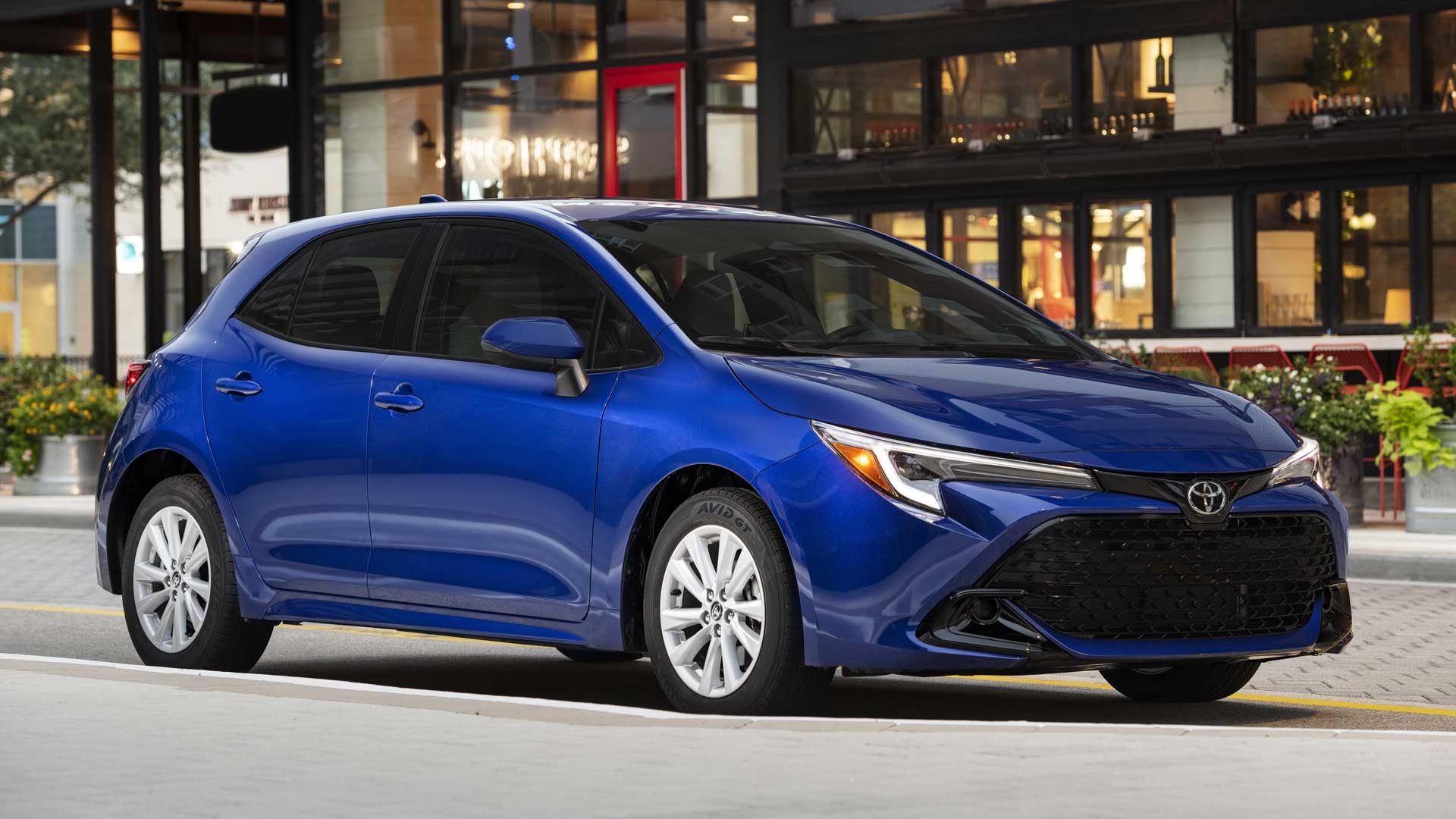 |
|---|---|---|---|---|
| 2026 Kia K4 | 2026 Honda Civic | 2026 Mazda3 | 2026 Toyota Corolla | |
| All-Inclusive Price (CAD) | $27,029 to $38,579 | $31,569 to $43,279 | $28,240 to $42,940 | $27,779 to $40,574 |
| Powertrains | 2.0L I4 Turbo 1.6L I4 | 2.0L I4 Turbo 1.5L I4 2.0L I4 HEV | 2.5L I4 Turbo 2.5L I4 | 2.0L I4 1.8L I4 HEV |
| Drivetrains | FWD | FWD | FWD, AWD | FWD, AWD |
| Output (hp) | 147 to 190 | 150 to 200 | 186 to 250 | 138 to 169 |
| Torque (lb-ft) | 132 to 195 | 133 to 247 | 186 to 320 | 105 to 151 |
| Combined Fuel Economy (L/100 km) | 7.0 to 8.3 | 4.9 to 7.7 | 7.8 to 8.9 | 4.7 to 6.8 |
| Wheelbase (mm) | 2,720 | 2,735 | 2,726 | 2,640 to 2,700 |
| Length (Sedan) (mm) | 4,710 | 4,655 | 4,662 | 4,630 |
| Length (Hatchback) (mm) | 4,430 | 4,529 | 4,470 | 4,370 |
| Width (mm) | 1,850 | 1,801 | 1,796 | 1,781 to 1,790 |
| Height (mm) | 1,420 to 1,430 | 1,410 to 1,415 | 1,445 to 1,455 | 1,435 |
| Headroom Front/Rear (Sedan) (mm) | 947 to 990 / 940 to 942 | 956 to 998 / 942 | 954 to 965 / 931 to 947 | 965 to 973 / 942 |
| Headroom Front/Rear (Hatchback) (mm) | 944 to 991 / 972 to 973 | 956 to 998 / 942 | 956 to 981 / 952 to 955 | 975 / 955 |
| Legroom Front/Rear (mm) | 1 074 / 964 | 1 074 / 950 | 1 073 to 1 075 / 891 to 909 | 1 067 / 759 to 883 |
| Trunk Volume (Sedan) (L) | 413 | 408 to 419 | 374 | 371 |
| Cargo Area Min/Max (Hatchback) (L) | 628 / 1,680 | 693 / 1,308 | 572 / 1,334 | 660 / NA |
Is the 2026 Kia K4 cabin spacious?
No problem entering and exiting the 2026 Kia K4, as its front and rear doors open pretty wide. As for cabin dimensions, the Kia fares well, especially for legroom and cargo space. However, the rather low roofline cuts down on headroom, particularly when the car is equipped with the sunroof. On paper, the K4 Hatchback offers the roomiest trunk with the rear seatbacks folded. The angle of said seatbacks isn’t adjustable, which would’ve made them more comfortable on longer road trips.

In general, we like the K4’s dashboard ergonomics, with well-positioned steering wheel buttons, easy-to-use climate controls in addition to an infotainment interface that isn’t too distracting while driving. We also get several handy storage points on the centre console, including retractable cupholders. However, the front seats in the GT-Line Limited we tested were flat and thin-cushioned, spoiling comfort.
Is the 2026 Kia K4 Fun to Drive?
Under the hood, the base engine isn’t all that exciting, but it stands out for its efficiency and, as we noticed over the years, its overall reliability. The turbocharged engine is clearly more energetic and obviously makes the K4 more amusing to drive. On the other hand, it’s tough to compare the turbo K4 to the Civic Si, which is only available with a manual transmission. One thing is certain, though, is that the Mazda3 Turbo as well as the Golf GTI and Jetta GLI, with their more generous low-end torque and their sportier suspension setups, and more engaging to drive. The Kia’s steering isn’t as precise, but it’s not numb either, and its brakes are up to the task. The K4’s Sport drive mode doesn’t add much to the experience.

Unlike the Mazda3, the Impreza and the Corolla Hybrid, the Kia isn’t available with an all-wheel drivetrain. And although sales in this sub-category are marginal, the K4 isn’t offered in a high-performance variant to rival the Civic Type R, the Elantra N, the MINI John Cooper Works, the GR Corolla and the Golf R. We didn’t include their specs in the table above.
In addition, there’s a delay in the Kia’s throttle response, which is probably meant to soften launches and maybe save a few drops of fuel, but this second during which nothing seems to happen after we press on the gas pedal becomes an irritation. On a more positive note, the K4 serves up good ride comfort for a compact car and its cabin is relatively well insulated.

So, is the 2026 Kia K4 Worth it?
In the small-car segment, it’s competitive in almost every aspect. The K4 is fuel-efficient, its cabin is roomy, its dashboard layout is fine, and it offers great value. Beauty is in the eye of the beholder, but yours truly will say that the hatchback is more attractive than the sedan, and that the extra $500 asked for the five-door variant is money well spent. The Kia also represents an excellent alternative for those who no longer stand to see Civics and Corollas on every street corner, and would certainly buy something else just to be different.
On the other hand, all-wheel drive isn’t available, which would’ve been great for our harsh Canadian winters, and the absence of a hybrid powertrain is a tangible disadvantage, especially when a litre of gasoline costs nearly $2. K4 buyers must also deal with some minor annoyances, like the throttle response delay, the hump in the floor for the rear centre occupant as well as the flat, uncomfortable front seats, at least in our opinion.

To sum things up, the K4 is worth it. It’s already an efficient car, but it would be even better if the brand decided to offer the hybrid powertrain that’s already found in the Elantra.


