

No matter which manufacturer we scrutinize, we can always find some hits and misses. It’s the case at Mazda, as elsewhere. The small Japanese firm has offered us gems over the years, as well as models that generated less buzz or fueled discussions for the wrong reasons, let’s put it that way.
The Mazda CX-30 made its debut for the 2020 model year
Undoubtedly, the most enjoyable to drive in its class
Its average fuel consumption is rated at 9.3 L/100 km
Strengths
Driving pleasure
Build quality
Reliability
Weaknesses
Terrible rear and rear three-quarter visibility
Disappointing cargo volume
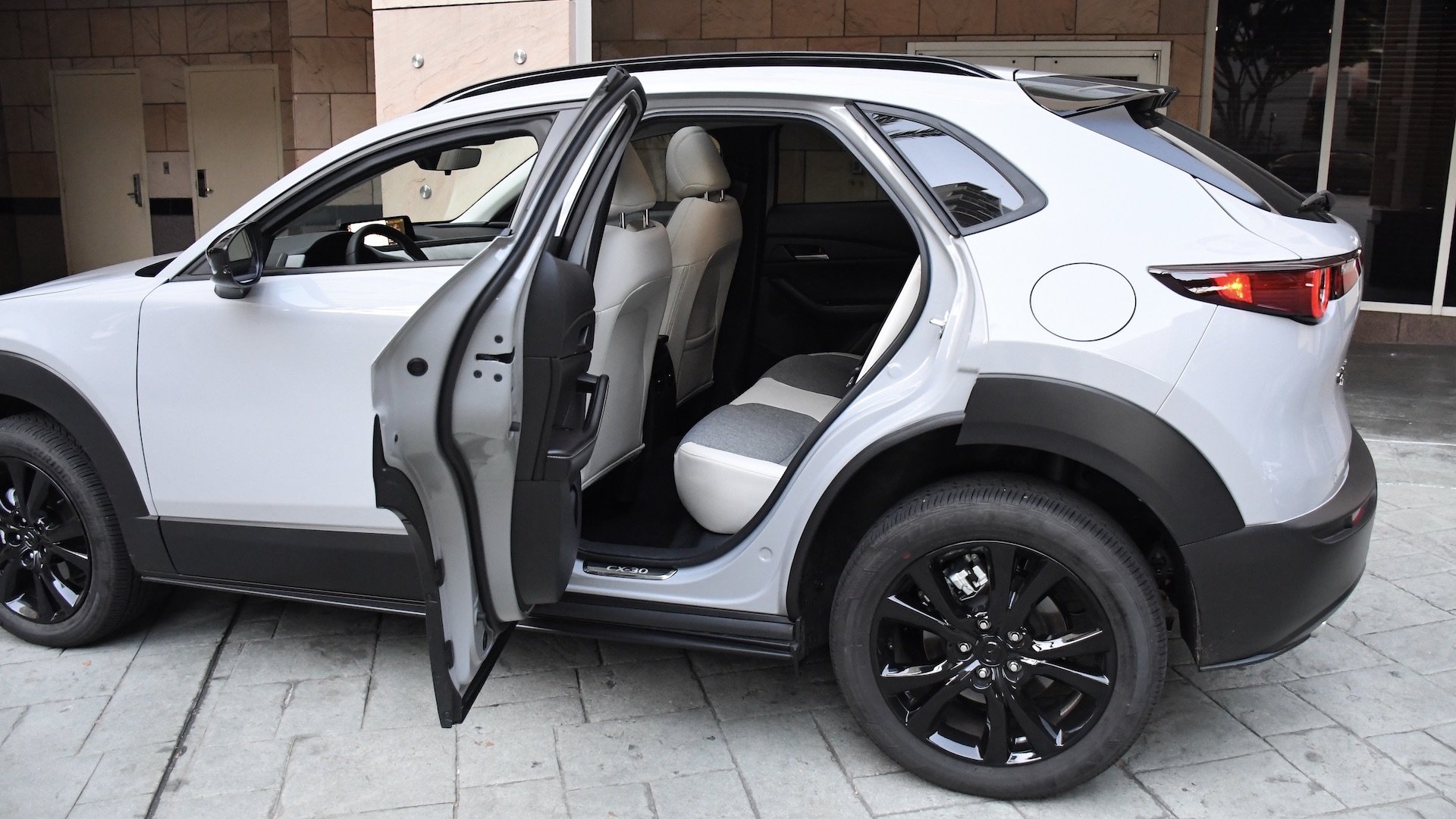
Limited rear seat space
Very pricey at $41,350
 2026 Mazda CX-30 Aire Edition – Photo : Daniel Rufiange
Take the MX-30, for instance. On the other hand, there’s the MX-5 that has delighted everyone for 35 years now.
Between the two, the company offers a range of models that meet a variety of needs, whether it’s the Mazda3 or the CX-90. And of course, this CX-30, a subcompact SUV that has established itself thanks to a host of qualities that make it a relevant product.
Not perfect, but relevant.
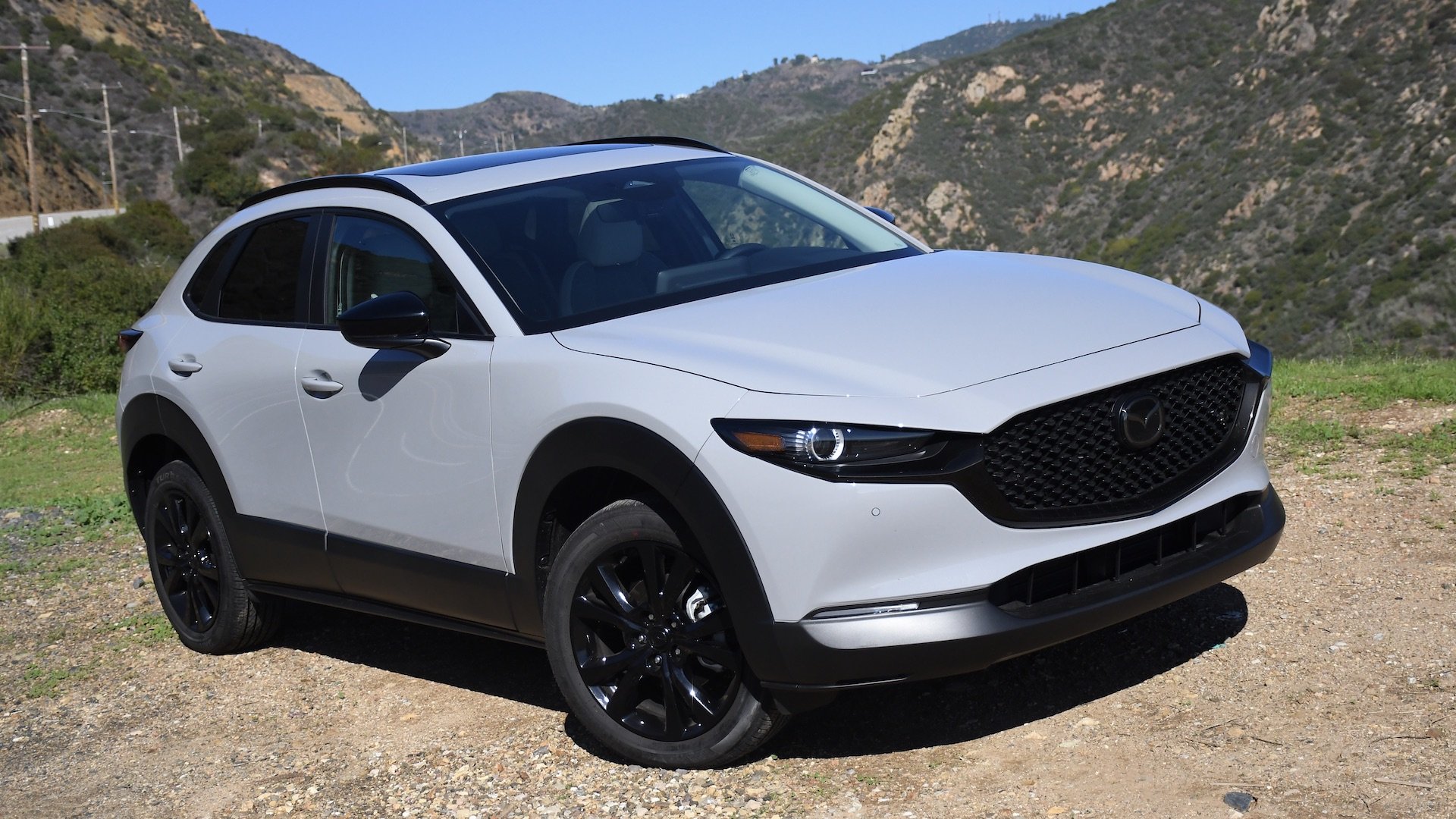
During a recent trip to California (covering the Los Angeles Auto Show), we had the opportunity to get behind the wheel of the new Aire Edition for 2026 in the US. In Canada, its sibling will be called the GT Kuro Edition.
Here’s what we thought of it.
Design and Format
It’s very easy to recognize a Mazda product on the road. The company’s signature has been the same for ages, and every model gets it, except for the MX-5 roadster. Fortunately, said signature is not ugly.
Note that we avoided saying it was beautiful. The fact is, when a design is kept for too long, we get used to it, perhaps a bit too much. It’s all right, but Mazda would gain by giving its stylists more freedom, and sooner rather than later.
 2026 Mazda CX-30 Aire Edition – Photo : Daniel Rufiange
As for the format, that’s much better. The company made its debut in the subcompact SUV segment with the Mazda2-based CX-3. It was small; very small. So much so that the arrival of the slightly larger CX-30 was very well received. The product offers a compact format, but it’s roomy enough not to feel like you’re making too many compromises.
That said, you don’t get the most accommodating subcompact SUV on the market with a cargo volume of only 1,280 litres with the rear seats folded down. That’s a step back compared to the competition (see table below).
Welcoming Up Front
Consequently, we understand that the CX-30 is aimed more at singles or young couples with a small child. Once a teenager, they’ll beg you to change vehicles, because space is limited in the back.
 2026 Mazda CX-30 Aire Edition – Photo : Daniel Rufiange
Up front, you get a simple yet well-executed, airy environment, provided you’re not overweight. The instrumentation remains classic, which becomes very appreciable in a world where screens have become invasive. Mazda’s 10.25-inch multimedia system on higher-end versions (8.8 inches on base models) still presents a less-than-intuitive interface that sometimes requires multiple steps to perform a single function.
 2026 Mazda CX-30 Aire Edition – Photo : Daniel Rufiange
Also note that, for safety reasons, it’s not touch-enabled at all times; only when stopped. That’s a wise decision by the company. It’s actually impossible to criticize, as constant screen access is a significant source of distraction for too many drivers. It’s even becoming a plague throughout the industry.
Luxury?
Where the CX-30 stands out is in terms of refinement. It’s no secret that Mazda wants to position itself as a more luxurious brand, playing a Buick-like role throughout the industry. Chic at an affordable price.
This was evident in our tester, the “Aire Edition”, which offered some very high-quality interior finishes, notably suede on the dashboard, a surface that pairs well with the quality leatherette draping the cabin. Contrasting stitching even livened up the presentation. The presence of seats offering white synthetic leather exclusive to the variant also added an interesting touch to the display.
 2026 Mazda CX-30 Aire Edition – Photo : Daniel Rufiange
Under the Hood
Speaking of engines, the tested variant featured the most powerful engine in the lineup, a turbocharged 2.5-litre 4-cylinder capable of delivering up to 250 horsepower and 320 lb-ft of torque. Note that these figures are achievable with 93-octane fuel. Otherwise, with regular fuel (87 octane), the output is 227 horsepower and 310 lb-ft of torque.
 2026 Mazda CX-30 Aire Edition – Photo : Daniel Rufiange
Interestingly, that engine is still paired with a six-speed automatic transmission. Some will criticize this, as it goes against the evolution of transmissions throughout the industry and may seem like a brake on fuel efficiency. That’s true, but on the other hand, this transmission’s reliability is rock-solid; you’ll never have a problem.
The fact is, the reliability of Mazda products results from this strategy, in which the longevity of mechanical components often exceeds established standards. Now, longevity rhymes with reliability. Manufacturers sometimes choose their battles; we, too, must do so as consumers.
Behind the Wheel
Beyond all this, what’s appealing about a CX-30 is the driving experience. We often say, politely, that certain SUVs drive like cars. This couldn’t apply better to the CX-30, which offers a dynamism not found elsewhere in the segment.
The chassis rigidity, suspension adjustments, steering calibration, everything was designed to satisfy the driver. Some will even find the suspension’s behaviour a bit stiff on rough surfaces.
This detail actually sums up the entire package with this vehicle: a matter of compromises. To enjoy the more compact format and driving pleasure, you must make sacrifices in terms of practicality and ride smoothness. You get the power of a luxury product, but fuel economy isn’t what it should be for a utility vehicle of this size. Mazda announces an average of 9.3 L/100 km combined with the turbo engine, which is far too much. Our average was 9.2 litres during our test.
Final Word
You’re not making a bad choice with the CX-30, quite the contrary. However, it’s imperative to carefully evaluate your needs and understand your preferences to determine whether this vehicle is tailor-made for you.
With some products, like a Toyota RAV4, the question doesn’t arise; it meets the needs of practically everyone. With a CX-30, Mazda‘s intention is more targeted.
With full knowledge, you won’t regret your purchase. Otherwise…
 2026 Mazda CX-30 Aire Edition – Photo : Daniel Rufiange
Watch For
While the model’s reliability is good, note that turbo engine versions require greater monitoring. There were some hiccups at their debut. Only six recalls have affected the model since 2020, which is low by current industry standards, where everything is scrutinized.
Some owners have also mentioned minor paint defects. Be aware.






 |  |  | |
|---|---|---|---|
| Mode- | Mazda CX-30 | Subaru Crosstrek | Toyota Corolla Cross |
| Base price (MSRP) | $ 29,300 | $ 30,595 | $ 28,580 |
| Engine (most powerful) | 4-cyl. turbo, 2,5 L | 4-cyl., 2,5 L | 4-cyl. hyb, 2,0 L |
| Output | 250 hp | 182 hp | 196 hp |
| Torque | 320 lb-ft | 178 llb-ft | 214 lb-ft |
| Transmission | Auto (6) | Auto (CVT) | Auto (CVT) |
| Drivetrain | AWD | AWD | AWD |
| 0-100 km/h | 6,1 sec. | 9,3 sec. | 8,2 sec. |
| Cargo capacity | 1280 L | 1549 L | 1328/1245 L (FWD/AWD) |
