

Earlier this year, the Canadian government allowed a limited quantity imported Chinese electric vehicles into the country, aiming to help consumers purchase an eco-friendly and affordable vehicle. However, we can arguably say that there are already a bunch of accessible EVs on our market, including the 2026 Nissan LEAF.
The 2026 LEAF ranks among the lowest-priced electric vehicles in our country, while introducing the third-generation model in Canada, as the first LEAF arrived here as a 2010 model. This new gen represents a significant change, since it has, well, officially become a crossover.

The result is a transformed 2026 Nissan LEAF, with a much more modern design and, in our humble opinion, it’s a lot more attractive than before. It shares some styling cues with the bigger Nissan ARIYA, the brand’s other EV, while boasting a stubbier appearance. The automaker also tried giving it a crossover coupe look by concealing the rear door handles into the pillars. Its drag coefficient of 0.26 proves its aerodynamic shape, which is an important aspect that contributes to its energy efficiency.
What Does the 2026 Nissan LEAF Compete With?
The LEAF now being a subcompact crossover, it must now confront the Chevrolet Bolt, the Hyundai Kona Electric, le Kia EV3, the soon-to-be-discontinued Kia Niro EV, the Subaru Uncharted, the Toyota C-HR and the Volvo EX30. For the price, we could also consider the Fiat 500e city car in addition to the Kia K4 and Tesla Model 3 sedans, along with the Chevrolet Equinox EV, Ford Mustang Mach-E and Kia EV5 compact crossovers. As we can see, there is no lack of affordable EVs in the Canada.

Obviously, and in all cases, automakers are seeking to attract shoppers who want an eco-friendly ride, but also one that will reduce their dependence on oil companies and rising fuel prices. And even if a subcompact model isn’t necessarily ideal for hauling the family, a crossover like the LEAF does offer versatility with its liftgate and fold-down rear seatbacks.
What’s the 2026 Nissan LEAF’s Driving Range?
Let’s get down to business. The 2026 LEAF lineup includes the S+, SV+ and Platinum+ trim levels, all equipped with an electric motor connected to the front wheels. Output is rated at 214 horsepower and 261 pound-feet of torque. Its 75 kWh lithium-ion battery pack allows for a driving range varying between 417 and 488 kilometres on a single charge.

For plugging the vehicle onto a level 2 charger, like at home, it includes a 7.2 kW on-board setup, a decent speed that’s about average for the segment. The outgoing generation was equipped with a 6.6 kWh charger. The LEAF sets itself apart by being fitted with two charge ports instead of one. On one side, there’s a J1772 connection for level 1 and level 2 charging, and on the other side, there’s an NACS port (the one Tesla engineered). So for DC quick charges, with a max speed of 150 kW, we must choose a station with an NACS connection, or with a CCS1 connection with an adaptor. Nissan could’ve just made things simpler by installed one connector instead of two, but whatever.
With an optional cable, we can also use the 2026 Nissan LEAF as a power source with the V2L (Vehicle to Load) feature, allowing us to plug external devices of up to 1,800 watts into the vehicle’s charge port. It’s handy for camping or when the power goes out at home and we need to keep the refrigerator or the basement sump pump running. The Platinum+ variant also gets two 1,500-watt outlets inside the vehicle—one in the rear-seat area and one in the cargo area.

Nissan recommends keeping the vehicle charged at home, even if we’re not planning on using it soon. That helps optimise the charging schedule when we’re ready to hit the road. Otherwise, the automaker doesn’t suggest keeping the battery charge level below 100 % in order to preserve its long-term health. Like all of today’s EVs, we can connect to it via a mobile app to plan our charging times and pre-condition the cabin before unplugging the vehicle for our drive.
One-pedal driving is possible with the e-Step feature. It uses regenerative braking to slow down the LEAF, but it won’t stop it completely, so must still press on the brake pedal. SV+ and Platinum+ trims also include wheel-mounted paddle shifters to set regenerative braking force.

Is the 2026 Nissan LEAF Efficient?
Here are the energy consumption and driving range figures for the three trim levels:
| Trim Level | City/Highway/Combined (L/100 km) | City/Highway/Combined (kWh/100 km) | Driving Range (km) |
| S+ | 1.8 / 2.1 / 1.9 | 16.0 / 18.8 / 17.3 | 488 |
| SV+ | 1.9 / 2.2 / 2.1 | 17.1 / 19.9 / 18.4 | 463 |
| Platinum+ | 2.1 / 2.5 / 2.3 | 19.1 / 21.9 / 20.3 | 417 |
During our summer drive of the LEAF Platinum+, the least efficient of the three due to the extra weight of its additional equipment and its 19-inch wheels wrapped in 235/45R19 tires, we observed an excellent average of 15.8 kWh/100 km. We achieved that by driving slightly below the highway speed limit and by fully exploiting the e-Step system. That works out to a potential range of 475 km on a single charge.

How Does the 2026 Nissan LEAF Stack Up to its Rivals?
Let’s compare the LEAF to a few main adversaries, such as the Chevrolet Bolt, the Kia EV3 and the Toyota C-HR:
| Specifications |  | 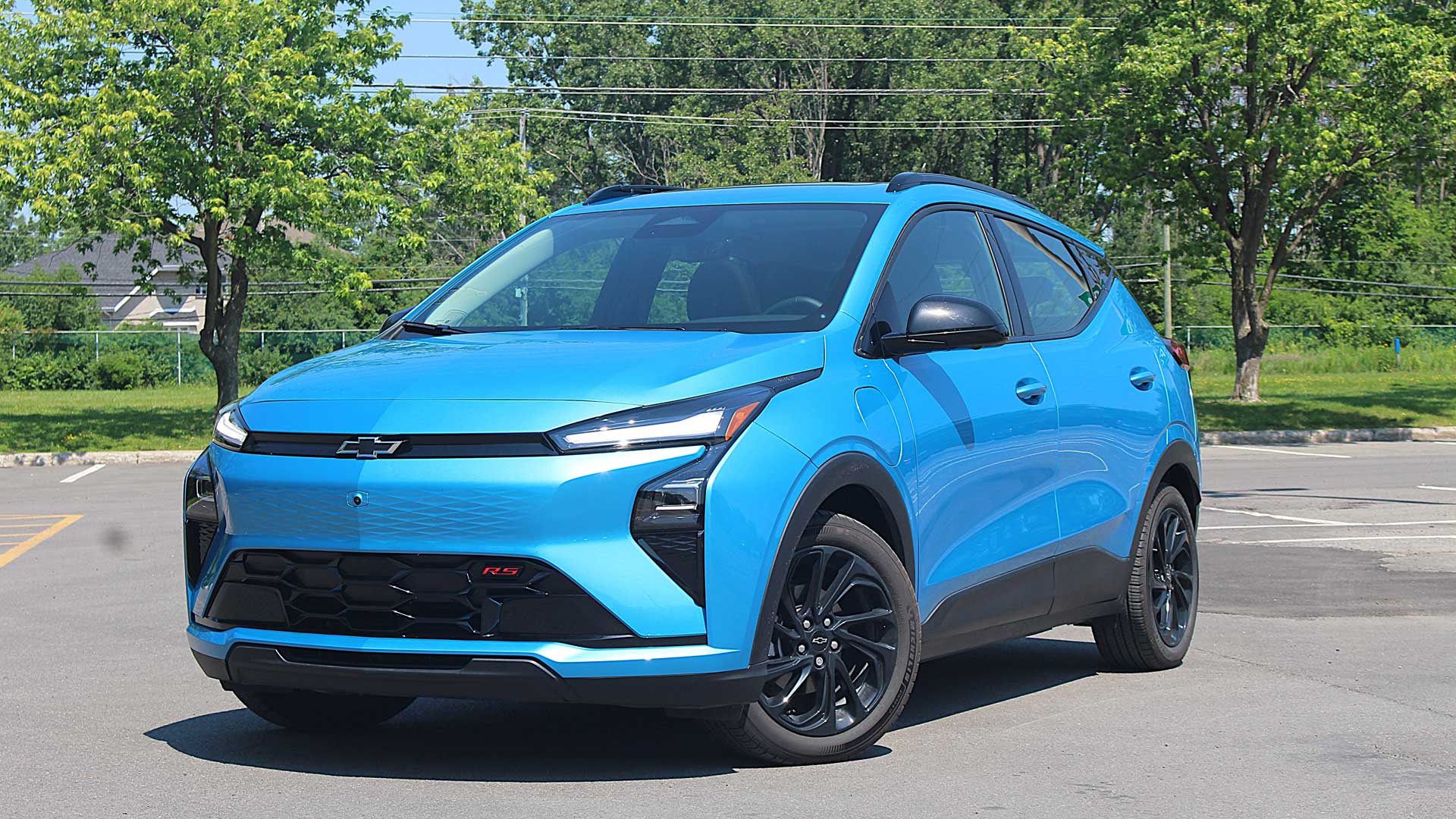 |  |  |
|---|---|---|---|---|
| 2026 Nissan LEAF | 2027 Chevrolet Bolt | 2027 Kia EV3 | 2026 Toyota C-HR | |
| All-Inclusive Pricing | $47,919 to $56,469 | $43,398 to $54,163 $ | $40,179 to $59,429 | $47,829 to $58,234 |
| Propulsion Systems | One Electric Motor | One Electric Motor | One Electric Motor Two Electric Motors | One Electric Motor Two Electric Motors |
| Drivetrains | FWD | FWD | FWD, AWD | FWD, AWD |
| Output (hp) | 214 | 210 | 201 to 288 | 221 to 338 |
| Torque (lb-ft) | 261 | 169 | 209 to 345 | 198 to 198/125 front/rear |
| City/Highway/Combined (Le/100 km) | 1.8 to 2.1 / 2.1 to 2.5 / 1.9 to 2.3 | 1.8 / 2.2 / 2.0 | 1.8 to 2.1 / 2.3 to 2.5 / 2.0 to 2.3 | 1.7 to 1.9 / 2.0 to 2.3 / 1.8 to 2.1 |
| City/Highway/Combined (kWh/100 km) | 16.0 to 19.1 / 18.8 to 21.9 / 17.3 to 20.3 | 15.6 / 19.8 / 17.5 | 16.2 to 19.3 / 20.5 to 21.7 / 18.0 to 20.5 | 15.0 to 17.2 / 17.8 to 20.6 / 16.2 to 18.7 |
| Battery Capacity (kWh) | 75 | 65 | 58.3 to 81,4 | 77 |
| Driving Range (km) | 417 to 488 | 422 | 356 to 517 | 438 to 496 |
| Wheelbase (mm) | 2,690 | 2,675 | 2,680 | 2,750 |
| Length (mm) | 4,405 | 4,307 | 4,300 to 4,310 | 4,520 |
| Width (mm) | 1,810 | 1,770 | 1,850 | 1,870 |
| Height (mm) | 1,557 | 1,622 | 1,570 to 1,575 | 1,620 |
| Headroom Front/Rear (mm) | 1,014 / 929 to 946 | 992 to 1,016 / 960 | 1,015 / 955 | 981 to 993 / 953 |
| Legroom Front/Rear (mm) | 1,078 / 808 | 1,124 / 993 | 1,060 / 950 | 1,070 / 818 |
| Cargo Volume Min/Max (L) | 566 / 1,572 | 459 / 1,594 | 609 to 740 / 1,470 to 1,600 | 651 to 716 / 1,685 |

Looking at driving range, the LEAF isn’t too shabby, thanks to its relatively big battery. Its energy consumption is comparable in the segment, though the Subaru Uncharted, the Tesla Model 3 and the Toyota C-HR are a slightly more efficient.
Most of its rivals are available with all-wheel drive, a feature that isn’t offered in any capacity on the 2026 LEAF. With a good set of winter tires, we can certainly get through the cold season, but the Nissan is nonetheless at a disadvantage here.

Is the 2026 Nissan LEAF fun to drive?
On the road, the LEAF is zippy with its 214 horsepower. Takeoffs are quick without being violent, steering feel is as good as we expect in the segment, and its brakes scrub off speed very nicely. In short, the LEAF drives well, though it doesn’t stand out in its group in a good—or a bad—way. However, rivals offering AWD are more powerful with their extra electric motor, and more entertaining to drive.
The Nissan’s cabin dimensions for front-seat occupants are comparable to those of the other subcompact electric crossovers, give or take a few millimetres. However, rear-seat legroom isn’t great, despite the flat floor, the middle occupant might rub their head on the headliner, and the rear seatback angle isn’t adjustable for extra comfort. The LEAF isn’t the best choice in the segment for families, whether we’re commuting with young kids in their child seats or growing teenagers.

The cargo area volume is adequate, with a modular load floor for hauling taller objects or securing them in place. By folding down the seatbacks, we obtain a maximum of 1,572 litres, slightly below that of the Bolt, the EV3, the Uncharted and the C-HR.
The infotainment system is easy to use, but the button zones to access the main features could be bigger in order to reduce driver distraction. Same goes for the touch-sensitive climate controls located just under the touchscreen, as we prefer rotary dials for setting cabin temperature and fan speed. At least we get a real volume knob and an easily accessible camera system button. Storage points aren’t plentiful, but the cupholders are placed in a good location and the compartment under the centre armrest is reasonably sized and deep.

Outward visibility is good, and the seats offer good lateral support, but their cushions could be more stuffed. We had some trouble finding a good driving position during our week-long test. We recommend making sure we’re at ease sitting behind the wheel during an eventual test drive at the dealership, even if this is an aspect that can vary from one person to another.
The LEAF’s price ranges from $47,919 to $56,469, which includes the $2,200 freight and delivery charges, the $100 A/C tax, the $621 dealer fees and all factory-installed options.

Standard features aboard to the 2026 Nissan LEAF include a heat pump, 18-inch wheels with covers, a windshield wiper de-icer, heated outside mirrors, a smart key, cloth seat upholstery, heated and height-adjustable front seats, a 12.3-inch digital driver instrument cluster, a 12.3-inch infotainment system touchscreen, SiriusXM with 360L satellite radio (subscription required after trial period), wireless Apple CarPlay/Android and a four-speaker audio system.
On the safety front, the LEAF also includes the ProPILOT semi-autonomous drive system, a surround-view camera system, automatic emergency braking with pedestrian and cyclist detection, blind-spot monitoring, lane keep assist, driver distraction detection, park sonar and auto high beams.

Starting at $50,919, the SV+ trim level adds 18-inch alloy wheels, TailorFit simulated leather seating, an eight-way power driver’s seat, heated rear seats, a 14.3-inch infotainment touchscreen running Google built-in (with connectivity services for five years), rear-seat USB-C ports, wireless phone charging and six speakers.
The Platinum+ starts at $55,719 and benefits from 19-inch alloy wheels, rain-sensing wipers with heated washer fluid nozzles, a power tailgate, a fixed panoramic glass roof, roof rails, head-up display, driver’s seat power lumbar support, driver’s seat position memory, ambient interior lighting and a Bose ten-speaker stereo.

Is the 2026 Nissan LEAF Worth it?
The new LEAF is much more attractive, and more modern as well. It’s energy efficient and offers decent range, too. On the other hand, if passengers regularly ride in the back seat, the LEAF isn’t the most spacious crossover out there.
Though it’s affordable and eligible for available government EV rebates, no less than nine other electric vehicles boast a lower base price at the moment, including the Kia EV3, EV4 and EV5, the Hyundai Kona Electric, the Tesla Model 3 imported from China, the Chevrolet Bolt as well as the Subaru Uncharted and the Toyota C-HR. For a few dollars more a month, we could also choose a compact model such as the Ford Mustang Mach-E, the Chevrolet Equinox EV and the Kia EV5. However, the LEAF is well-equipped for the money, even is base trim.

The LEAF S will join the lineup for the 2027 model year, a new base variant with 174 horsepower and a 53 kWh battery allowing for a driving range of 341 km. Its $37,919 base price will make the LEAF the lowest-priced EV on the Canadian market.
To sum things up, in such a competitive segment, Nissan will need to be creative with its financial incentives to attract buyers, or simply allow its dealerships to keep sufficient inventory for those who want an EV right now instead of ordering one and wait for it to be built.


