

815 hp vs 637 hp: The Mustang GTD produces 178 more horsepower and 37 more lb-ft of torque than the CLE 646
325 km/h vs 310 km/h: The GTD’s top speed is 15 km/h higher
Near 50/50 vs 56/44: The GTD’s rear-mounted transaxle shifts weight rearward; the CLE 646 carries 56% of its mass over the front axle
Mercedes-AMG revealed the CLE 646 Spezialanfertigung last week, as the second model in its Mythos Series after the PureSpeed. Production is capped at 30 units, and every one was sold before the world premiere. The Ford Mustang GTD is built in small numbers each year, so its 2027 badge is little more than a date stamp: the car carries the same specification it launched with.
Both are two-seat, rear-drive V8 coupes built from production models and engineered around the racetrack, but the hardware choices split early. AMG runs a 4.0-litre twin-turbo V8, a nine-speed automatic and adjustable KW coilovers. Ford uses a 5.2-litre supercharged V8, a rear transaxle and semi-active dampers. Few people will ever see either one in person, so the spec sheets are the closest look most of us will get.
Powertrain and Performance: 637 hp Twin-Turbo vs 815 hp Supercharged V8
 Ford Mustang GTD | Photo: Ford
Output and acceleration are the first numbers anyone checks on cars like these, and the two engines take very different routes to get there.
The CLE 646 uses an extensively reworked AMG M177 EVO 4.0-litre (3,982 cc) twin-turbo V8 with a flat-plane crankshaft. It produces 637 hp at 6,000–6,250 rpm and 627 lb-ft between 2,500 and 4,500 rpm. The “646” in the name comes from the engine’s metric PS rating, which is why the horsepower figure reads lower.
A 48-volt integrated starter generator adds up to 23 hp and 151 lb-ft of assistance. Three separate cooling circuits are upgraded for sustained track use and high ambient temperatures, and the titanium exhaust’s rear section was developed with Akrapovič.
On paper, the CLE 646 reaches 100 km/h in 3.9 seconds, 200 km/h in 11.4 seconds and 300 km/h in 36.2 seconds in its Street configuration (36.8 seconds in Track). Top speed is 310 km/h.
Ford’s approach leans on displacement and boost. The Mustang GTD’s supercharged 5.2-litre V8 produces an SAE-certified 815 hp at 7,400 rpm and 664 lb-ft at 4,800 rpm. A dry-sump oil system, the first on a road-going Mustang, raises maximum engine speed to 7,650 rpm, while a smaller supercharger pulley, revised intake and titanium Akrapovič exhaust complete the package.
Here’s an interesting wrinkle: despite the 178 hp gap, the smaller AMG engine produces slightly more power per litre, roughly 160 hp against roughly 157 hp for the GTD.
The GTD’s top speed is 325 km/h. Its official Nordschleife lap stands at 6:52.072; a separate, further-developed GTD Competition special edition later ran 6:40.835.
| Specification | 2027 Mercedes-AMG CLE 646 Spezialanfertigung | 2027 Ford Mustang GTD |
| Engine | Twin-turbo V8 (AMG M177 EVO) | Supercharged V8 |
| Displacement | 3,982 cc | 5.2 L |
| Horsepower | 637 hp @ 6,000–6,250 rpm | 815 hp @ 7,400 rpm |
| Torque | 627 lb-ft @ 2,500–4,500 rpm | 664 lb-ft @ 4,800 rpm |
| Maximum engine speed | Not specified | 7,650 rpm |
| Lubrication | Not specified | Dry sump |
| Electrical assist | 48-volt ISG (23 hp / 151 lb-ft) | Not specified |
| Exhaust | Titanium, Akrapovič rear section | Titanium Akrapovič |
| 0–100 km/h | 3.9 s | Not specified |
| 0–200 km/h | 11.4 s | Not specified |
| Top speed | 310 km/h | 325 km/h |
| Nürburgring Nordschleife | Not specified | 6:52.072 |
Transmission and Driveline: Nine-Speed Automatic vs Eight-Speed Rear Transaxle
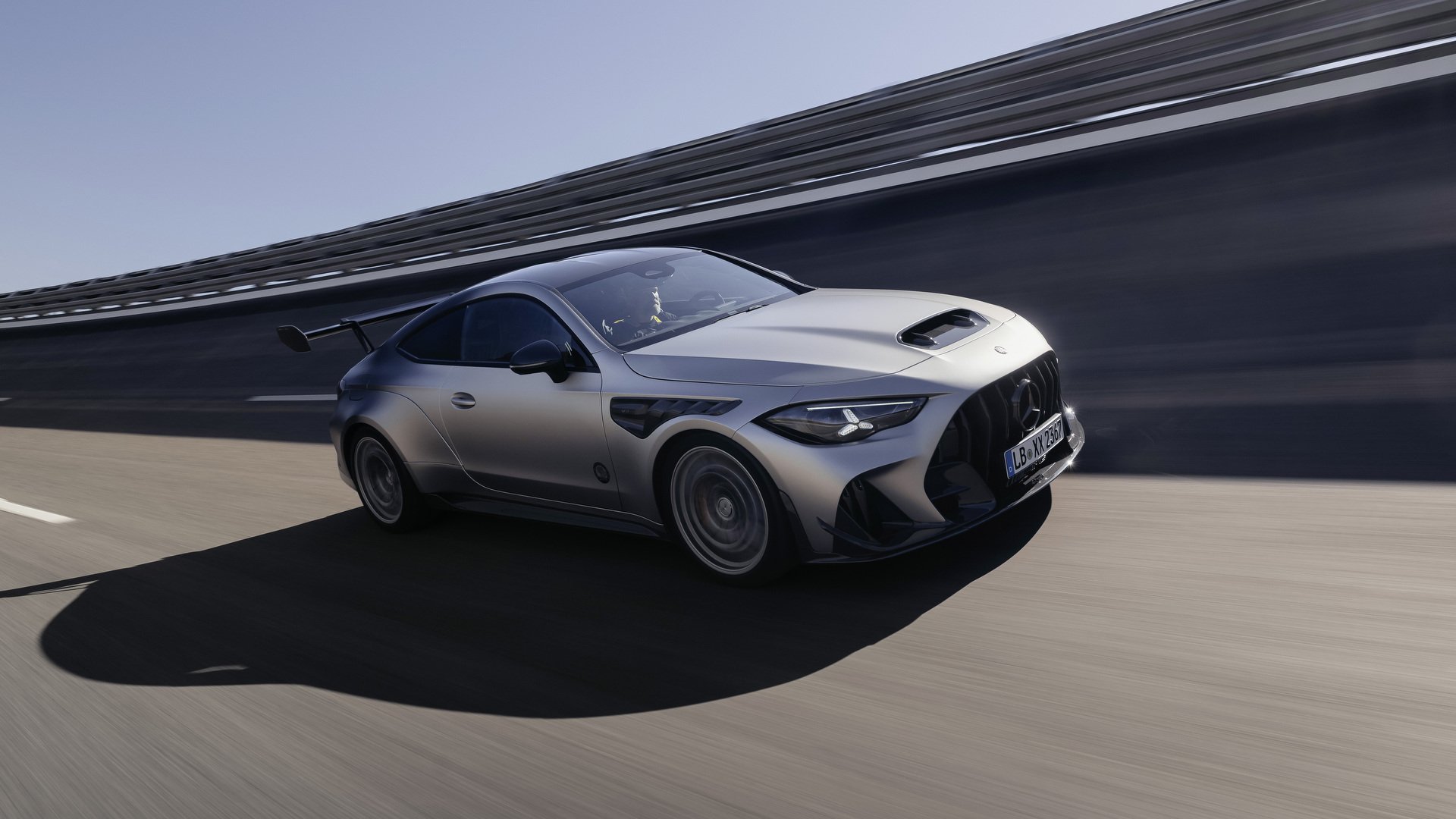 2026 Mercedes-AMG CLE 646 | Photo: Mercedes-AMG
Gearbox type and placement shape shift behaviour, packaging and, most visibly on a spec sheet, weight distribution.
The CLE 646 uses the AMG SPEEDSHIFT TCT 9G, a nine-speed torque-converter automatic with a double-declutch function. The donor CLE 53’s AMG Performance 4MATIC+ all-wheel-drive system is removed entirely. An electronically controlled limited-slip rear differential varies locking between the rear wheels, and Launch Control is recalibrated for the rear-drive layout.
Weight distribution is 56% front and 44% rear.
Ford relocated the gearbox entirely. Power travels through a carbon-fibre driveshaft to a rear-mounted eight-speed dual-clutch transaxle, which moves transmission mass rearward for near 50/50 weight distribution. Gear selection runs through a rotary dial and steering-column paddles.
| Specification | 2027 Mercedes-AMG CLE 646 Spezialanfertigung | 2027 Ford Mustang GTD |
| Transmission | 9-speed torque-converter automatic (AMG SPEEDSHIFT TCT 9G) | 8-speed dual-clutch, rear-mounted transaxle |
| Driven wheels | Rear | Rear |
| Rear differential | Electronically controlled limited-slip | Not specified |
| Driveshaft | Not specified | Carbon fibre |
| Weight distribution (front/rear) | 56/44 | Near 50/50 |
Chassis, Brakes and Tires: KW Coilovers vs Multimatic Semi-Active Dampers
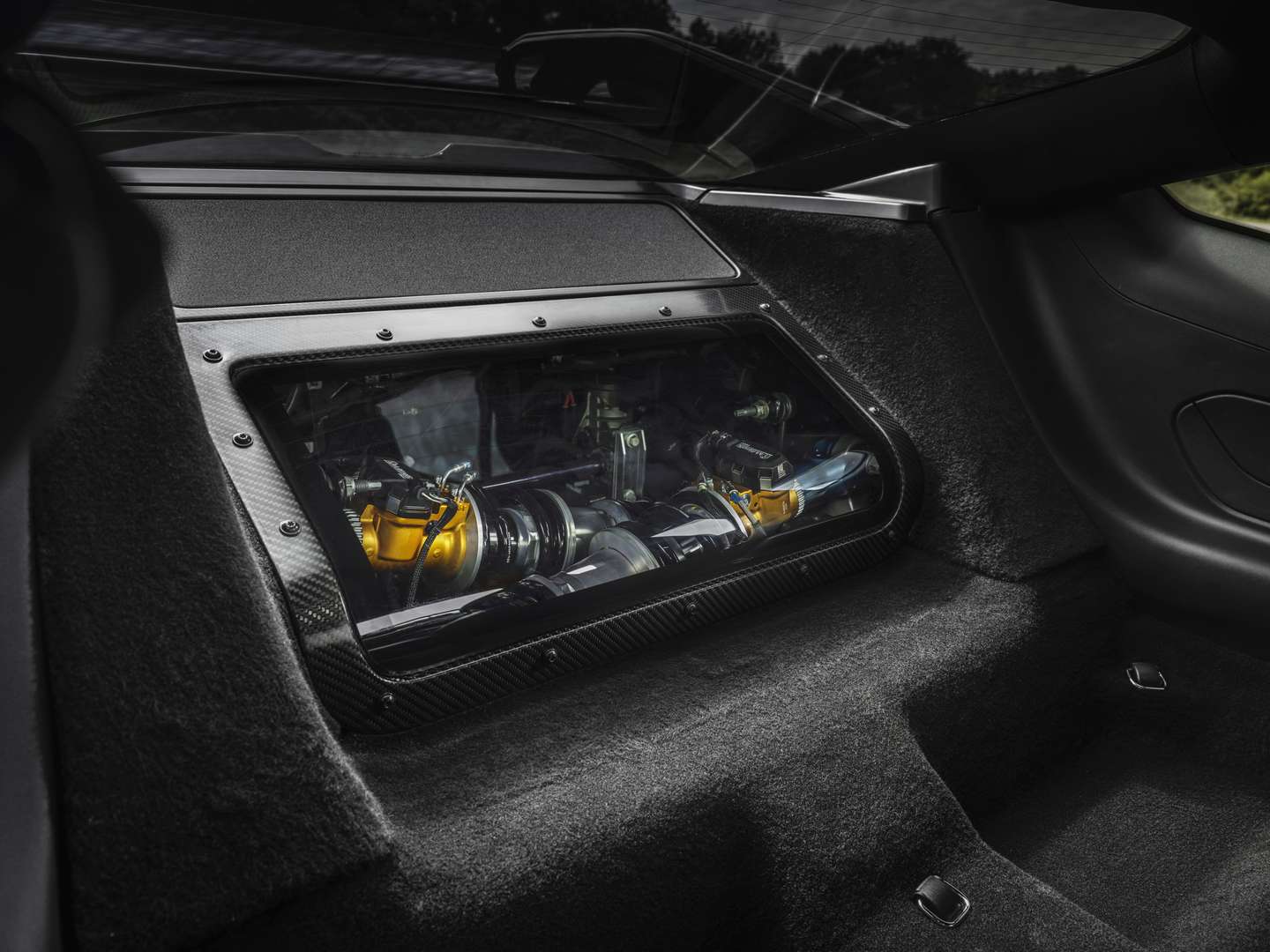 Ford Mustang GTD | Photo: Ford
Suspension architecture decides how each car gets set up for a circuit, and who does the adjusting.
The CLE 646 uses steel-sprung coilovers co-developed with KW automotive. The dampers are four-way adjustable, with independent low-speed and high-speed settings for both compression and rebound. Ride height drops 22 mm at the front axle and 16 mm at the rear, and the reinforced bodyshell adds 60 mm of width at both axles.
AMG carbon-ceramic discs measure 420 x 40 mm at the front with six-piston fixed calipers, and 360 x 32 mm at the rear with single-piston floating calipers. Forged 20-inch wheels measure 11.0 J front and 12.0 J rear, carrying 305/30 ZR20 and 335/30 ZR20 tires derived from development work for the Mercedes-AMG ONE.
The Mustang GTD replaces the standard Mustang’s suspension with a short-long arm front layout and a pushrod-actuated, inboard-mounted multilink rear. Multimatic Adaptive Spool Valve semi-active dampers handle damping, and a push-button hydraulic system lowers the car by 40 mm for track use.
Brembo six-piston forged calipers clamp carbon-ceramic rotors at the front. Michelin Pilot Sport Cup 2 R tires measure 325 mm wide at the front and 345 mm at the rear, on standard 20-inch forged aluminum wheels. For owners chasing lower unsprung mass, forged magnesium wheels are available.
| Specification | 2027 Mercedes-AMG CLE 646 Spezialanfertigung | 2027 Ford Mustang GTD |
| Suspension | KW steel coilovers | Short-long arm front; pushrod inboard multilink rear |
| Dampers | Four-way adjustable (low/high-speed compression and rebound) | Multimatic ASV semi-active |
| Ride height | Lowered 22 mm front / 16 mm rear | 40 mm push-button hydraulic drop for track use |
| Front brakes | 420 x 40 mm carbon-ceramic, six-piston fixed | Carbon-ceramic, Brembo six-piston forged |
| Rear brakes | 360 x 32 mm carbon-ceramic, single-piston floating | Not specified |
| Wheels | Forged, 20 x 11.0 J / 20 x 12.0 J | Forged aluminum, 20-inch (forged magnesium available) |
| Tires | 305/30 ZR20 / 335/30 ZR20 | Michelin Pilot Sport Cup 2 R, 325 mm / 345 mm |
Exterior Design and Aerodynamics: 250+ kg of Downforce vs Available Active Aero
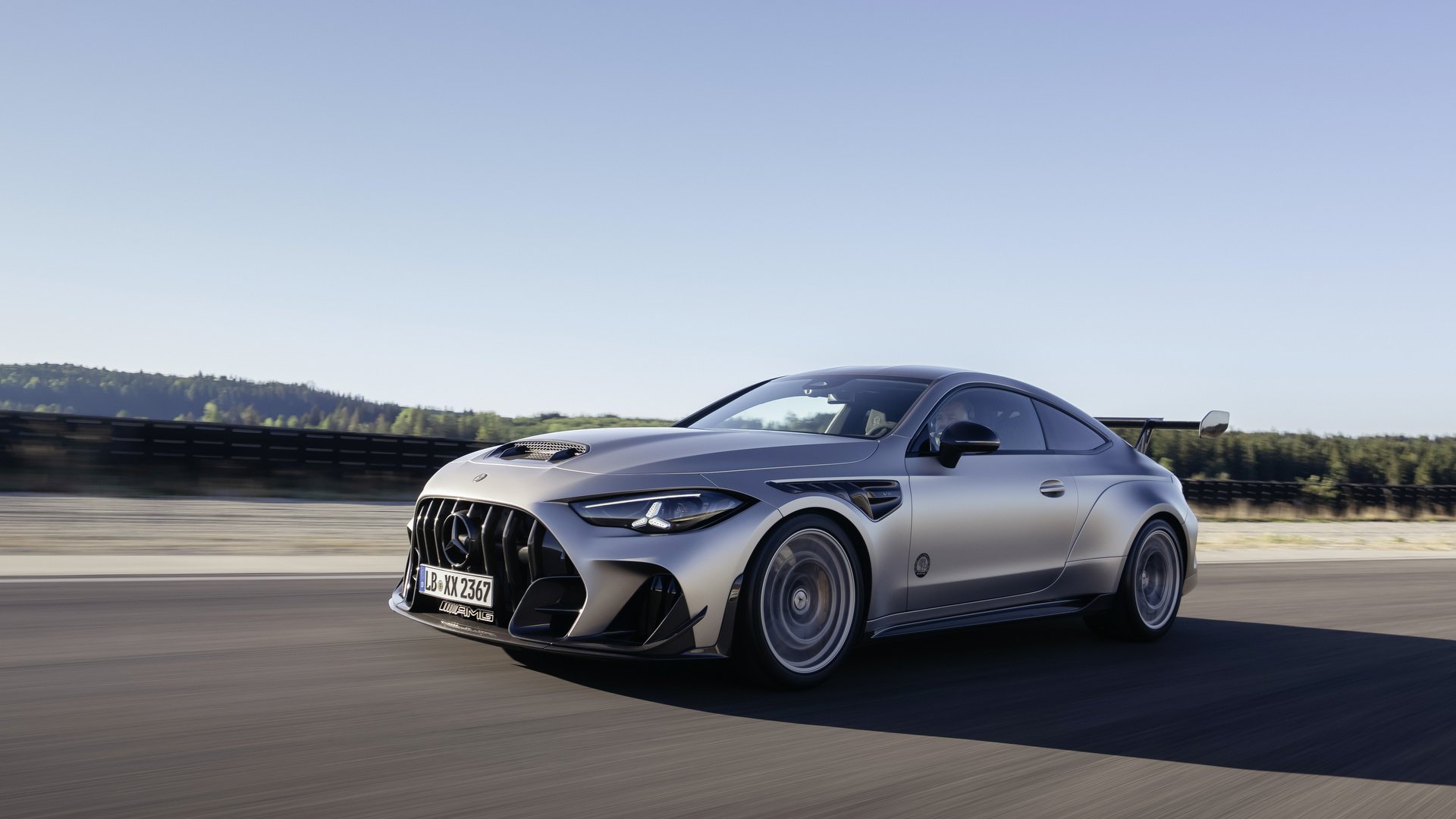 2026 Mercedes-AMG CLE 646 | Photo: Mercedes-AMG
Both programmes are built around aero hardware and lightweight construction, and it shows in the bodywork. Here’s where the two philosophies are easiest to spot from the outside.
The CLE 646 generates more than 250 kg (550 lbs) of downforce at top speed. Its front diffuser moves manually, via three fasteners, between Street and Race positions, with Race intended only for track use. The carbon-fibre rear wing’s centre section is also manually adjustable. Drag coefficient is 0.402 in Street and 0.417 in Race.
Channels beside the headlights route air through the wheel arches and out through louvres in the widened fenders. Flics on the front apron add front-axle downforce and brake cooling, while a nearly enclosed flat floor uses longitudinal fins to accelerate underbody airflow.
Carbon fibre forms the fenders, front apron, side sills, hood, roof, rear apron with diffuser, trunk lid and rear wing. The rear side windows and rear window are polycarbonate, and a lighter 12-volt battery is fitted. Curb weight is 1,895 kg, about 170 kg less than the donor vehicle.
Overall length, width and height measure 4,949 mm, 1,987 mm and 1,420 mm on a 2,875 mm wheelbase. Every car wears the same two-tone finish: Mojave Silver Magno ahead of the B-pillar and Obsidian Black Magno behind it.
The Mustang GTD carries a carbon-fibre, C-pillar-mounted rear wing as standard. The available Drag Reduction System changes the wing’s angle and activates flaps under the front of the car, trading downforce for straight-line speed as conditions require. Enlarged front fender vents, derived from the Mustang GT3 race car, release wheel-arch pressure to reduce lift and drag.
Carbon-fibre body panels are standard, and the car can be ordered in any colour, including a match to a customer-supplied sample.
| Specification | 2027 Mercedes-AMG CLE 646 Spezialanfertigung | 2027 Ford Mustang GTD |
| Downforce | More than 250 kg (550 lbs) at top speed | Not specified |
| Drag coefficient | 0.402 (Street) / 0.417 (Race) | Not specified |
| Front aero adjustment | Manual diffuser, Street/Race positions | Active flaps (with available DRS) |
| Rear wing | Carbon fibre, manually adjustable centre section | Carbon fibre, C-pillar-mounted; active angle with available DRS |
| Carbon-fibre body components | Fenders, front apron, sills, hood, roof, rear apron, trunk lid, wing | Body panels |
| Rear glazing | Polycarbonate | Not specified |
| Curb weight | 1,895 kg | Not specified |
| Length / width / height | 4,949 / 1,987 / 1,420 mm | Not specified |
| Wheelbase | 2,875 mm | Not specified |
| Paint | Mojave Silver Magno / Obsidian Black Magno two-tone | Any colour, including custom match |
Interior: Two Seats, Two Approaches to Cutting Weight
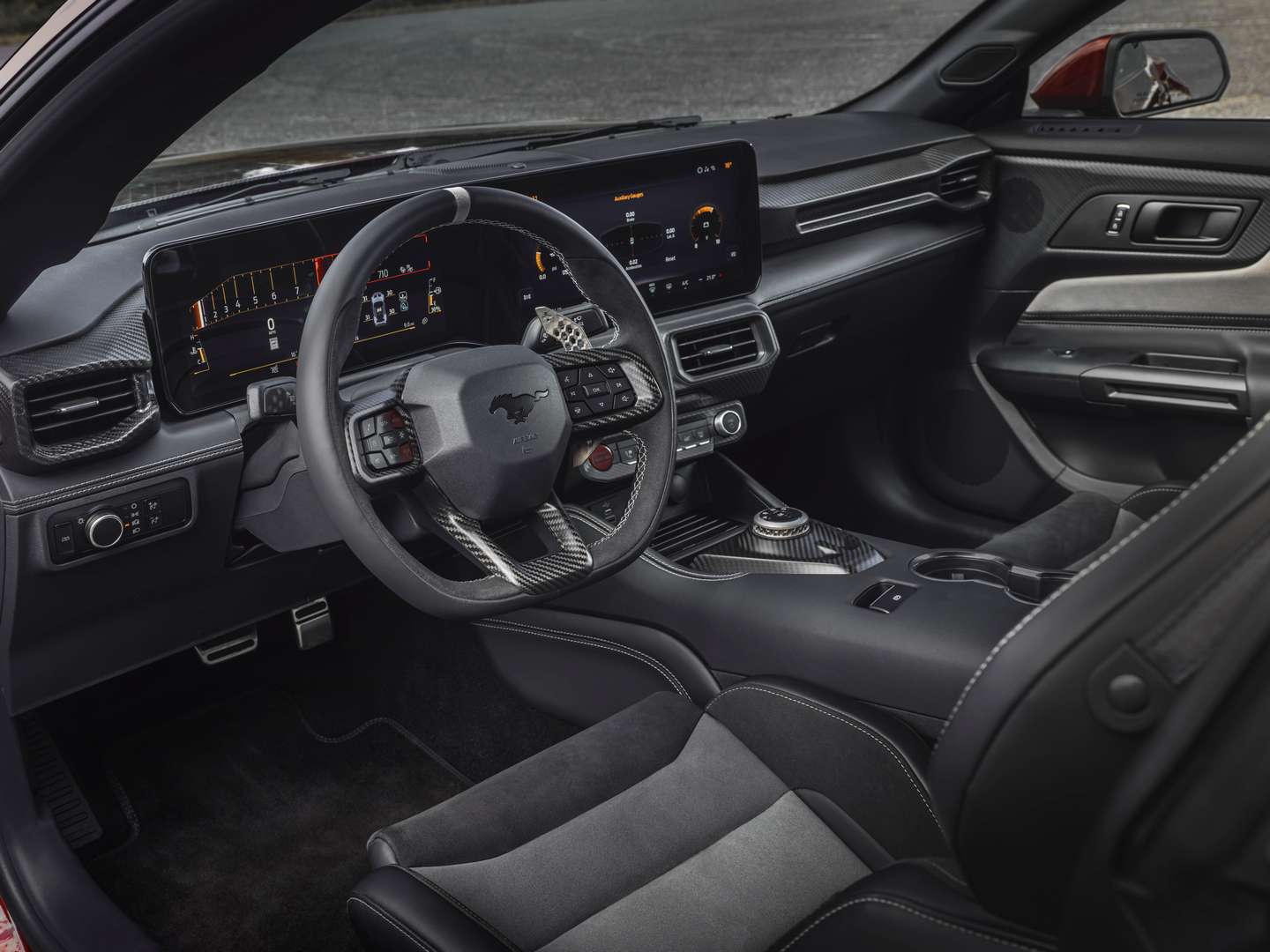 Ford Mustang GTD | Photo: Ford
Both cabins lose their rear seats. The difference is how much road-car equipment stays behind.
The CLE 646’s rear seats and acoustic insulation are gone. Ultra-lightweight racing bucket seats, carbon-fibre door panels and a roll-over bar that also stiffens the bodyshell are standard. The AMG Performance steering wheel has a flattened DINAMICA microfibre rim and fewer controls, since several drive modes and assistance systems were deleted.
Comfort features are reduced, the sound system is simplified and PARKTRONIC parking assistance is not included. For owners who prefer to be strapped in properly, an optional Performance Package adds six-point harnesses for driver and passenger.
The Mustang GTD’s rear seating area is removed to save weight and create cargo space, with an interior window exposing the inboard rear suspension. RECARO seats are finished in laser-etched Miko suede, and a flat-bottom steering wheel carries buttons for suspension and exhaust modes.
For a more personal touch, the available titanium paddle shifters, rotary dial shifter and serial plate are 3D-printed from retired Lockheed Martin F-22 titanium parts.
| Specification | 2027 Mercedes-AMG CLE 646 Spezialanfertigung | 2027 Ford Mustang GTD |
| Seating capacity | 2 | 2 |
| Seats | Ultra-lightweight racing buckets | RECARO, laser-etched Miko suede |
| Rear seat area | Removed | Removed; cargo space and suspension viewing window |
| Acoustic insulation | Removed | Not specified |
| Roll-over bar | Standard | Not specified |
| Harnesses | Six-point (optional Performance Package) | Not specified |
| Door panels | Carbon fibre | Not specified |
| Steering wheel | Flattened, DINAMICA microfibre | Flat-bottom, suspension and exhaust buttons |
| Titanium trim | Not specified | Available F-22-sourced paddles, dial shifter, serial plate |
| Parking assistance | PARKTRONIC not included | Not specified |
| Cargo volume | Not specified | Not specified |
Technology and Track Features: Reduced Infotainment vs 13.2-Inch Touchscreen
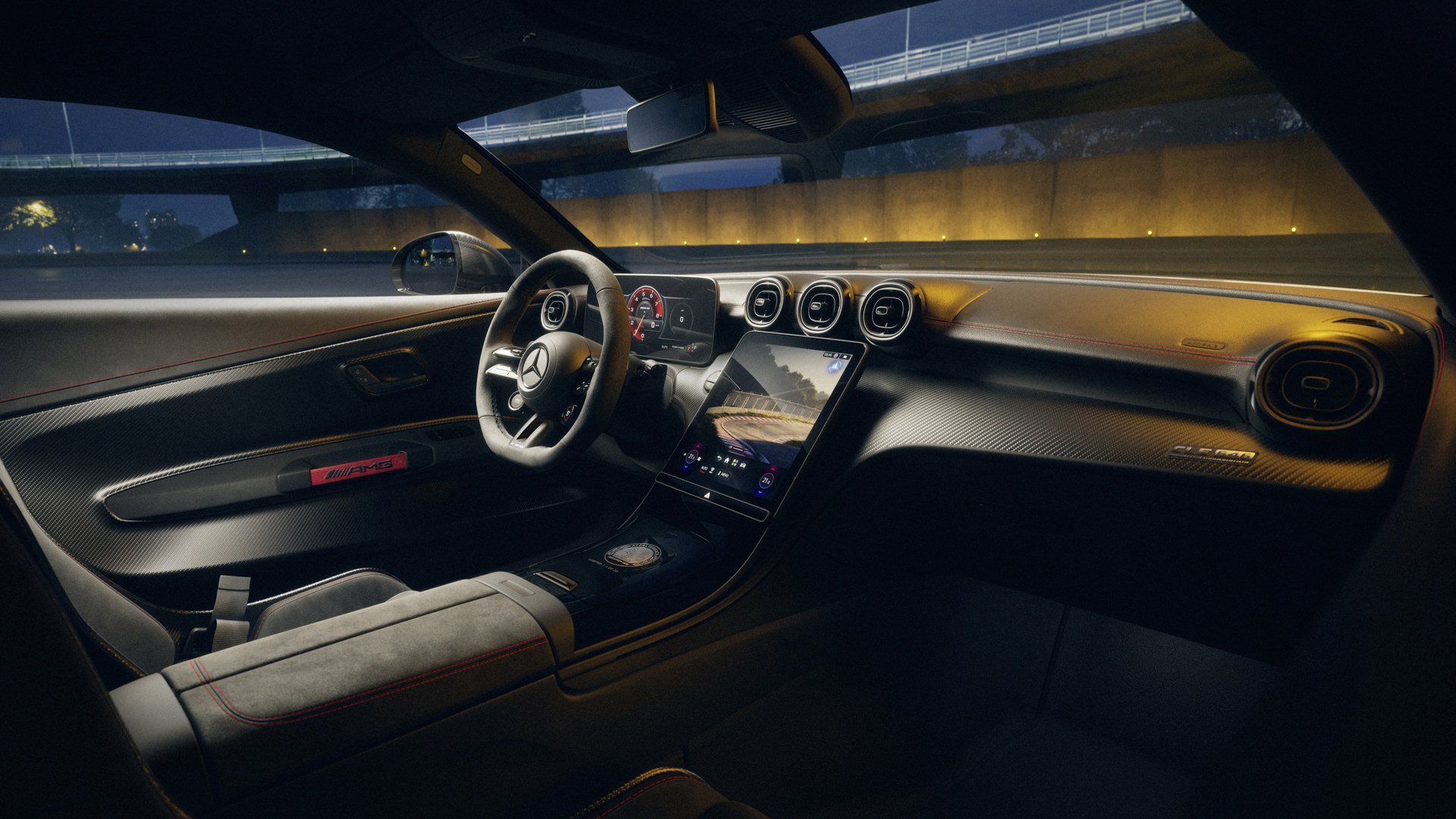 2026 Mercedes-AMG CLE 646 | Photo: Mercedes-AMG
Screens and software follow the same split. AMG trimmed content to save weight, while Ford kept the current Mustang’s electrical architecture.
Infotainment and assistance content on the CLE 646 is reduced. AMG DYNAMIC SELECT drive programs remain for tailoring transmission behaviour, with some modes deleted. AMG TRACTION CONTROL offers nine preselectable levels of rear-wheel slip for closed-circuit use with ESP deactivated.
The Mustang GTD uses a 12.4-inch digital instrument cluster and a 13.2-inch centre touchscreen with graphics powered by Unreal Engine. SYNC 4 handles smartphone connectivity, and Track Apps are included. Steering-wheel buttons adjust the semi-active suspension and exhaust.
| Specification | 2027 Mercedes-AMG CLE 646 Spezialanfertigung | 2027 Ford Mustang GTD |
| Instrument cluster | Not specified | 12.4-inch digital |
| Centre display | Not specified | 13.2-inch touchscreen, Unreal Engine graphics |
| Infotainment | Reduced content | SYNC 4 |
| Track software | Not specified | Track Apps |
| Drive programs | AMG DYNAMIC SELECT (reduced) | Not specified |
| Traction control | AMG TRACTION CONTROL, 9 stages | Not specified |
| Aero adjustment | Manual (diffuser, wing centre section) | Available active DRS |
| Ride height control | Not specified | Push-button 40 mm hydraulic drop |
Pricing: 30 Sold-Out AMGs and an Estimated $440,000 Mustang
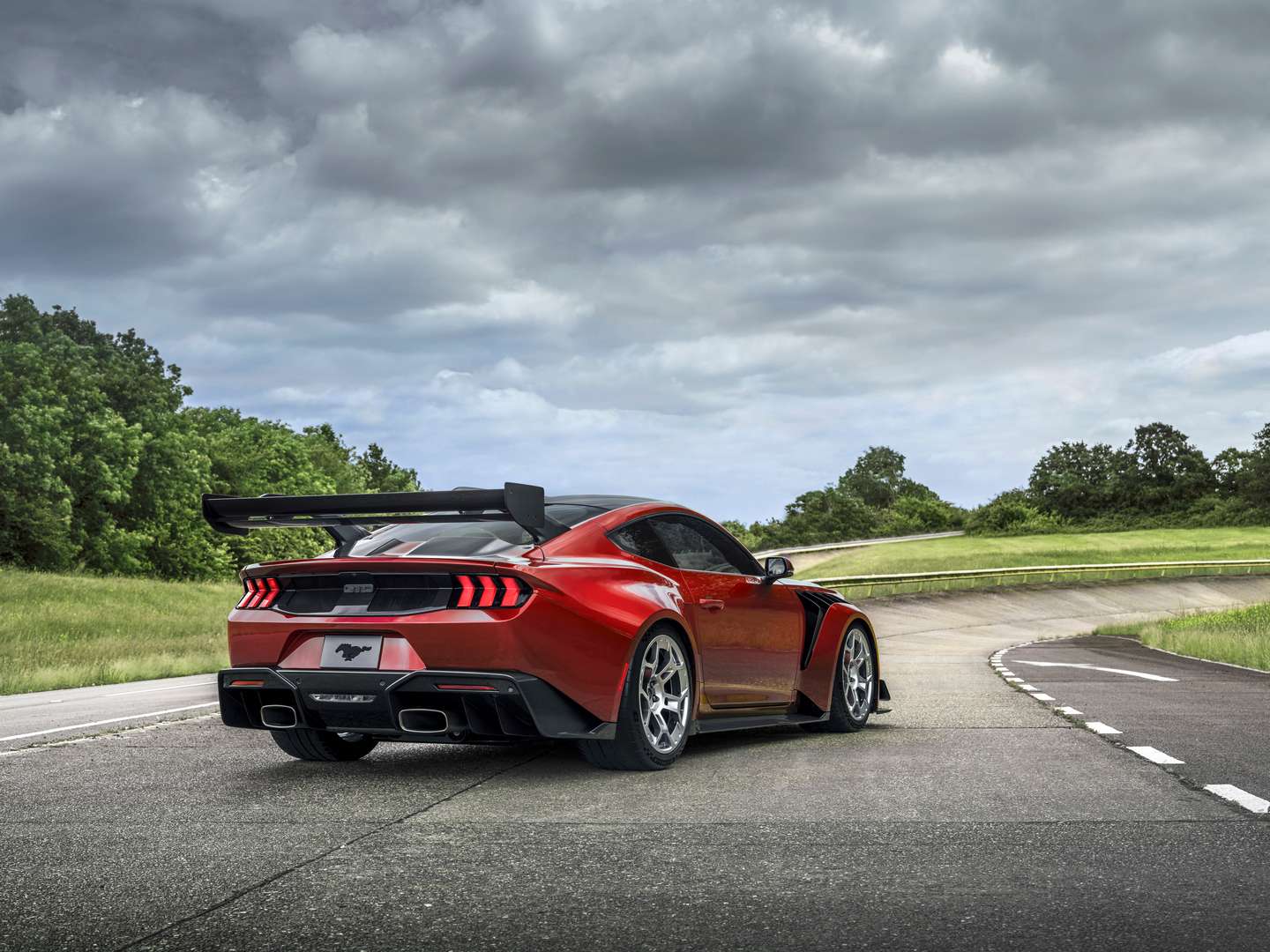 Ford Mustang GTD | Photo: Ford
Neither brand lists an official Canadian MSRP, but what’s out there puts both cars firmly in collector territory.
All 30 CLE 646 Spezialanfertigung units were sold before the car’s world premiere. The only confirmed option is a Performance Package with six-point harnesses.
The Mustang GTD carries a U.S. starting price of US$327,960, which converts to an estimated $440,000 to $450,000 CAD. That range is a currency-based estimate, not a Ford of Canada MSRP, and it excludes freight, PDI and options.
Confirmed GTD options include the Performance Package, which adds the Drag Reduction System, forged magnesium wheels and front dive planes. Custom-matched paint is also available.
| Specification | 2027 Mercedes-AMG CLE 646 Spezialanfertigung | 2027 Ford Mustang GTD |
| Canadian MSRP | Not specified | Not specified |
| Estimated CAD price | Not specified | $440,000–$450,000 (currency conversion estimate) |
| U.S. starting price | Not specified | US$327,960 |
| Freight and PDI | Not specified | Not specified |
| Confirmed packages | Performance Package (six-point harnesses) | Performance Package (DRS, magnesium wheels, front dive planes) |
| Paint options | Single two-tone scheme | Any colour, custom match available |
| Related special editions | Mythos Series model | GTD Competition (limited, serialized) |
Availability: 30 Units vs a Three-Year Application Window
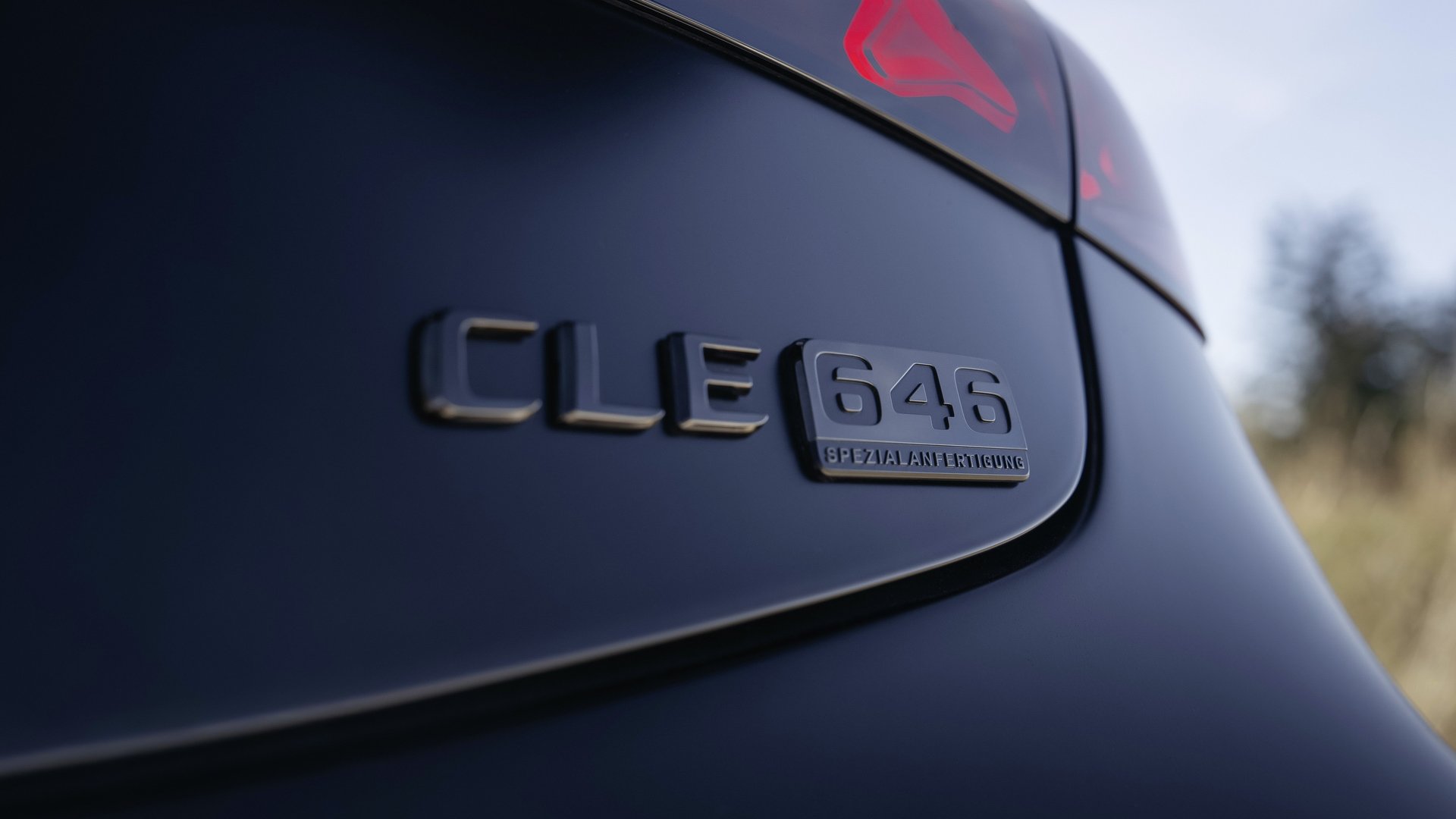 2026 Mercedes-AMG CLE 646 | Photo: Mercedes-AMG
Neither car will ever sit on a dealer lot, and the two allocation processes look nothing alike.
The CLE 646 is limited to 30 units worldwide, each hand-built in Affalterbach on a CLE 53 basis, and all are sold.
Ford reopened Mustang GTD applications on April 17, 2026, for the 2027 model year, and that round covers the next three years of production. Approved applicants complete the purchase through Ford’s Mustang GTD Concierge team.
Bodies are built at Flat Rock Assembly in Michigan and completed by Multimatic in Markham, Ontario. The GTD Competition is planned as a separate, strictly limited, serialized special edition.
| Specification | 2027 Mercedes-AMG CLE 646 Spezialanfertigung | 2027 Ford Mustang GTD |
| Production volume | 30 units worldwide | Not specified |
| Build location | Affalterbach, Germany | Flat Rock, Michigan; completed by Multimatic in Markham, Ontario |
| Sales process | Sold out before premiere | Application-based; latest round opened April 17, 2026 |
| Application coverage | Not applicable | Next three years of production |
Understanding the Differences
 Mercedes-AMG CLE 646 Spezialanfertigung, Ford Mustang GTD | Photo: Mercedes-Benz/Ford
On paper, the Mustang GTD’s numbers are higher for output (815 hp vs 637 hp), torque (664 lb-ft vs 627 lb-ft) and top speed (325 km/h vs 310 km/h), and its rear transaxle yields near 50/50 balance. The CLE 646’s headline figures are a 30-unit production run, a 3.9-second 0–100 km/h time and more than 250 kg of downforce.
The engineering split is just as clear: manually adjustable KW coilovers and aero on the AMG; semi-active dampers, push-button ride height and available active aero on the Ford. Both end up in the same place, a road-legal coupe engineered around the racetrack, after starting from opposite directions.
