


FLO pays 10¢/kWh at home and on public FLO stations from November 2.
Federal Clean Fuel Regulations fund every program; only network operators can create the credits.
Most programs limit each charger to one rewards program per calendar year.
Last updated: October 2026
FLO opens enrolment in its new rewards program on November 2, paying 10¢ for every eligible kWh charged on a connected FLO Home station or at public FLO stations. The Quebec charging network joins about two dozen Canadian programs that pay EV owners for charging at home, all funded through the federal Clean Fuel Regulations.
Advertised rates run from 2¢ to more than 20¢ per kWh, and the fine print varies even more. Here’s how the money works, what each program pays and what to check before you enrol.
Where the Money Comes From: Clean Fuel Credits
Canada’s Clean Fuel Regulations require fuel suppliers to lower the carbon intensity of the gasoline and diesel they sell. Suppliers that fall short buy compliance credits, and electricity used to charge an EV generates those credits.
Here’s the catch for homeowners: you can’t create those credits yourself. For home chargers, the regulation reserves that right for the charging-network operator, the company that runs the data platform and owns the charging data. That’s why every program needs a networked charger or a connected vehicle, and why each one keeps your kWh data.
The operator sells the credits and passes part of the value back to you. Credits for a calendar year are reported to Ottawa by April 30 of the following year, which is why so many programs pay out once a year.
FLO Reward Program: 10¢/kWh at Home and on the Road
 Flo Home Charger | Photo: Flo
- Rate: 10¢ per eligible kWh, with no tiers and no minimum per session
- Home hardware: FLO Home X3, X6 or X8 on Wi-Fi, or an X5 through its PLC module, paired in the FLO app; the older G5 isn’t eligible
- Public charging: stations listed under the “FLO” filter in the app; partner-network and workplace stations don’t earn
- Enrolment: free, opens November 2 in the FLO app; rewards start the day you join, with no backdating
- Payout: FLO Wallet credit for public charging from spring 2027, cash payouts from fall 2027
- Warranty: an enrolled FLO Home keeps its warranty for as long as the program runs and you stay in it
FLO has sold its connected X-series home chargers since it announced the X3, X6 and X8 in April 2024. You don’t need one to join, though. Any FLO app user in Canada can earn on public FLO stations, something none of the other programs reviewed here pay for.
A few conditions are worth knowing up front. Leave the program and your FLO Home drops back to its standard warranty, counted from the original purchase date. FLO can change or end the rate, but rewards already earned are honoured, and the company notes they may be taxable.
EV Charging Rewards in Canada, Side by Side
For most owners, the charger already on the wall narrows the field quickly. Rates below are as advertised by each operator.
Use Your Own Charger
| Program | Rate | Eligible hardware | How you’re paid |
|---|---|---|---|
| FLO Reward Program | 10¢/kWh | FLO Home X3, X5, X6, X8 | FLO Wallet (spring 2027), cash (fall 2027) |
| Grizzl-E Club | 3¢ to 10¢/kWh, rising with lifetime kWh; extra 5¢ on owned chargers from Oct. 1, 2026 | Grizzl-E Connect chargers | Cash withdrawal from a $10 balance |
| ChargeLab Rewards | 10¢/kWh | Supported OCPP chargers, single-family homes | Quarterly gift cards; cash payouts planned by end of 2026 |
| Chargy | 10¢/kWh | OCPP chargers, single-family homes | Monthly e-transfer or EFT, minimum 100 kWh in the month |
| Electric Avenue | 13¢/kWh | Electric Avenue or compatible OCPP 1.6 chargers | First payments early 2027; charging counted from Aug. 1, 2026 |
| Roulez Électrique Club | 13¢ to 18¢/kWh in Quebec, Ontario and B.C., by charger brand | Listed OCPP chargers, Sigenergy, FractalEV; Tesla Wall Connector in beta | Once a year; 2026 points paid around September 2027 |
| metroEV Rewards | 10¢/kWh | Eligible OCPP chargers | Direct deposit once a year, $100 minimum |
| Variablegrid Plus | 10¢/kWh | Variablegrid chargers | Cash from a $50 balance |
| Pion Power GreenMiles | 10¢/kWh in points; 16¢ to Dec. 31 after 5,000 kWh | Pion Flex-AC, Flex-AC Elite | Once a year from 1,000 points ($100) |
| EcoWatt (TechnoVE) | 12¢/kWh (indicative) | Listed TechnoVE chargers on Wi-Fi | Cheque once a year, first in summer 2027 |
Roulez Électrique Club is invitation-only. Variablegrid Plus launched in September with Kia Canada as its first automaker partner.
Tesla Owners and Vehicle-Based Tracking
 Tesla charger | Photo: Tesla
| Program | Rate | Eligible hardware | How you’re paid |
|---|---|---|---|
| RoadToEV | 10¢/kWh, up to 15¢ with referrals | Tesla Wall Connector | Once a year, to a wallet, then Interac e-transfer |
| WattsApp | 21 to 33 points/kWh in October (1 point = 1¢) | Tesla Wall Connector Gen 3 or Universal | Interac e-transfer after first-quarter verification, $100 minimum |
| Telemiq Rewards | 5¢ to 14.5¢/kWh, tiered by annual volume | Tesla or Ford vehicle account, with charging verified at home | Interac e-transfer after first-quarter audit, $100 minimum |
Telemiq reads charging data from the vehicle, so a basic, non-networked Level 2 charger can still qualify.
Charger Supplied Against a Deposit
| Program | Rate | Refundable deposit |
|---|---|---|
| SWTCH Home Charging Program | 3¢, then 11¢ after 1,500 kWh | $300 |
| Hypercharge Home Club | 3¢, then 11¢ after 1,500 kWh | $299 plus $30 shipping |
| DashSharing | 3¢, then 11¢ after 1,500 kWh | Varies by model |
| Soneil Spark Cashback | 6¢, then 11¢ after 1,250 kWh | $299 plus $25 shipping |
| Clearshot Labs | 3¢ | $300 |
Read “free charger” with an asterisk here. Each offer still requires the deposit, which comes back once the charger logs the target energy.
Regional Programs
- Iceberg EV (Newfoundland and Labrador): 12¢/kWh, paid quarterly by e-transfer, on Autel MaxiCharger units
- EcoCharge Rewards (B.C. single-family homes): 10¢/kWh once the $199 deposit is refunded at 1,500 kWh
- Charging Right (Ontario pilot): 3¢ to 13¢/kWh across its available plans
- KENI Recharge: has announced a 13¢/kWh Club Privilège for KENI chargers, not yet open
One Charger, One Program Per Year
 ChargeLab’s app tracks energy used and rewards earned: 512.7 kWh at 10¢/kWh comes to $51.27 | Photo: ChargeLab
The regulation bars anyone from claiming the same electricity twice. Programs turn that into a contract rule: ChargeLab, RoadToEV and Roulez Électrique each limit a charger to one program per calendar year.
In practice, switching waits until January 1. Backdating varies too: Electric Avenue counts charging from August 1, 2026, some Roulez Électrique hardware counts from January 1, and FLO starts the day you enrol.
Five Things to Check in the Fine Print
Before signing up, five clauses deserve a close read.
- Who owns the credits: Chargy’s terms give it the exclusive right to your charger’s credits; metroEV’s assign it other incentives tied to the charger
- Minimum term: metroEV requires 12 months; Chargy lets either side leave on 30 days’ notice
- Offline penalties: SWTCH can keep the deposit and earnings on a free charger left offline 180 days; metroEV can remove a charger after the same period
- Thresholds and clawbacks: payout minimums range from $10 (Grizzl-E) to $100 (several programs), and Chargy can claw back up to 24 months of payments over false or duplicate claims
- Rate changes: FLO and Chargy both reserve the right to change rates, and Pion Power will set its 2027 rate next year
What a Typical Driver Earns
The math is simple. At 10¢/kWh, every 1,000 kWh charged at home pays $100. A driver who puts 4,000 kWh through a home charger in a year earns $400 at that rate, or $520 at 13¢.
Deposit programs start slower. The first 1,500 kWh at 3¢ return $45 before the 11¢ rate applies.
Rebates for the Charger Itself
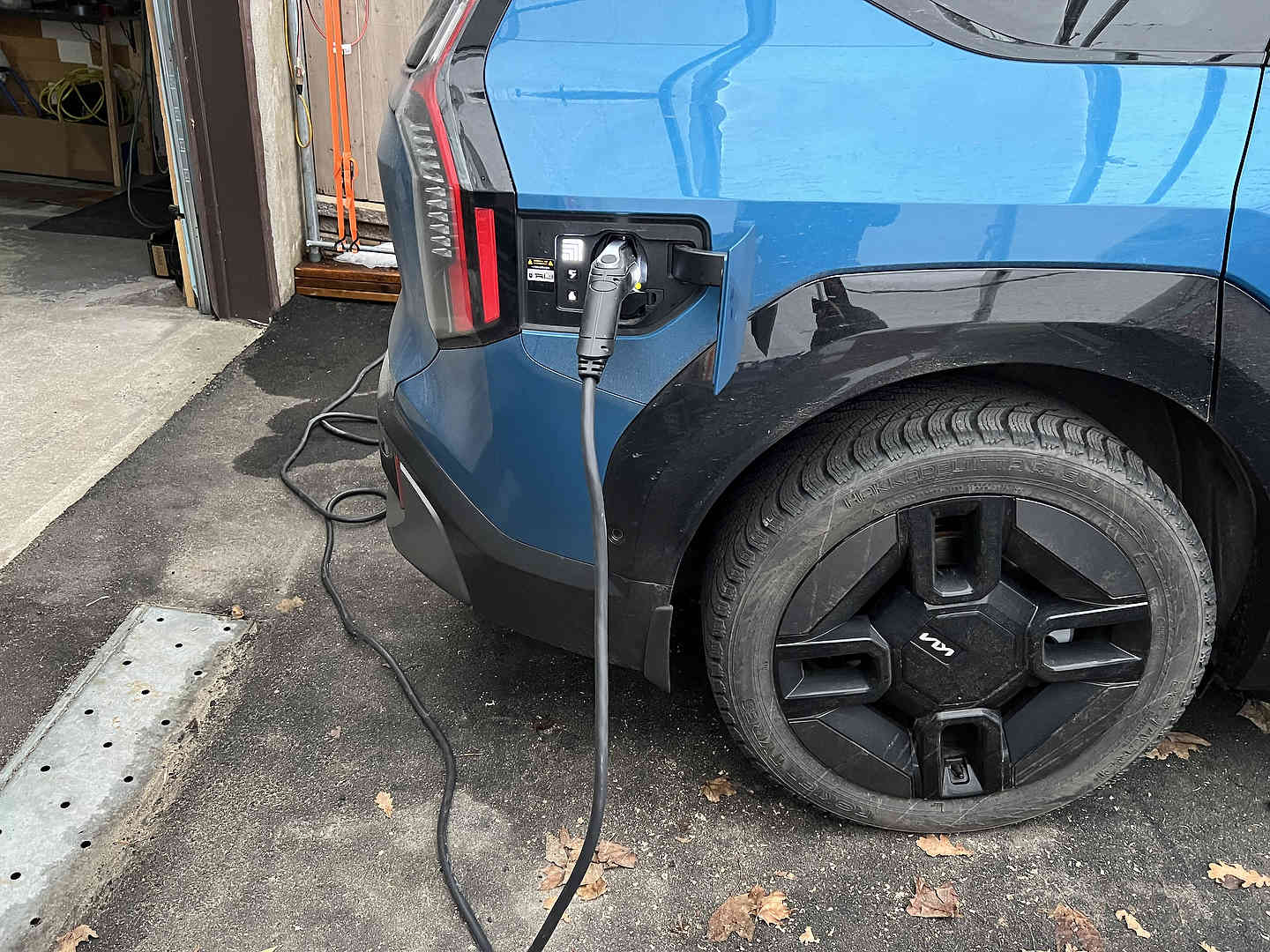 FLO Home X5 Charger | Photo: Matt St-Pierre
Rewards pay per kWh. Provincial programs still help with the purchase, for those buying a charger now:
- Quebec: Écorecharge pays a flat $600 for an eligible home charger costing at least $600 before taxes; you must own an EV when you apply, and installation isn’t covered. Dorval adds 50% up to $500, and Saint-Eustache adds $250.
- British Columbia: CleanBC Go Electric covers 50% up to $350 (75% up to $750 for Indigenous applicants). In select postal codes, a $1,750 BC Hydro top-up through December 31, 2026, plus a $250 Peak Saver bonus, brings the total to $2,350. Tesla chargers no longer qualify.
- Manitoba: Manitoba Hydro lends up to $3,000 per charger, installation included, through its Home Energy Efficiency Loan.
- Closed: New Brunswick ended its charger rebate on July 1, 2025, and Yukon’s ended March 31, 2026.
Peak Pricing Still Applies
Rewards programs pay the same per kWh at any hour, so the timing question falls to your utility. Hydro-Québec’s Flex D rate charges 46.463¢/kWh during winter peak events (6 to 10 a.m. and 4 to 8 p.m., up to 120 hours between December 1 and March 31), and the Winter Credit Option closed to new customers on March 31, 2026.
Hilo can pause charging automatically during those events, though only EVduty home chargers are compatible. Hydro-Québec has also surveyed drivers about a $50 annual reward for overnight charging, with no program announced. In B.C., Peak Saver pays $50 for every season a device stays enrolled.
So where do you start? With the charger you already own. FLO and Grizzl-E owners have a house program, OCPP owners can shop for the best rate each year, and Tesla Wall Connector owners have a short list of their own.
Quick Answers
Can I sell my home-charging credits myself? No. Under the Clean Fuel Regulations, only the charging-network operator can create credits from a home charger. You join a program, and the operator shares part of the value with you.
Can I join two programs with the same charger? Not in the same calendar year. The regulation bars claiming the same electricity twice, and programs such as ChargeLab, RoadToEV and Roulez Électrique limit each charger to one program per year, so switching waits until January 1.
Does my older charger qualify? Only if it connects to a network and reports its usage. A non-networked charger can’t generate credits; FLO’s older Home G5, for example, isn’t eligible. Vehicle-based programs such as Telemiq are the exception, reading charging data from a Tesla or Ford account.
How much can I earn in a year? At 10¢/kWh, every 1,000 kWh charged at home pays $100, so 4,000 kWh returns $400.
When do I get paid? It depends on the program. Many pay once a year, after credits are reported to Ottawa by April 30 of the following year; Chargy pays monthly, while ChargeLab and Iceberg EV pay quarterly.
