Automakers are naturally very proud of their heritage and seek every opportunity to highlight it, often through anniversaries and celebrations. The 20th anniversary of a particular model, the 75th anniversary of a specific technology, the 90th anniversary of the brand, etc.
The first model named F-150 was released in 1975.
The F-150 slotted between the F-100 and F-250.
The history of the Ford F-Series dates back to 1948.
Sometimes they find ways to celebrate other types of milestones. That’s what we saw this week at Ford, which celebrated 50 years of the F-150.
But be careful what you’ve just read. The F-150, the pickup truck we know, is much older than that. It’s the F-150 name that’s 50 years old.
Let’s go back in time.
1948: the first generation
In 1948, Ford launched the F Series with a model it simply called the F1. In fact, there was a whole series, from F1 to F8. The number reflected the model’s capacities. The F1 to F3 corresponded roughly to what we know today as Ford’s 150, 250, and 350 series, or the 1500, 2500, and 3500 with GM and Ram. Half-ton, three-quarter-ton, and one-ton capabilities—does that ring a bell? That’s kind of what it referred to.
Fun fact: in Canada, the first generation of the F Series was designated F47, F57, and F68, with the number representing the vehicle’s GVWR (gross vehicle weight rating), i.e., the maximum weight it can carry with occupants and cargo. With the first F Series, we are talking about 4,700, 5,700, and 6,800 pounds.
Another fun fact: Mercury also sold versions in Canada: the M47, M57, etc.
Second generation
Ford standardized the naming with the model’s second generation in 1953. At that time, the company began using the number 100 for its half-ton trucks. However, it used 250 and 350 for its three-quarter-ton and one-ton pickups, respectively.
Ford Halts Production of the F-150 Lightning Due to Fire at its Aluminium Supplier
As for the reason behind the name change, there is no official answer. They wanted to change things up, and with the arrival of a new generation, it seemed like the right time.
However, rumor has it the name was inspired by the US Air Force’s F-100 jet. The Korean War had just ended, and the name resonated with the public. It was also the era of supersonic travel, with the race for speed and soon for space.
One thing is sure: the move paid off.
1975
It brings us to the mid-1970s, when Ford launched the first F-150 model. It was an addition to the lineup, not a name change, as that year’s catalog shows the F-100, F-150, F-250, and F-350.
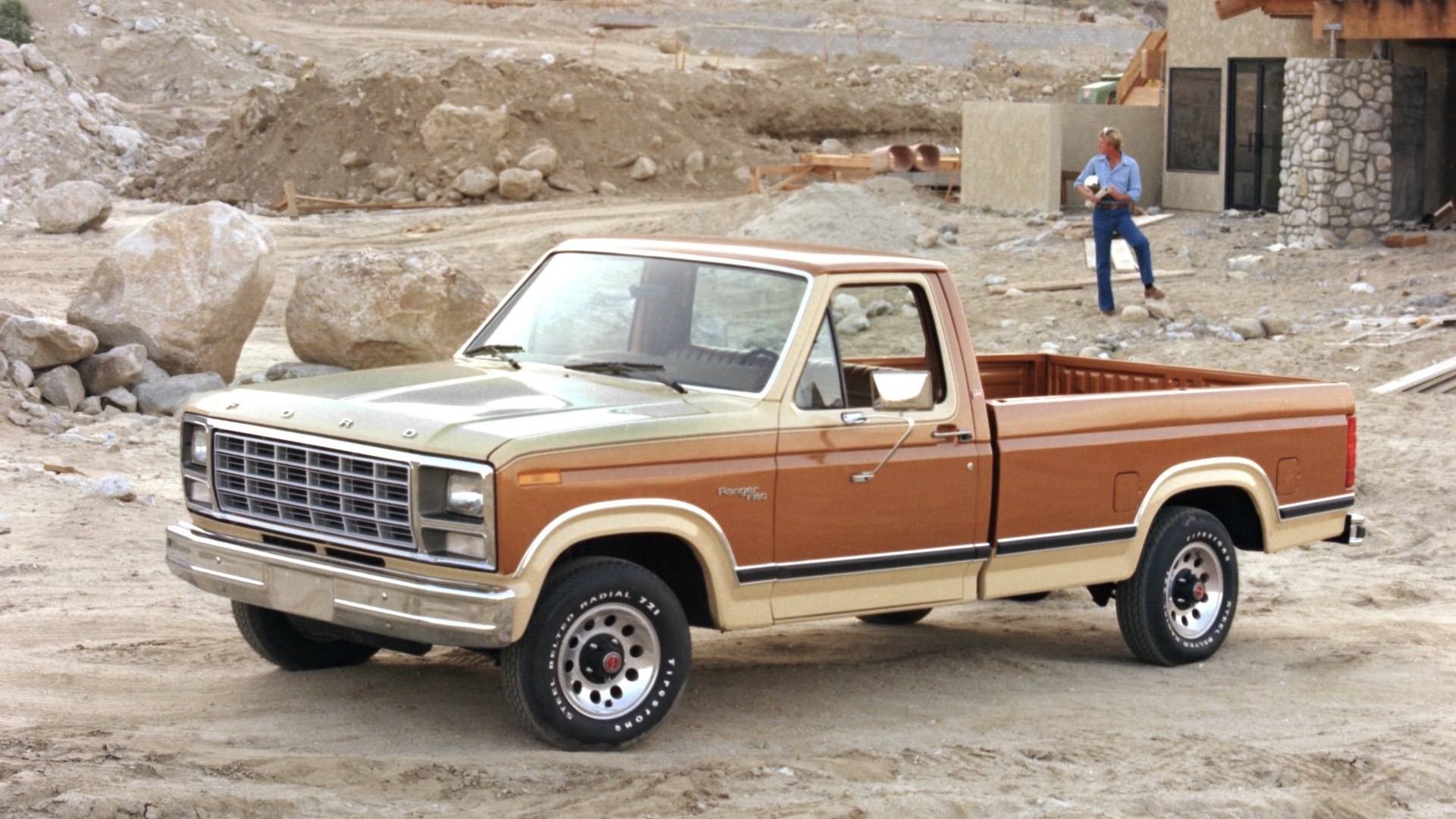
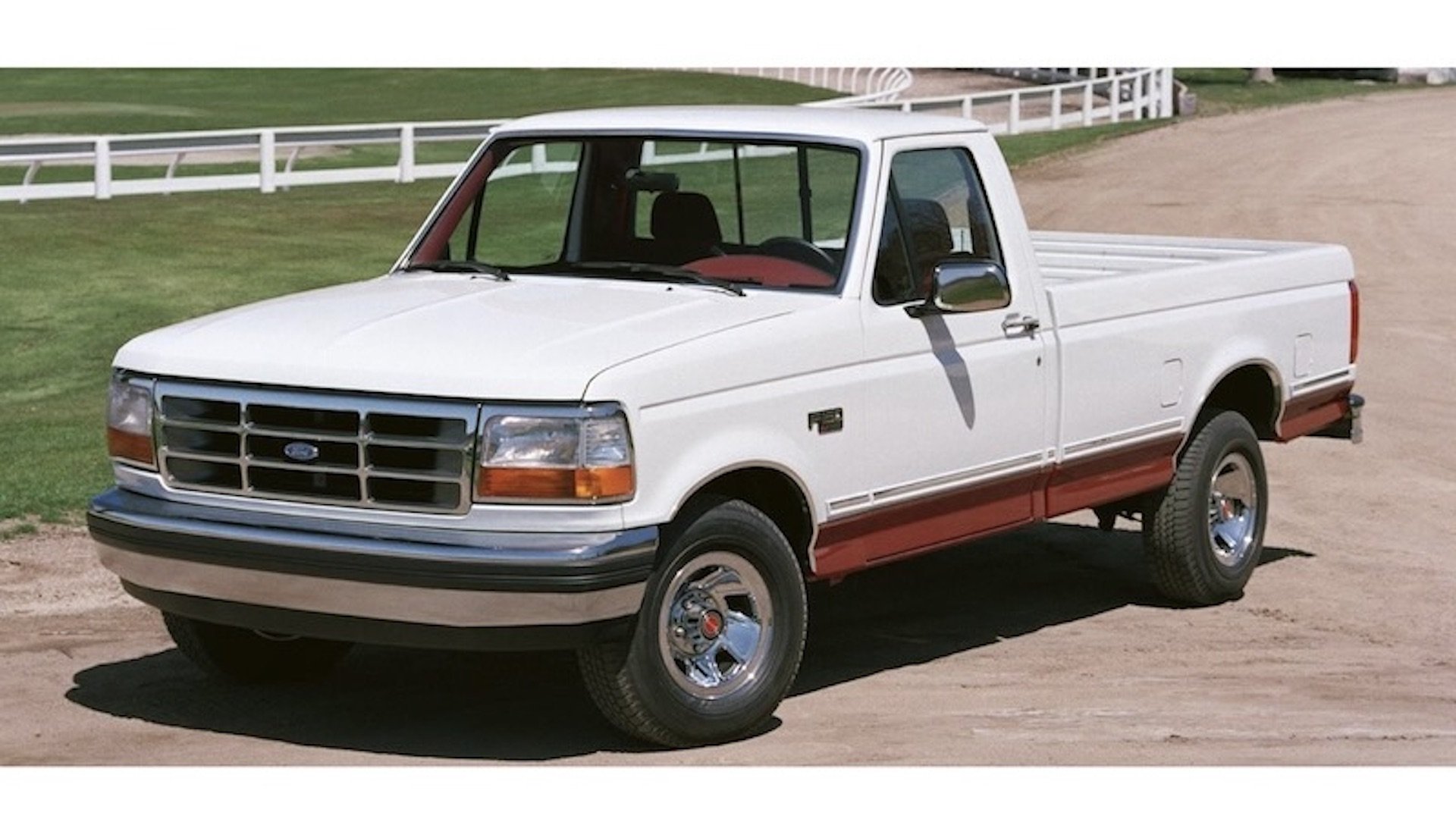
 1976 Ford F-150
The reason for this decision was the emissions standards of the time. Let’s recall that in 1970, the US government passed the Clean Air Act, a law aimed at fighting air pollution. It gave the EPA (Environmental Protection Agency) the authority to impose stricter standards on manufacturers. By 1975, they had to reduce carbon monoxide and nitrogen oxide emissions by 90%, not to mention unburned hydrocarbons.
It forced car makers’ engineers to develop the catalytic converter, which became mandatory on several vehicles starting in 1975.
The F-100
The F-100, which was the base trim at the time, was on the list of models that had to be equipped with a catalytic converter because its gross weight (5,700 pounds) was below 6,000 pounds.
However, with the introduction of the new F-150, which offered greater capacity, stronger axles, and heavy-duty springs, the model’s gross weight was 6,050 pounds. Therefore, it did not need a catalytic converter.
Buyers at the time preferred this because converters required unleaded gasoline, as lead destroyed the catalytic converter. And, as you can imagine, unleaded gas was more expensive. So the F-150 could be fueled with leaded gasoline.
 1979 Ford F-150
The prices of unleaded and leaded gasoline converged in the 1980s, and by the end of that decade, unleaded gasoline had become the norm.
As for the F-150, it offered capabilities that were between those of the F-100 and the F-250. Ford continued to offer the F-100 for a few years, but the company quickly realized that its new flagship model was the F-150, as buyers responded very positively to it.
The rest, as they say, is history.