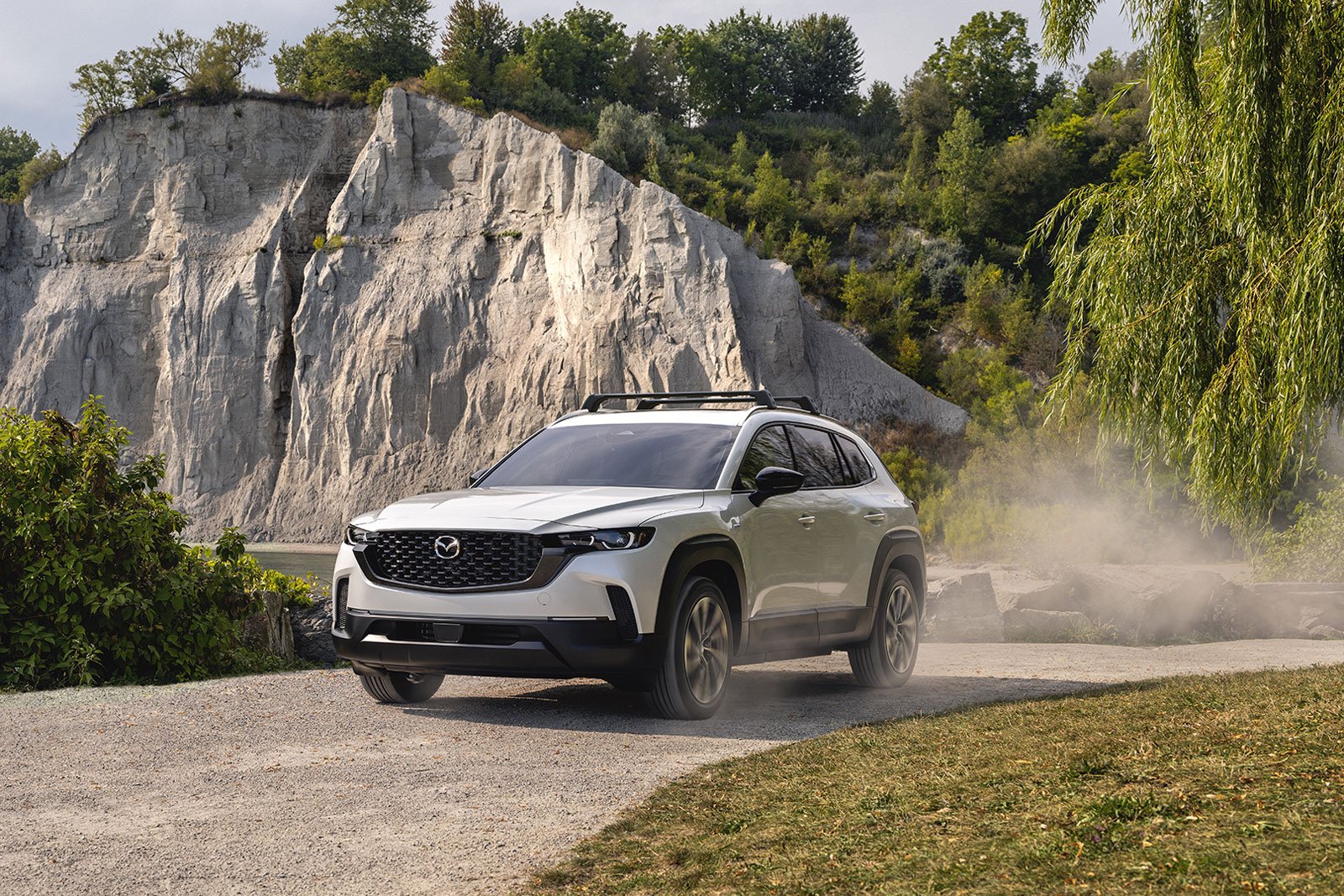
The 2025 Mazda CX-50 is sold alongside the Mazda CX-5 in the compact crossover segment, but features a more robust appearance for shoppers who prefer a little more character to the brand’s “Kodo: Soul of Motion” design language.
However, for its third year on the market, the CX-50 gains a new powertrain option that the CX-5 doesn’t get, thanks to the collaboration of another Japanese manufacturer.
2025 Mazda CX-50 Changes and Updates
In addition to the two existing Mazda-developed powertrains, the CX-50 is now available with a hybrid propulsion system. The latter is provided in its entirety by Toyota, and it’s the same one found in the RAV4 crossover. The CX-50 Hybrid is not only powerful than the variants equipped with Mazda’s base 2.5L engine, but it’s noticeably more fuel-efficient. By configuration, it also includes AWD. The system can shift torque front/rear distribution between 100:0 and 20:80 depending on driving conditions.
Ground clearance drops from between 210 to 219 millimetres on the regular CX-50 to between 199 to 205 mm on the CX-50 Hybrid, while the hybrid variant’s overall height rises by about 50 millimetres. Otherwise, the CX-50 Hybrid can be distinguished mainly by its appropriate front fender badging.
All 2025 Mazda CX-50 variants get Private eCall, a communications system that connects vehicle occupants to an emergency call centre, if such as need arises, by pressing an SOS button on the vehicle’s headliner. The service includes a two-year trial period when the vehicle is purchased new, after which a subscription is required to keep activated. And since the vehicle is connected, a Stolen Vehicle Assistance feature is available as well, which can geolocate the vehicle and share it with authorities.
Finally, a new green paint color is available, called Cypress.

2025 Mazda CX-50 Trim Levels and Pricing
The CX-50 is available is GS-L, GS-L Hybrid, Kuro Hybrid, GT, GT Turbo, GT Hybrid and Meridian Edition. The latter can also be upgraded with the Apex Package that adds roof rack crossbars, a roof platform as well as front and rear splash guards.
The GS-L and GT are equipped with a naturally aspirated 2.5L four-cylinder engine that develops 187 horsepower and 185 pound-feet of torque, featuring cylinder deactivation, managed by a six-speed automatic transmission. Meanwhile, a turbocharged 2.5L four-cylinder engine with automatic stop/start is optionally available on the GT and standard on the Meridian Edition, producing 227 horsepower and 310 pound-feet of torque when using regular fuel, or 256 horsepower and 320 pound-feet with premium 93-octane gasoline.
The new hybrid powertrain consists of a 2.5L four-cylinder engine, two front-mounted electric motors and a rear-mounted propulsion motor, a 1.59 kWh battery pack and an electronically controlled continuously variable automatic transmission, for a combined output of 219 horsepower.
| Engine | Trans | Drive | MSRP | Freight & PDI | A/C Tax | Dealer Fees | Net Price | |
|---|---|---|---|---|---|---|---|---|
| GS-L | 2.5L I4 | 6AT | AWD | $39,950 | $2,195 | $100 | $795 | $43,040 |
| GS-L Hybrid | 2.5L I4 HEV | ECVT | AWD | $42,950 | $2,195 | $100 | $795 | $46,040 |
| Kuro Hybrid | 2.5L I4 HEV | ECVT | AWD | $44,850 | $2,195 | $100 | $795 | $47,940 |
| GT | 2.5L I4 | 6AT | AWD | $45,350 | $2,195 | $100 | $795 | $48,440 |
| GT Turbo | Turbo 2.5L I4 | 6AT | AWD | $47,850 | $2,195 | $100 | $795 | $50,940 |
| GT Hybrid | 2.5L I4 HEV | ECVT | AWD | $48,350 | $2,195 | $100 | $795 | $51,440 |
| Meridian Edition | Turbo 2.5L I4 | 6AT | AWD | $50,350 | $2,195 | $100 | $795 | $53,440 |
| Meridian Edition with Apex Package | Turbo 2.5L I4 | 6AT | AWD | $52,300 | $2,195 | $100 | $795 | $55,390 |

2025 Mazda CX-50 Specifications
| GS-L | GT | GT Turbo | Meridian Edition | Meridian Edition with Apex Package | |
|---|---|---|---|---|---|
| Engine | 2.5L I4 | 2.5L I4 | Turbo 2.5L I4 | Turbo 2.5L I4 | Turbo 2.5L I4 |
| Transmission | 6AT | 6AT | 6AT | 6AT | 6AT |
| Drivetrain | AWD | AWD | AWD | AWD | AWD |
| Output (with 93-octane fuel) (hp @ rpm) | 187 @ 6,000 | 187 @ 6,000 | 227 (256) @ 5,000 | 227 (256) @ 5,000 | 227 (256) @ 5,000 |
| Torque (with 93-octane fuel) (lb-ft @ rpm) | 185 @ 4,000 | 185 @ 4,000 | 310 (320) @ 2,000 (2,500) | 310 (320) @ 2,000 (2,500) | 310 (320) @ 2,000 (2,500) |
| Power-to-Weight Ratio (with 93 octane fuel) (kg/hp) | 9.2 | 9.2 | 7.8 (6.9) | 7.8 (6.9) | 7.8 (6.9) |
| City/Highway/Combined Fuel Economy (L/100 km) | 9.7 / 8.0 / 8.9 | 9.7 / 8.0 / 8.9 | 10.4 / 8.2 / 9.4 | 10.4 / 8.2 / 9.4 | 10.4 / 8.2 / 9.4 |
| Fuel Tank Capacity (L) | 60 | 60 | 60 | 60 | 60 |
| Required Fuel | Regular | Regular | Regular | Regular | Regular |
| Standard Wheels and Tires | 225/65R17 | 245/45R20 | 245/45R20 | 225/60R18 | 225/60R18 |
| Turning Diameter, Curb-to-Curb (m) | 11 | 11 | 11 | 11 | 11 |
| Wheelbase (mm) | 2,815 | 2,815 | 2,815 | 2,815 | 2,815 |
| Length (mm) | 4,720 | 4,720 | 4,720 | 4,720 | 4,720 |
| Width Without Mirrors (mm) | 1,920 | 1,920 | 1,920 | 1,920 | 1,920 |
| Height (mm) | 1,613 | 1,622 | 1,622 | 1,622 | 1,622 |
| Track Width Front/Rear (mm) | 1,658 / 1,662 | 1,648 / 1,652 | 1,648 / 1,652 | 1,648 / 1,652 | 1,648 / 1,652 |
| Ground Clearance (mm) | 210 | 219 | 218 | 216 | 216 |
| Approach/Breakover/Departure Angles (degrees) | 17.8 / 17.7 / 24.1 | 18.5 / 18.5 / 24.8 | 18.3 / 18.2 / 24.6 | 18.4 / 18.4 / 24.6 | 18.4 / 18.4 / 24.6 |
| Headroom Front (With Sunroof)/Rear (mm) | 981 / 952 | 981 / 952 | 981 / 952 | 981 / 952 | 981 / 952 |
| Legroom Front/Rear (mm) | 1,058 / 1,012 | 1,058 / 1,012 | 1,058 / 1,012 | 1,058 / 1,012 | 1,058 / 1,012 |
| Shoulder Room Front/Rear (mm) | 1,419 / 1,361 | 1,419 / 1,361 | 1,419 / 1,361 | 1,419 / 1,361 | 1,419 / 1,361 |
| Hip Room Front/Rear (mm) | 1,361 / 1,323 | 1,361 / 1,323 | 1,361 / 1,323 | 1,361 / 1,323 | 1,361 / 1,323 |
| Cargo Volume Min/Max (L) | 889 / 1,595 | 889 / 1,595 | 889 / 1,595 | 889 / 1,595 | 889 / 1,595 |
| Curb Weight (kg) | 1,729 | 1,729 | 1,777 | 1,777 | 1,777 |
| Towing Capacity (kg) | 907 | 907 | 1,588 | 1,588 | 1,588 |
| GS-L Hybrid | Kuro Hybrid | GT Hybrid | |
|---|---|---|---|
| Engine | 2.5L I4 HEV | 2.5L I4 HEV | 2.5L I4 HEV |
| Transmission | ECVT | ECVT | ECVT |
| Drivetrain | AWD | AWD | AWD |
| Combined Output (hp) | 219 | 219 | 219 |
| Combined Torque (lb-ft @ rpm) | 163 @ 3,600 to 5,200 | 163 @ 3,600 to 5,200 | 163 @ 3,600 to 5,200 |
| Battery Capacity (kWh) | 1.59 | 1.59 | 1.59 |
| Power-To-Weight Ratio (with 93 octane fuel) (kg / hp) | 8.3 | 8.3 | 8.3 |
| City/Highway/Combined Fuel Economy (L/100 km) | 6.1 / 6.4 / 6.2 | 6.1 / 6.4 / 6.2 | 6.1 / 6.4 / 6.2 |
| Fuel Tank Capacity (L) | 55 | 55 | 55 |
| Required Fuel | Regular | Regular | Regular |
| Standard Wheels and Tires | 225/65R17 | 225/65R17 | 225/55R19 |
| Turning Diameter, Curb-to-Curb (m) | 11.8 | 11.8 | 11.8 |
| Wheelbase (mm) | 2,815 | 2,815 | 2,815 |
| Length (mm) | 4,727 | 4,727 | 4,727 |
| Width Without Mirrors (mm) | 1,920 | 1,920 | 1,920 |
| Height (mm) | 1,666 | 1,666 | 1,672 |
| Track Width Front/Rear (mm) | 1,658 / 1,662 | 1,658 / 1,662 | 1,648 / 1,652 |
| Ground Clearance (mm) | 199 | 199 | 205 |
| Approach/Breakover/Departure Angles (degrees) | 17.4 / 16.1 / 22.6 | 17.4 / 16.1 / 22.6 | 18.0 / 16.6 / 23.0 |
| Headroom Front (With Sunroof)/Rear (mm) | 981 / 932 | 981 / 932 | 981 / 932 |
| Legroom Front/Rear (mm) | 1,058 / 959 | 1,058 / 959 | 1,058 / 959 |
| Shoulder Room Front/Rear (mm) | 1,419 / 1,361 | 1,419 / 1,361 | 1,419 / 1,361 |
| Hip Room Front/Rear (mm) | 1,362 / 1,314 | 1,362 / 1,314 | 1,362 / 1,314 |
| Cargo Volume Min/Max (L) | 826 / 1,595 | 826 / 1,595 | 826 / 1,595 |
| Curb Weight (kg) | 1,808 | 1,808 | 1,808 |
| Towing Capacity (kg) | 680 | 680 | 680 |

2025 Mazda CX-50 Warranty Coverage
In Canada, the 2025 Mazda CX-50 is covered by a 3-year/unlimited km Comprehensive Limited Warranty and a 5-year/unlimited km Powertrain Limited Warranty. The hybrid variants’ high-voltage battery is covered by an 8-year, 160,000 km Limited Warranty. In addition, the CX-50 is backed by a 7-year/unlimited km Rust Perforation Limited Warranty.
24-hour roadside assistance is offered on the CX-50 for 3 years and unlimited km in Canada.

What the 2025 Mazda CX-50 Does Well
- The crossover’s interior design and high-quality fit and finish give the vehicle a premium feel as well. We’d just like an extra grab handle on the interior door panels to hold it better on windy days.
- Obviously, fuel consumption is pretty low with the new electrified powertrain. The CX-50 also uses Toyota’s proven hybrid components.
- The Hybrid variant doesn’t look any less rugged and purposeful than the regular CX-50. As mentioned above, the ride height is reduced a little, but that’s it.
- Also typically Mazda, the CX-50 is engaging to drive with good handling characteristics.

What the 2025 Mazda CX-50 Doesn’t Do Well
- For its size, the CX-50 doesn’t offer a very spacious rear seating area. Occupants risk scraping their heads on the ceiling, legroom isn’t all that generous, and the rear seatback angle isn’t adjustable for extra comfort on longer trips. The hybrid variant’s cargo space is rated at 826 litres with the rear seatbacks up, as opposed to 889 litres in the regular CX-50, although with the seats folded down, max cargo space is the same at 1,595 litres. The latter is below average for the segment.
- The Mazda Connect infotainment system has been designed to be ergonomic, and it is, but time is needed to figure out how many clicks we need to turn the rotary dial to reach the desired option, and so forth. It’s meant to be used while keeping our eyes on the road and be less distracting. However, some users would much prefer simply having a touchscreen. Said screen isn’t touch-sensitive when using Mazda’s interface, but becomes tactile when Apple CarPlay and Android Auto is activated—and only when the vehicle is stopped. Simply put, those who prefer CarPlay and Android won’t find the system particularly user-friendly.
- While the CX-50 handles fine, and despite the extra ponies over the base engine, the hybrid powertrain isn’t the most energetic powertrain out there. However, we knew that already with the RAV4 Hybrid. Mazda’s very competent all-wheel drivetrain isn’t on board, replaced by the Toyota hybrid powertrain’s AWD system, whose rear wheels spin on electric power alone. In addition, towing capacity is reduced to 680 kilograms or 1,500 pounds, while the regular CX-50 is rated at 907 to 1,588 kg or 2,000 to 3,500 pounds.
- Ride quality isn’t as good as some of its competitors such as the Toyota RAV4 and the Honda CR-V, and even the Mazda CX-5 for that matter. Blame the CX-50’s stiffer suspension setup.

2025 Mazda CX-50 Competition
The CX-50 competes with the Buick Envision, the Chevrolet Equinox, the Chevrolet Equinox EV, the Ford Bronco Sport, the Ford Escape, the GMC Terrain, the Honda CR-V, the Hyundai Tucson, the Jeep Compass, the Kia Sportage, the Mazda CX-5, the Mitsubishi Eclipse Cross, the Mitsubishi Outlander, the Nissan Rogue, the Subaru Forester, the Toyota RAV4 and the Volkswagen Tiguan.