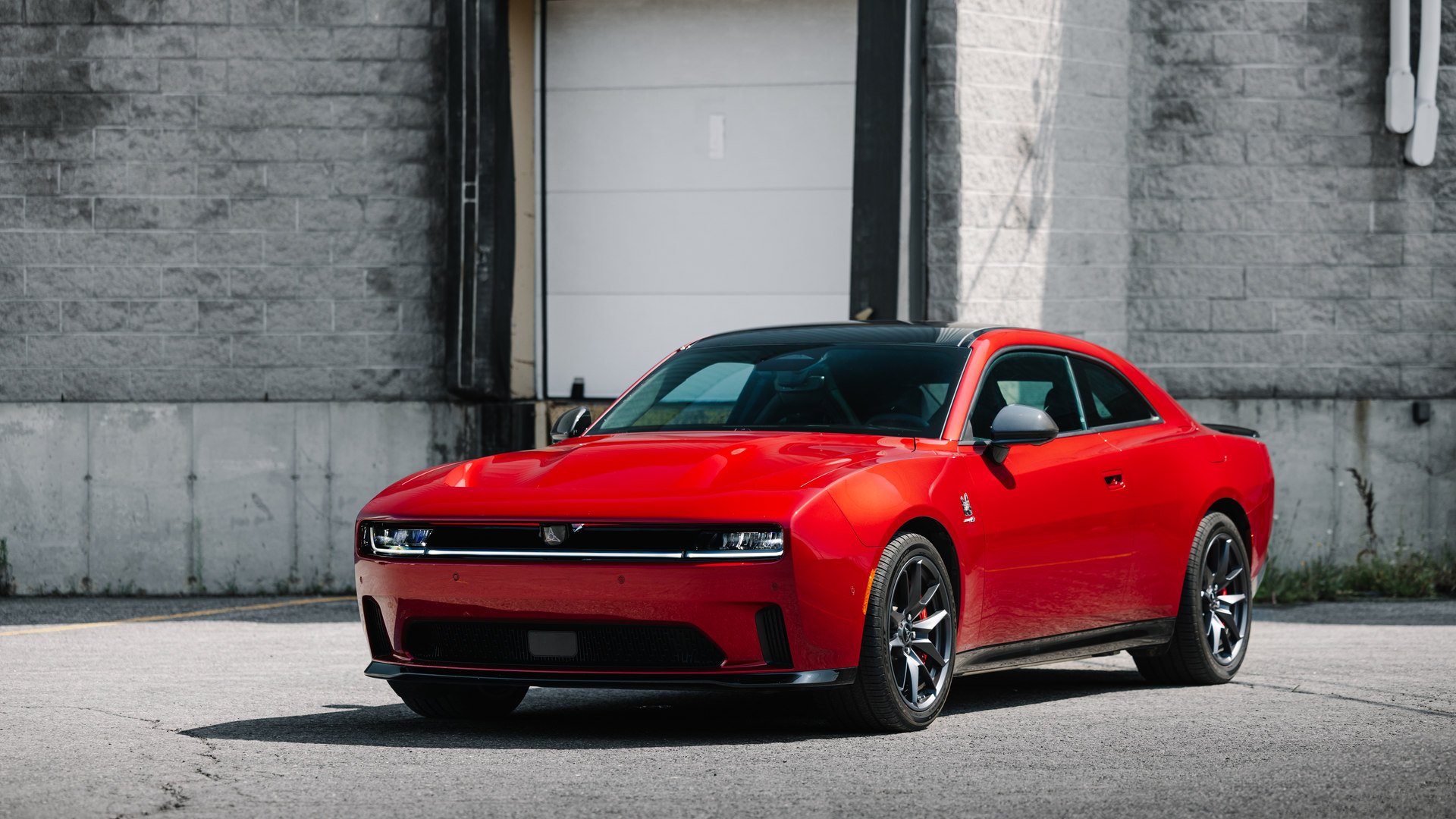
The 2025 Dodge Charger Daytona Scat Pack is an electric car with a strong personality, but it seems to be aimed at a customer base that doesn’t exist.
An electric muscle car?
While Dodge took longer than its competitors to produce its first electric model, the least we can say is that the American brand didn’t do it quietly.
Indeed, it takes a lot of audacity to enter the world of EVs with a whole new category of vehicle: the electric muscle car.
The original recipe from the 1960s was very simple: Take a mid-size coupe, install the biggest V8 that fits under the hood, and give the whole thing a more aggressive style than the model it’s based on.
 2025 Dodge Charger Daytona Scat Pack | Photo: Olivier Delorme
American manufacturers have successfully followed this recipe ever since, without changing much. Of course, some adjustments have been made over the years; muscle cars have notably become standalone models with no direct links to their manufacturer’s other products, but one thing has remained practically constant: the V8.
At least, that was true until last year, when Dodge chose to retire its old Charger and Challenger models and replace them with an all-new two-door Charger, offered so far only in an electric version.
Unfortunately, sales are not meeting expectations, and the manufacturer is now paying more attention to the six-cylinder powered versions, which will arrive in dealerships by the end of the year.
Specifications and Price
 2025 Dodge Charger Daytona Scat Pack | Photo: Olivier Delorme
For 2025, the Charger Daytona is offered in two versions: R/T and Scat Pack.
Both are powered by a 100.5 kWh battery and two electric motors developing a total of 456 horsepower in the R/T and 630 horsepower in the Scat Pack, not counting the Power Shot mode, which boosts power up to 496 and 670 horsepower respectively for 10 seconds. Torque is rated at 404 lb-ft for the R/T and 627 lb-ft for the Scat Pack, making a 0 to 60 mph (0 to 96 km/h) sprint possible in just 4.7 seconds or 3.3 seconds, respectively.
According to Natural Resources Canada, the maximum range of the Charger Daytona R/T is 496 kilometers, and the Scat Pack’s is 388 kilometers.
The price range is unusually wide, with an entry-level R/T model starting at $54,790 and the more powerful and better-equipped Scat Pack starting at $82,790. Several options are available, notably the Plus Group, which includes items such as a head-up display, ambient lighting, a front trunk, mirror position memory, automatic high beams, a power liftgate, surround-view cameras, rain-sensing wipers, and wireless phone charging, among others, for the handsome sum of $9,495.
The Scat Pack model I tested was equipped with this package, in addition to the Sun & Sound group (18-speaker Alpine audio and glass roof) at $3,695, as well as the Suede and Carbon group, priced at $3,995, which includes leather and suede upholstery, carbon fiber dashboard and door trim, and unique 20-inch wheels.
All of this explains the nearly $108,000 price tag of the vehicle provided to me.
Note: The R/T version will not be returning for the 2026 model year.
Why buy a 2025 Dodge Charger Daytona
Although Dodge missed the mark with the Charger Daytona, that doesn’t make it a bad car, especially when it comes to performance and features.
- Impressive performance
 2025 Dodge Charger Daytona Scat Pack | Photo: Olivier Delorme
Of course, the whole point of a muscle car is brutal acceleration and thrilling sensations. Dodge knows this well, which is why the 2025 Charger Daytona Scat Pack boasts up to 670 horsepower and an instant 627 lb-ft of torque. This makes it 0.4 seconds faster in the 0-60 mph (96 km/h) sprint than the 2023 Challenger Hellcat Redeye Widebody, despite the latter’s supercharged V8 developing 797 horsepower.
The standard all-wheel drive on the Charger Daytona certainly has something to do with it, as it allows for explosive launches without too much wheelspin from the enormous rear tires. This level of performance is all the more impressive when you consider the size and mass of the electric Charger. Indeed, this 2-door coupe is 44 millimeters longer than the Jeep Grand Cherokee L and weighs 317 kilos (700 pounds) more than the heaviest version of that 7-passenger SUV. Moreover, if the Charger Daytona were just 5 millimeters wider, Transport Canada would require the installation of central clearance lights, just like on semi-trucks!
Thus, it’s not surprising that the Charger Daytona doesn’t have the agility of a Miata, especially with the adaptive suspension in comfort mode. Nevertheless, the firmer settings allow for better control of body movements, and the Charger Daytona Scat Pack tackles curves with enough composure to give the driver confidence. As such, its performance isn’t limited to the drag strip.
- A strong character
 2025 Dodge Charger Daytona Scat Pack | Photo: Olivier Delorme
We often hear that electric cars have no character, and in many cases, that’s quite true. The 2025 Dodge Charger Daytona Scat Pack is a fine exception to this rule. Its unique design, inspired by the legendary Chargers of the late 1960s, and its massive dimensions give the Charger Daytona an unmissable presence that turns heads wherever it goes.
Furthermore, the “Fratzonic exhaust” system, essentially a series of speakers and resonance chambers placed under the rear bumper, provides the sound and vibrations that are missing from the experience of other sporty electric models. While the startup sound is much too loud and sometimes downright embarrassing, the sound at idle and at low speeds is convincing, at least at its quietest setting.
Many consider the idea of an electric car emitting gasoline engine sounds ridiculous, but I appreciate that Dodge developed this system. Who said EVs have to sound like an alien invasion?
In any case, you can easily activate and deactivate this function via the central screen.
- Surprisingly practical and comfortable
 2025 Dodge Charger Daytona Scat Pack | Photo: Olivier Delorme
One surprising aspect of the Dodge Charger Daytona is the ease with which it handles daily driving tasks. Indeed, this coupe takes advantage of its generous dimensions to offer an interior that can comfortably accommodate four adults, with more rear headroom than in the 2023 Charger sedan and almost as much legroom. In comfort mode, the suspension effectively absorbs bumps, and the seats are well-padded and supportive, making all journeys more pleasant. Even with the suspension in track mode, the Charger remains more civilized than one might think. By deactivating the Fratzonic sound, the ride is fairly quiet, and the electric powertrain generally operates smoothly (we’ll come back to this later). The presence of a rear liftgate also makes transporting luggage and groceries easier, allowing this model to be a rather practical daily driver, which is uncommon for a sports coupe.
- Very complete equipment
 2025 Dodge Charger Daytona Scat Pack | Photo: Olivier Delorme
The 2025 Dodge Charger Daytona can be very expensive (we’ll get to that too), but at least buyers get a lot for their money. Indeed, our test model, equipped with practically all available option groups, had little to envy from other sports cars. For example, the front seats were heated, ventilated, and 12-way adjustable, with heated rear seats, leather and suede upholstery, carbon fiber interior and exterior trim, a head-up display, ambient lighting, a glass roof, an 18-speaker Alpine audio system, a power liftgate, bright metal pedals, a very comprehensive camera system including blind-spot and curb-view monitors, adaptive cruise control with steering assist, and all the active safety technologies one would expect.
- Surprising efficiency
 2025 Dodge Charger Daytona Scat Pack | Photo: Olivier Delorme
Although the range announced by Dodge for the Charger Daytona Scat Pack is only 388 kilometers, it seems this figure is quite pessimistic. In fact, I achieved a surprisingly low average consumption of 20.8 kWh/100 km, comparable to much less powerful EVs. For comparison, I averaged 23 kWh/100 km in similar weather conditions with a Kia EV9, which is certainly less aerodynamic but which I drove much more gently than the Charger. This puts the possible real-world range with the usable battery capacity (93.9 kWh) closer to 450 kilometers, without holding back from having fun behind the wheel.
Even more impressive: a journey of about 140 kilometers, mostly on the highway, resulted in an average of 17.0 kWh/100 km! Such efficiency seems almost impossible when you glance at the Charger Daytona’s spec sheet. The tires alone seem incompatible with any notion of energy efficiency due to their dimensions, being 305/35ZR20 in the front and 325/35ZR20 in the rear.
By moderating your enthusiasm, it seems very easy to achieve a much more interesting range than the one advertised, making the Charger Daytona Scat Pack better suited for road trips than it appears.
Why not to buy a 2025 Dodge Charger Daytona
Dodge’s first electric model is not without its flaws, and its manufacturer still has some elements to refine in terms of technology and mechanics.
- Is it really a muscle car?
 2025 Dodge Charger Daytona Scat Pack | Photo: Olivier Delorme
With all the effort Dodge has put into making the Charger Daytona a worthy successor to the previous generation Charger and Challenger, can we say it’s a true muscle car? In my opinion, not really. Even as the auto industry evolves, the V8 engine has been such a crucial element in the creation and history of muscle cars that it is simply irreplaceable. While the Charger Daytona is certainly one of the electric vehicles with the strongest personality, the power delivery typical of electric motors and the absence of gear shifts, as well as the synthetic sound, break the illusion. This largely explains why the Charger Daytona has not yet achieved the expected success, as it interests neither traditional muscle car enthusiasts, who see it as a threat to the existence of their favorite models, nor electric vehicle fans, who see it as a car that is too big, too heavy, too expensive, and not as fast as some other performance electric models, which also boast a better-advertised range.
- Complex technology
 2025 Dodge Charger Daytona Scat Pack | Photo: Olivier Delorme
The 2025 Dodge Charger Daytona is equipped with an impressive list of all sorts of technologies, but unfortunately, they are not the easiest to get used to. The Uconnect 5 infotainment system is so comprehensive that it becomes difficult to find what you’re looking for among its many menus, several of which could have been combined. Also, some functions are accessible in multiple ways, which adds to the confusion. This is all the more frustrating as the interior of the Charger Daytona does not have many physical buttons, forcing frequent interaction with the screen. An often slow response time doesn’t help the situation. Another criticism of the electric Charger’s tech offering is that the digital instrument cluster seems to have a delay (lag) in its responses. In reality, this impression comes from the fact that, for some unexplained reason, the needles of the speedometer and power indicator move in fixed increments rather than in a fluid motion. Although both screens in the Charger Daytona are overflowing with all kinds of information, there is curiously very little data on charging, with only the estimated time to 100% displayed on the dashboard.
- Questionable build quality and uncertain reliability
 2025 Dodge Charger Daytona Scat Pack | Photo: Olivier Delorme
Two other weak points of the 2025 Dodge Charger Daytona are its subpar assembly quality and its as-yet-unknown long-term reliability. In the model provided to me, the fit of some plastics was uneven, and a rattle could be heard from the liftgate. Additionally, the vehicle emitted loud crackling and popping noises during fast charging, possibly due to the expansion and contraction of metal caused by the high-voltage battery’s temperature. No other electric vehicle I have tested exhibits this trait, which is not very reassuring… Furthermore, the Charger Daytona is the first electric model from its manufacturer, along with the Jeep Wagoneer S which shares the same STLA Large platform. This means we still don’t know what to expect regarding long-term reliability. For now, the first units of both models seem to have been plagued by several electronic glitches, some of which required a tow. In our test model, the front seats acted strangely when the cord used to access the back seat was not fully retracted, and the driver’s seat tried to crush rear passengers trying to get in on a few occasions. All these problems seem easy to fix, but they don’t inspire much confidence.
- Acceleration/regeneration transitions that lack smoothness
 2025 Dodge Charger Daytona Scat Pack | Photo: Olivier Delorme
While the mechanics of the 2025 Dodge Charger Daytona are generally impressive, they lack a bit of refinement compared to other electric vehicles on the market. This is particularly noticeable during the transition between power and regeneration when you release or press the accelerator in slow-moving traffic. Indeed, jolts can be felt, especially when regenerative braking is set to level 2 or 3. This same characteristic makes the Charger Daytona’s one-pedal driving unpleasant to use in heavy traffic, as you constantly feel shocks in the drivetrain unless you are driving at an almost constant speed. Moreover, activating this function is a two-step process that requires digging into the central screen. When driving normally at the lowest regeneration level, the transitions are acceptable, but we expect more refinement at this price point.
- Indecently priced options
 2025 Dodge Charger Daytona Scat Pack | Photo: Olivier Delorme
Speaking of price, the 2025 Charger Daytona is not kind on the wallet. While the starting price of $82,790 is already quite high, you must not forget the numerous options, many of which should be included as standard. Thus, you have to add $9,495 to get ambient lighting, a head-up display, memory for the mirrors and steering column, automatic high beams, lighting for the glove box and door pockets, 360-degree cameras, automatic wipers, and wireless phone charging. Even the front trunk is optional. Additionally, the glass roof and the 18-speaker Alpine audio system require another outlay of $3,695. All this contributes to inflating the bill for truly desirable models to an indecent level, which undoubtedly hurts the Charger Daytona’s popularity.
Conclusion
 2025 Dodge Charger Daytona Scat Pack | Photo: Olivier Delorme
So, should you buy a 2025 Dodge Charger Daytona?
Unfortunately, the excessively high price and reliability concerns compel me to say no. You can indeed find better if you are looking for an electric sports car with a budget of $100,000 to $110,000, notably the Hyundai Ioniq 5N, the BMW i4 M50, or even the Lucid Air.
However, there is one situation where I would buy a Dodge Charger Daytona Scat Pack. Due to the model’s lower-than-expected popularity, many dealerships are struggling to get rid of them and are offering extremely attractive discounts, sometimes exceeding $45,000 off the MSRP!
For less than $70,000, it is difficult to find a better combination of style, performance, character, and equipment than the 2025 Dodge Charger Daytona Scat Pack, provided you are willing to live with a few quirks.
 |  |  | |
|---|---|---|---|
| Model | Dodge Charger Daytona Scat Pack | BMW i4 M50 xDrive | Lucid Air Touring |
| Base MSRP (Canada) | $80 095 | $80 500 | $110 500 |
| Horsepower | 630 hp (670 hp boost) | 536 hp | 620 hp |
| Torque | 627 lb-ft | 586 lb-ft | 885 lb-ft |
| 0 to 100 km/h | 3.4 s (est.) | 3.9 s | 3.6 s |
| Range (NR Can) | 388 km | 430 km | 653 km |
| Battery size | 100.5 kWh | 83.9 kWh | 92 kWh |
| Max. Charging speed | 183 kW | 205 kW | 250 kW |
| Weight | 5 767 lb (2 616 kg) | 5 049 lb (2 290 kg) | 5 009 lb (2 272 kg) |
| Legroom (FR/RR) | 1 081 mm / 945 mm | 1 054 mm / 869 mm | 1 153 mm / 955 mm |
| Headroom (FR/RR) | 992 mm / 938 mm | 970 mm / 930 mm | 1 006 mm / 960 mm |
| Cargo volume (FR/RR) | 42 L / 644 L | N/A / 470 L | 283 L / 626 L |