

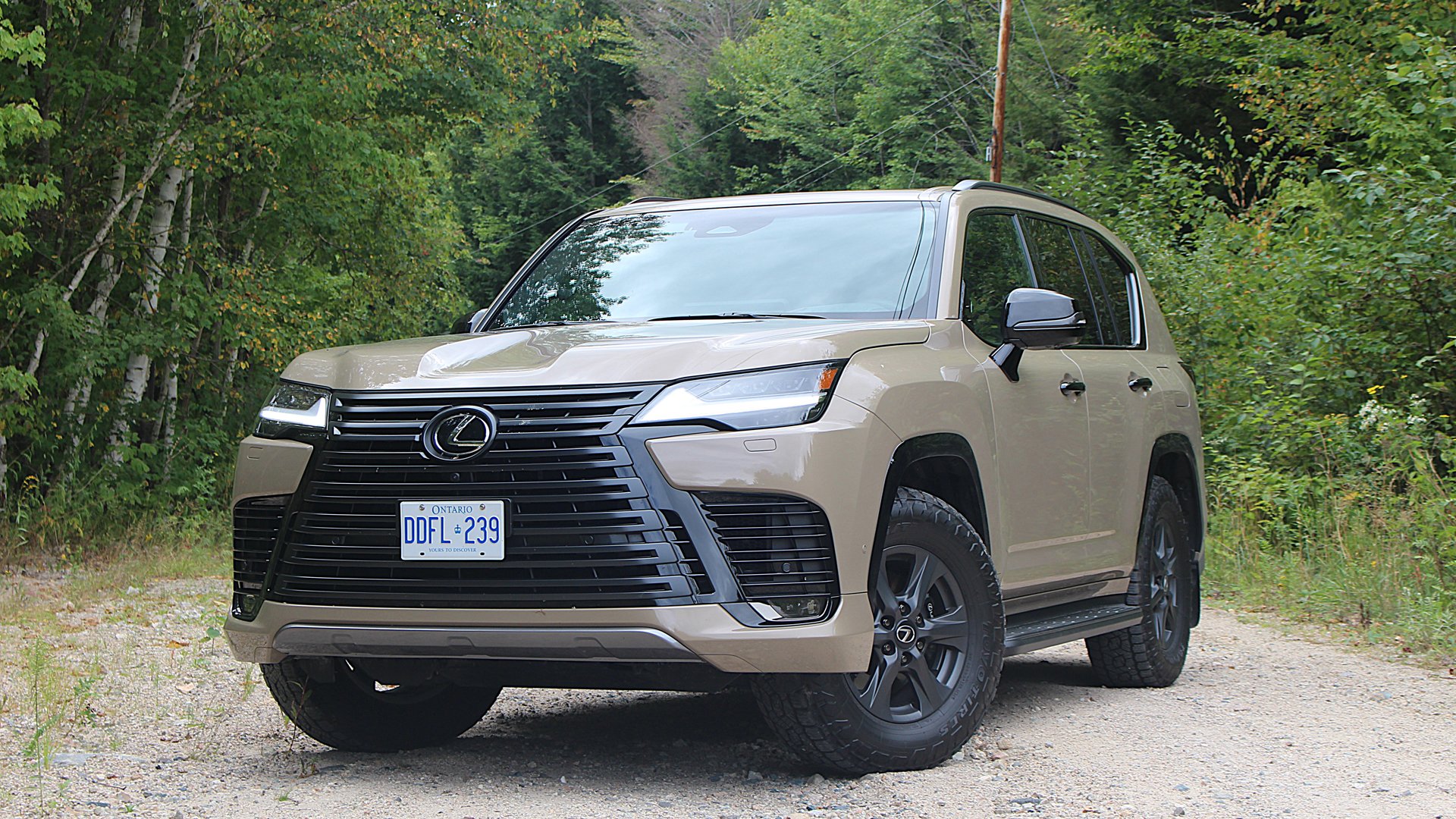
The 2025 Lexus LX is a luxurious large SUV that’s great for road tripping with the family, as long as you pack light.
Arguably, buying a full-size SUV is more of a want than a need for most people, and those needs are likely the result of another want. We need a big vehicle to haul our four kids, because we decided to have a big family. We need a truck or SUV to tow the boat or the camping trailer because we wanted to enjoy those recreational vehicles. And splurging for a luxury-brand SUV such as the 2025 Lexus LX, instead of a more-affordable one sold by a mainstream brand, is another want.

In this category, it’s normal for consumers to want the best, whatever best means for them. These behemoths provide space for everyone, four-wheel drive at the touch of a button, great towing capacity and the sense of safety that such a big vehicle can provide—though safety isn’t necessarily directly linked to size.
The 2025 Lexus LX competes with other luxury body-on-frame full-size SUVs such as the Cadillac Escalade, the Cadillac Escalade IQ, the GMC Yukon Denali, the Infiniti QX80, the Jeep Grand Wagoneer, the Lincoln Navigator, and the Mercedes-Benz G-Class. We can also throw in full-size crossovers like the BMW X7, the Mercedes-Benz EQS SUV, the Mercedes-Benz GLS and the Range Rover.

The LX is available with one of two powertrains. The LX 600 is equipped with a twin-turbocharged, 3.4L V6 that develops 409 horsepower and 479 pound-feet of torque, connected to a 10-speed automatic transmission and a four-wheel drivetrain. Meanwhile, the hybrid LX 700h gets a the same engine, but also an electric motor and a 1.87 kWh battery pack, for a total output of 457 horsepower and 583 pound-feet. According to the manufacturer, the former accelerates from 0 to 96 km/h (0-60 mph) in 6.9 seconds, while the latter accomplishes that feat in 6.4. The LX’s towing capacity is rated at 3,629 kilograms or 8,000 pounds.
Fuel economy ratings are as follows, and both powertrains require premium unleaded fuel:
| Powertrain | City/Highway/Combined L/100 km |
| Twin-Turbo 3.4L V6 | 14.2 / 10.8 / 12.7 |
| Twin-Turbo 3.4L V6 Hybrid | 12.5 / 10.7 / 11.7 |

The hybrid powertrain is more fuel-efficient, but the difference between the two engines is only 1 L/100 km. The LX 700h simply offers a little more power and a little more eco-friendliness over the LX 600. During our test of the LX 700h Overtrail+ trim level, which rides on all-terrain tires, we managed an average of 11.7 L/100 km. And our test included a round trip from Montreal to New Hampshire.
In Canada, the 2025 Lexus LX is offered in several trim levels. The LX 600 is available in Premium, F SPORT 1 and Luxury variants, while the LX 700h gets Overtrail+ and Executive VIP variants. The Overtrail+ can be chosen with room for five or seven passengers, the Executive VIP has five seats, and the rest of the model range are three-row, seven-passenger vehicles.

Standard features includes a LED exterior lighting, 20-inch alloy wheels, a height-adjustable suspension, a tow hitch, a power-sliding sunroof, rain-sensing windshield wipers, soft-close doors, a power-adjustable steering column, leather seat upholstery, heated and ventilated front seats, heated second-row seats, a heated steering wheel, a refrigerated center console box, a 12.3-inch digital driver instrument cluster, head-up display, a Lexus Interface infotainment system with a 12.3-inch touchscreen, wireless Apple CarPlay/Android Auto, connected services with a three-year trial and a surround-view camera system.
Since it’s a four-wheel-drive SUV, it also offers hill start assist, downhill assist control, low-speed Crawl Control and Multi-Terrain Select drive modes, all for heading off the beaten path—if that’s our thing. Options are numerous as well, such as 18-inch (Overtrail+) or 22-inch wheels, semi-aniline leather seating, interior wood or aluminum trim, front and rear massaging seats, ventilated second-row seats, power-folding second- and third-row seats, four-zone climate control, ambient lighting, a rear-seat entertainment system with dual screens and a Mark Levinson 25-speaker surround sound system.

In Canada, 2025 Lexus LX pricing ranges from $124,200 to $173,980, which includes freight and delivery charges, but excludes the $999 dealer fees and the Canadian luxury tax that applies to vehicles costing more than $100k. In the United States, the LX’s price ranges from $107,450 to $142,545, freight and delivery charges included.
Why You Should Buy a 2025 Lexus LX
- The LX offers good on-road ride comfort and great off-road capabilities, so there’s no sacrifice involved to obtain these two attributes. This despite our Overtrail+ tester being equipped with all-terrain tires. The LX’s 8,000-pound tow capacity is also pretty high, though behind the class-leading Grand Wagoneer (10,000 pounds) and the Lincoln Navigator (8,700 pounds). Both engines are smooth and powerful, while the vehicle is equipped with an artificial cabin engine sound system for more melodious accelerations—at least from inside the vehicle.
- The LX 700h’s hybrid powertrain is reasonably fuel-efficient with a combined average of 11.7 L/100 km, given the vehicle’s size and engine output. The full-size SUV segment leaders include the GMC Yukon Denali with its diesel engine (10.7 L/100 km) and the BMW X7 xDrive40i (10.7 L/100 km), and that’s excluding the fully electric models in the segment like the Escalade IQ and the EQS SUV, of course.

- Interior fit and finish is beyond reproach, though this is fully expected in this price class. Simply put, the LX doesn’t disappoint in this regard. There’s a mix of hard buttons and on-screen buttons for fiddling with the climate control system, but at least there’s temperature rocker switches. The optional Mark Levinson sound system is excellent.
- The LX currently enjoys the best reputation for reliability in its segment. That translates into lower maintenance costs in the long term and a higher resale value.

Why You Shouldn’t Buy a 2025 Lexus LX
- This is a big vehicle, and yet, there’s very little cargo space, especially when compared to the gigantic Escalade, Yukon Denali, Grand Wagoneer and Navigator. When the third row is occupied, there’s about just enough space for an umbrella. As that wasn’t enough, the tiny glovebox can’t hold the huge owner’s manual. The latter is stored in a leather pouch that ends up taking space in the cargo hold, as there isn’t anywhere else to put it.
- One of the main reasons to get a full-size SUV instead of a pickup truck is to carry the extended family. In this regard, once again, the LX disappoints as its third-row seats are small while their cushions are low to the ground so occupants sit with their knees way up, which isn’t a comfortable posture for longer trips. The second-row outboard seats are fine, but the middle occupant on that bench has to deal with a hump on the floor.

- Lexus’ infotainment system is generally user friendly. However, some features are buried in multiple menu layers, such as the massaging seat controls. Meanwhile, the surround view camera button is located on the left side of the steering wheel, which isn’t the best place for it when we’re in the middle of a parking manoeuvre.
- The Toyota and Lexus brands are known for their reliable and durable products, and that advantage is also one of their disadvantages. Many of their models are prone to theft, meaning owners must take extra precautions such as installing a steering wheel theft-deterrent device, keep the keyfobs in a Faraday box at home and park in well-lighted or crowded areas. No luxury utility vehicle is safe from thieves, but Lexus models seem to be targeted vehicles.

Should You Buy a 2025 Lexus LX?
The LX is an enjoyable luxury rig. It’s big, but not as gargantuan as its GM, Ford and Jeep rivals, so it’s a little easier to navigate around the shopping mall parking lot. It feels solid, safe and substantial, as if it will last forever with regular and rigorous maintenance. It’s also comfortable and a great road tripper, with good towing capacity to boot. It satisfies a mix of needs and wants.
On the other hand, its cargo capacity is the lowest in its class, and the third-row seats aren’t very accommodating despite the LX being a full-size vehicle. There’s also the question of price, as the LX is more affordable than the Range Rover and the G-Class, but costs more than the Grand Wagoneer, the Yukon Denali and the QX80.




| Specifications | |  |  |  |  |
|---|---|---|---|---|---|
| 2025 Lexus LX | 2025 Cadillac Escalade / ESV | 2025 Infiniti QX80 | 2025 Range Rover RWB / LWB | 2025 Lincoln Navigator / L | |
| Price Range Before Options and Luxury Tax ($CAD) | $124,200 to $173,330 | $120,899 to $214,699 | $107,490 to $127,490 | $135,250 to $272,800 | $125,895 to $129,895 |
| Engines | - Twin-Turbo 3.4L V6 - Twin-Turbo 3.4L V6 HEV | - 6.2L V8 - Supercharged 6.2L V8 | - Twin-Turbo 3.5L V6 | - Turbo 3.0L I6 MHEV - Turbo 3.0L I6 PHEV - Twin-Turbo 4.4L V8 | - Twin-Turbo 3.5L V6 |
| Output (hp) | 409 to 457 | 420 to 682 | 450 | 395 to 606 | 440 |
| Torque (lb-ft) | 479 to 583 | 460 to 653 | 516 | 406 to 590 | 510 |
| Combined Fuel Economy (L/100 km) | 11.7 to 12.7 | 15.0 to 17.7 | 13.8 | 11.0 to 13.2 | 13.5 |
| Wheelbase (mm) | 2,850 | 3,071 / 3,407 | 3,075 | 2,997 / 3,197 | 3,112 / 3,340 |
| Length (mm) | 5,095 | 5,383 / 5,765 | 5,365 | 5,052 / 5,252 | 5,334 / 5,636 |
| Width (mm) | 1,990 | 2,059 | 2,115 | 2,047 | 2,032 |
| Height (mm) | 1,895 | 1,948 / 1,941 | 1,945 | 1,867 | 1,981 |
| 1st-Row Headroom (mm) | 960 | 1,074 | 993 | 999 | 973 |
| 2nd-Row Headroom (mm) | 990 | 988 | 960 | 997 / 1,005 | 963 |
| 3rd-Row Headroom (mm) | 895 | 970 | 919 | N.A. | 950 |
| 1st-Row Legroom (mm) | 1,045 | 1,131 | 1,112 | 1,013 / 1,014 | 1,105 |
| 2nd-Row Legroom (mm) | 930 | 1,060 | 995 | 1,027 | 1,067 |
| 3rd-Row Legroom (mm) | 790 | 886 / 933 | 835 | 864 | 1,105 |
| Cargo Volume Behind 1st Row (L) | 1,772 to 2,010 | 3,412 / 4,027 | 2,860 | 1,841 / 2,050 | 3,030 / 3,443 |
| Cargo Volume Behind 2nd Row (L) | 877 to 1,303 | 2,065 / 2,665 | 1,670 | 818 / 857 | 1,979 / 2,393 |
| Cargo Volume Behind 3rd Row (L) | 205 to 311 | 722 / 1,175 | 623 | - / 212 | 648 / 1,059 |
| Towing Capacity (kg) | 3,629 | 3,674 | 3,856 | 3,500 | 3,946 |
