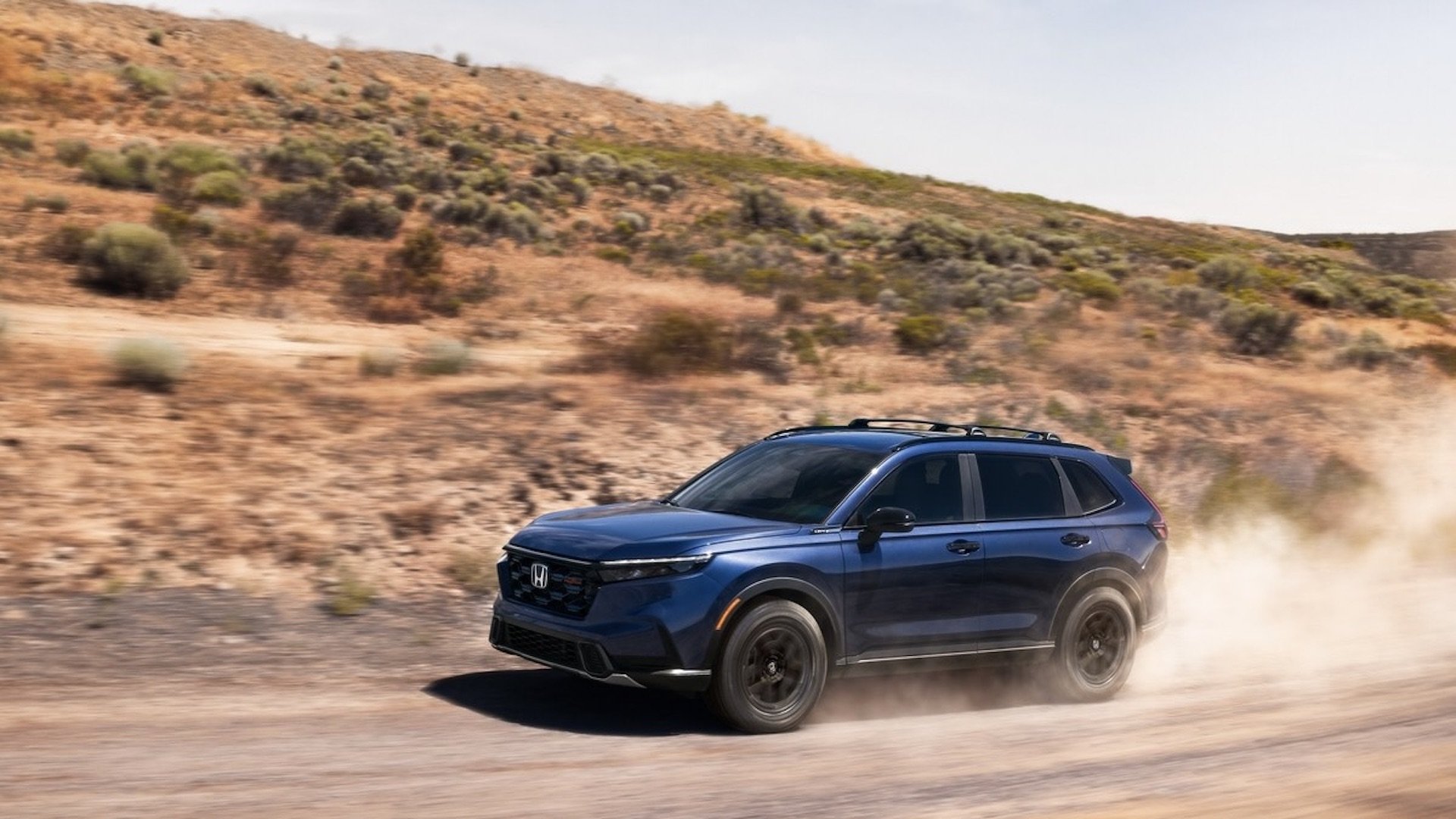
Honda’s hybrid system doesn’t run like the others. While most automakers rely on a planetary gear system, like Toyota’s, Honda chose a two-motor architecture instead- simpler on paper, but completely against the grain. The result? A different approach that shows there’s more than one way to build an excellent hybrid system.
Two electric motors linked through an architecture different from Toyota’s planetary gear system.
A clutch that locks the gas engine directly to the drive wheels at cruising speed.
A philosophy built on mechanical simplicity rather than versatility.
How the e:HEV system works today
The system relies on two electric motors and three driving modes (electric, hybrid and engine). At low speed, the vehicle runs in series mode: the gas engine acts as a generator, while electricity propels the wheels. At cruising speed, a locking clutch connects the combustion engine directly to the wheels. This means it eliminates the need for a conventional automatic transmission. The hybrid propulsion system takes care of the rest.
An architecture that stands apart from the rest of the industry
Toyota’s planetary gear set continuously doses the split between gasoline and electricity, no matter the speed. Honda, on the other hand, simplifies things at cruising speed with its direct connection: two philosophies, two ways of reaching the same goal. Honda’s bet is a simpler mechanical architecture aimed at limiting losses under certain operating conditions, at the cost of somewhat less versatility in mixed driving.
Honda Recalls 325,000 Odyssey Minivans Over Defective Backup Cameras
What it looks like on the road
The table below compares four compact and midsize sedans well known to Quebec drivers. The Camry (front-wheel-drive version) shows identical averages in the city, on the highway, and combined, reflecting the efficiency of Toyota’s hybrid system. Honda vehicles show a different profile, with a slight city advantage that fades somewhat on the open highway.
| Model | City (L/100 km) | Highway (L/100 km) | Combined (L/100 km) |
| Toyota Camry Hybrid (FWD) | 4.9 | 4.9 | 4.9 |
| Toyota Prius (AWD) | 4.8 | 4.7 | 4.8 |
| Honda Accord Hybrid | 5.0 | 5.7 | 5.3 |
| Honda Civic Hybrid | 4.7 | 5.1 | 4.8 |
What the numbers don’t tell you
Official figures come from laboratory testing, not the road. The official city cycle assumes standardized driving, without the congestion, cold starts and extended idling that come with real-world traffic, conditions that hurt real-world consumption far more than the rating suggests. Highway averages are fairly accurate, but they don’t account for the drives we do around town, often at average speeds of 70 to 80 km/h. And that’s exactly where Honda’s system truly shines. In tests I ran recently with the Civic and Accord, I got impressive numbers on country roads and secondary routes where speeds rarely exceeded 90 km/h. As a result, I ended up with a better consumption rating on these routes than in the city, something much harder to achieve with a Toyota. That’s no coincidence. It’s exactly the speed range where Honda’s locking clutch is most at ease, with the gas engine turning under a light, steady load, free of both the constant transitions of city traffic and the aerodynamic penalty of true highway speed.
Here are the results from trips of about 100 km each.
| Model | City (L/100 km) | Secondary roads, 70-80 km/h avg. (L/100 km) |
| Honda Civic Hybrid | 4.3 | 3.9 |
| Honda Accord Hybrid | 6.0 | 4.8 |
Advantages and drawbacks
With Honda‘s system, the wheels are driven by the electric motor in most driving situations. The gas engine then mainly acts as an onboard power plant rather than a direct source of propulsion.
The advantages: a smooth, quiet ride without the flare-ups sometimes associated with continuously variable transmissions, and a relatively simple mechanical architecture.
The drawback: Honda’s system is a bit less flexible than Toyota’s planetary gear set in finely dosing energy under certain conditions.
So it comes down to figuring out what most of your driving looks like, to know which system, Honda or Toyota, will give you the best fuel economy.
What’s interesting is that Honda never set out to copy Toyota’s recipe. It preferred its own, even if that meant swimming against the current.