At Subaru, all-wheel drive is part of the brand’s identity. The company built its reputation on the quality of its systems, and its customers always expect more on that front. That is why Subaru often delivers more, as it does with its X-Mode function. This setting adds an extra layer of capability for drivers who want a vehicle that performs better than average in certain specific situations.
X-Mode first appeared in 2014 on the Forester
There are different configurations of the system, depending on the model
Using it and benefiting from it require no effort from the driver
On an icy slope or muddy trail, how power is managed matters as much as the number of driven wheels. That is precisely the role of X-Mode.
Relatively Recent
X-Mode debuted on certain trims of the 2014 Forester. Early on, it was paired with models equipped with the Lineartronic CVT. Today, it even works on the all-electric Solterra.
The Outback adopted it the following year, and the system then spread across the lineup. In 2019, the fifth-generation Forester introduced a version offering two distinct settings: one for snow and dirt, the other for deep snow and mud.
How it works
X-Mode activates with a simple button press or through the touchscreen, depending on the model. It then acts on several components at once. For example:
- It modifies throttle response to smooth it out and limit wheelspin.
- It changes how the CVT operates, favouring a shorter gear ratio, somewhat as if it were imitating a low range.
- It optimizes torque distribution between the front and rear axles, while reacting more quickly for greater effectiveness.
- On the braking side, traction control steps in earlier to brake the spinning wheel and send torque to the wheels with more grip.
Added to these functions is a hill descent control system, which automatically modulates braking on steep downhill grades. X-Mode is designed for low-speed driving. It deactivates automatically above a certain speed (around 30 km/h).
Tech in a Flash: The Secret Behind the IIHS Top Safety Pick Qualification Criteria
What sets it apart
The difference lies mainly in the mechanical configuration of the all-wheel-drive system. On many competing models, all-wheel drive is primarily on demand, with a clutch that can vary how much the rear axle engages depending on conditions. At Subaru, Symmetrical All-Wheel Drive is full-time. As a result, X-Mode does not activate all-wheel drive. When engaged, it fine-tunes a system that is already working.
Subaru also focused on simplicity. One button, one or two settings, and the electronics handle the rest. There is no low range and no locking differential: this is not a hardcore off-road system.
It never claimed to be.
Its strengths
Its greatest quality is its accessibility. The driver does not need off-road experience to benefit from it. In fact, the driver can concentrate on controlling the vehicle and let the system manage traction.
On a rough trail, when driving at low speed during a snowstorm, or on an icy road with a steep grade, it adds a level of confidence for the driver.
From one trim to another
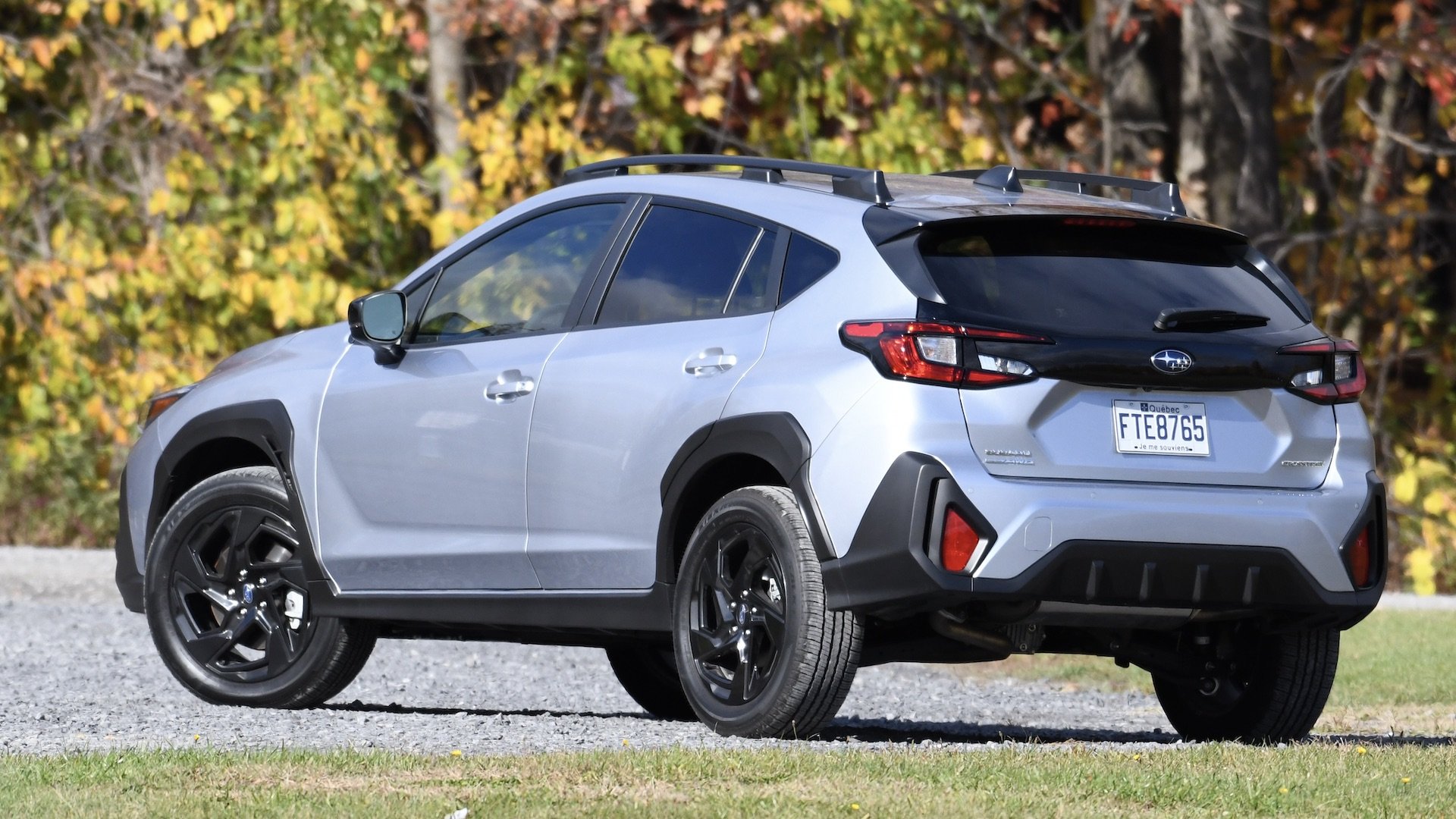
Not all X-Mode systems are identical. On the 2026 Crosstrek, the Convenience and Touring trims get the single-mode system, while the Onyx and Limited trims benefit from the dual-mode version.
The same logic applies elsewhere in the lineup: entry-level trims generally get the simplified version, while the more upscale or adventure-oriented trims (Wilderness) get the more advanced system.
Don’t look for this mode on the sporty WRX, though, since it wasn’t built for off-road trails. As for the BRZ, forget it: it is a rear-wheel-drive model.
Discreet, simple and effective, X-Mode reflects Subaru’s philosophy: delivering real capability without asking anything of the driver.