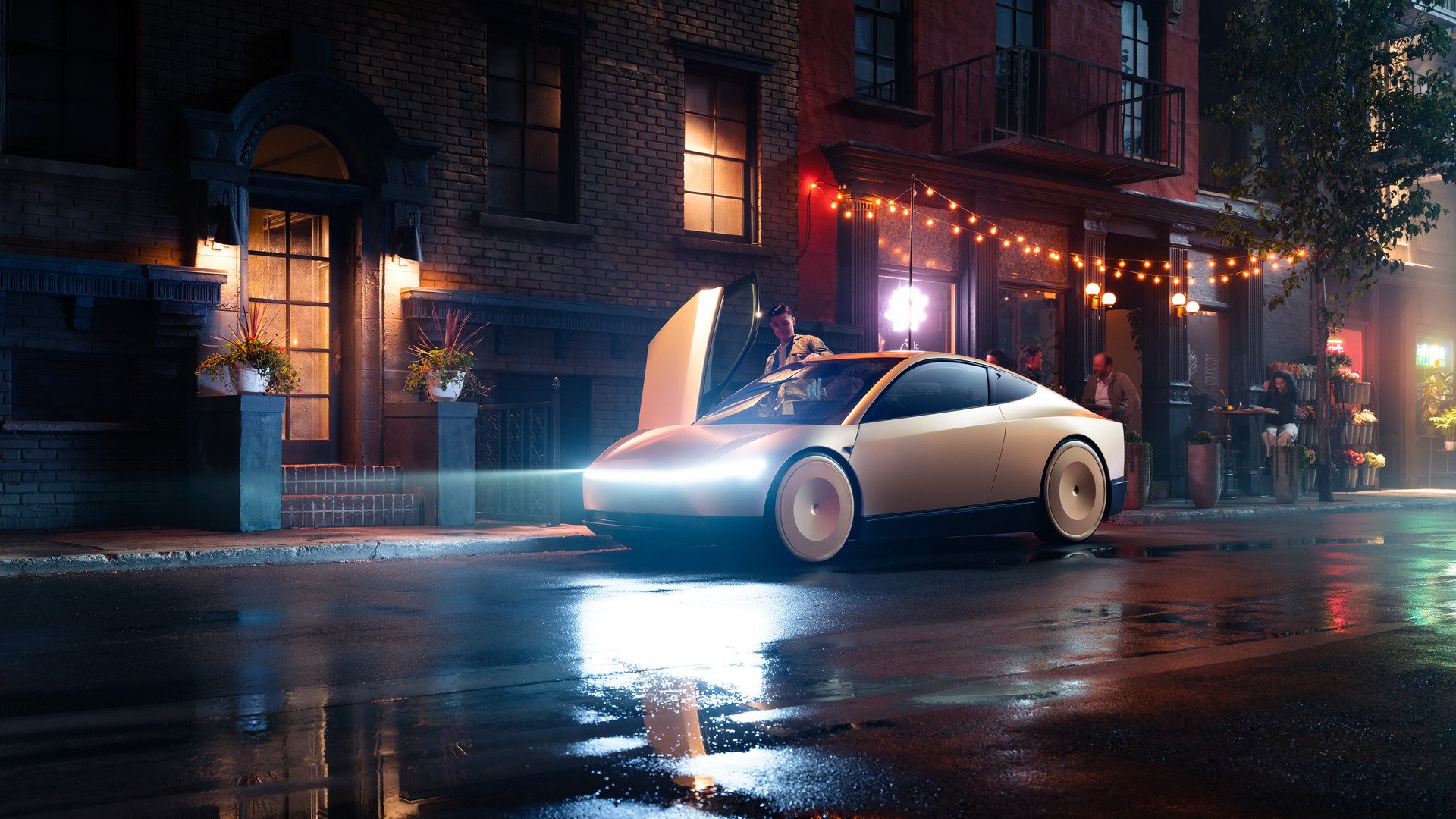
The Tesla Cybercab has no hydraulic brakes. No fluid, no lines, no master cylinder. Tesla simplifies the assembly line, with fewer parts to install and more work in parallel. A small electric motor, in each caliper, clamps the disc in this two-seat autonomous taxi, with no steering wheel or pedals, that Tesla runs in its Robotaxi service.
- The Cybercab is the first Tesla to eliminate the entire hydraulic brake circuit.
- The Chery Exeed EX7 has been on sale in China since April 2026. It uses a dry brake, on all-wheel-drive versions only.
- NHTSA opened an audit in early September 2026. Tesla self-certified about 1,000 Cybercab vehicles with no steering wheel or pedals. The agency is asking whether that is legal. This is not an investigation of the brake.
Tesla builds it in modules. That is its Unboxed process. Front, rear and structural battery move forward in parallel, then the three are joined. It remains a novelty in the history of automotive assembly. Running hydraulic lines from one end to the other is not impossible. It is just more complex than the chosen solution.
The company justified it the same day; electric brakes avoid running hydraulic lines all through the car.
 Tesla Cybercab Interior | Tesla Canada
Paid rides started in Austin in early September 2026, after a private launch the day before. The Texas registry listed 45 Cybercab vehicles registered and in service. The service area is limited to the city of Austin for now. Hundreds of Model Y vehicles also run on the Robotaxi network. You do not necessarily hail a Cybercab. That is the nuance.
A small motor clamps the disc
Usually, pads pinch a disc. Fluid in hydraulic lines does the work. You press, the fluid pushes, friction braking takes hold and the car slows down. In the Cybercab, that circuit no longer exists. A small electric motor, attached to the caliper at each wheel, clamps the disc on its own. The autonomous driving computer handles the closed-loop control.
The discs and pads stay. Only the plumbing and the hydraulic components come out.
Tesla has published neither clamping force nor response time. Nothing on stopping distance either.
In town, regenerative braking at the front wheels does most of the work. The friction brake mainly handles emergency stops and holding the vehicle still.
 Tesla Cybercab | Tesla Canada
Why remove hydraulic brakes: the Unboxed process
Tesla is not dropping hydraulics for fun. The GigaTexas plant in Austin builds the Cybercab in modules. The front on one side. The rear on the other. The structural battery in the middle, seats already mounted. The three are assembled at the end at a marriage station.
The exterior panels are plastic, injection-molded. Body color is already in the material.
Which means: no steel sheet to stamp, and no paint shop either. In a conventional plant, that is often the biggest building, the most expensive, the longest. Here, the car does not go through it.
Product engineer Eric Earley said at the launch: the Unboxed process shortens the line by about 50% and raises the pace. Less floor space. Fewer parts to install. More work in parallel.
A hydraulic line that runs the length of the body breaks that layout. A motor in each caliper, a cable, and each module finishes on its own.
 Tesla Cybercab brake caliper | Nic Cruze Patane
Ford is playing the same game in Louisville for the Ford Fathom, its compact electric pickup. Ford calls it an assembly tree. The plant assembles the front, the rear, and the battery in parallel, each on its own side, then marries them. Like Tesla. Ford has not said it would remove hydraulic brakes. Nothing is announced; this is only speculation on my part.
The hydraulic safety net is gone
Many EVs already have a pedal that is little more than a sensor. A hydraulic circuit and a master cylinder remain as a safety net. The current Model Y keeps two master cylinders. Think of the Cybertruck, already sold here. The steering is electric, with no mechanical column. The brakes themselves remain hydraulic.
The Cybercab cuts that net. If the electronics die, a hydraulic circuit can still be pushed at the pedal. A fully electric brake cannot. Here, there is no driver. Safety rests entirely on electrical redundancy of the power supplies, controllers, and actuators. Tesla has published no schematic.
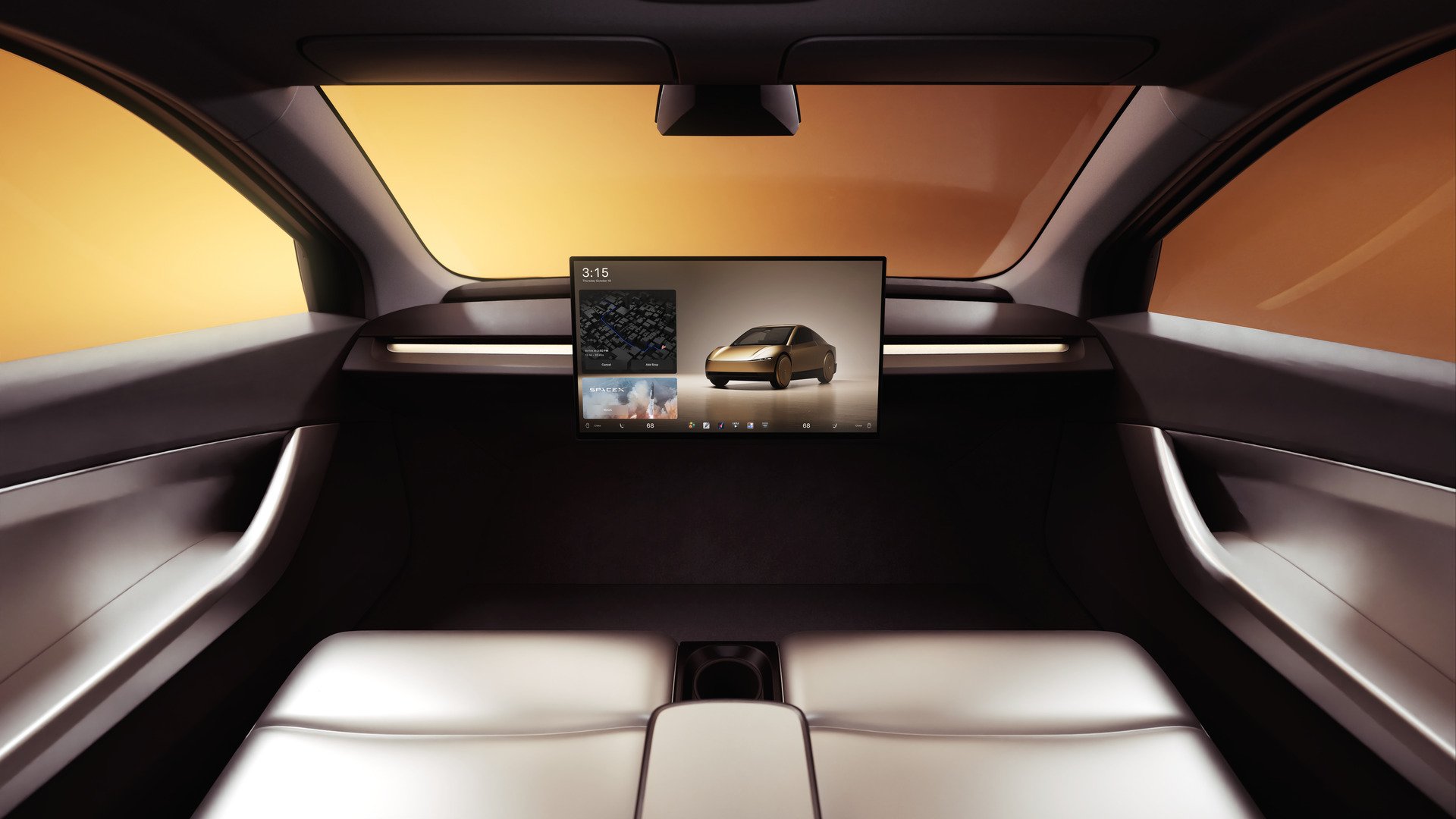 Tesla Cybercab Interior | Tesla Canada
China brought the dry brake to market before Tesla
Tesla did not invent the dry electric brake. The Chery Exeed EX7, Chery’s premium brand, has been on sale in China since April 2026 with a comparable electromechanical system. Only on all-wheel-drive versions. Rear-wheel-drive versions keep six-piston hydraulic calipers.
The Cybercab is the first Tesla vehicle to do it. Tesla is the first Western manufacturer to put a fully electric brake into service.
 Exceed EX7 | Chery Global
NHTSA is looking at the steering wheel, not the caliper
In early September 2026, the U.S. highway safety agency (NHTSA) opened an audit query, AQ26002, on about 1,000 Cybercab vehicles. Tesla self-certified the vehicle under current federal standards. The agency wants to know whether Tesla deemed some standards inapplicable, including those for the steering wheel, pedals, and mirrors. The standards in force remain in force, it reminded.
This is not an investigation of a defect in the electric brake. The agency is checking whether Tesla has the right to self-certify a car with no steering wheel and no pedals. If the answer is no, the Austin operation hits the rule and will have to change strategy.
On June 25, 2026, NHTSA proposed removing the requirement for a manual control on vehicles designed solely around an autonomous driving system.
Another player in autonomous mobility Zoox applied for an exemption. Granted in July 2026, capped at 2,500 vehicles per year for two years. Tesla did not apply for an exemption.
2028 Ramcharger Expected to Share Hardware With Grand Wagoneer
No Cybercab in Canada
For now, the Cybercab is not in Tesla Canada’s catalog. No autonomous taxi here, no availability date. Admittedly, the Robotaxi app can be downloaded. The waitlist points to Austin and the San Francisco Bay Area.
Transport Canada self-certifies under a regime close to the American method. A spring 2026 consultation covered vehicles with no steering wheel or pedals. A Canadian transposition is targeted around 2027. It is not yet written into law. An imported Cybercab would run into current rules.
In Ontario, the automated commercial vehicle pilot still requires a steering wheel and pedals, except with a federal exemption. Quebec has no framework for a driverless taxi. You will not be getting into a Cybercab in Montreal anytime soon.
The dry brake is in service, not yet in volume production. A taxi that runs 24 hours a day no longer has fluid to drain. The actuators, sensors and computers become the wear parts.
Would this be yet another paradigm shift waiting for the auto industry?