

The new 2025 Nissan Kicks replaces the outgoing Qashqai by being larger and by offering all-wheel drive.
The Volkswagen Taos receives styling and mechanical updates for the new model year.
Both SUVs offer practicality, style, and technology at a fairly affordable price.
The subcompact SUV segment is one of the most popular and most competitive in the North American market, with many new or refreshed models being added every year.
For 2025, the race will get even more competitive, with the launch of a brand-new Nissan Kicks and a refreshed Volkswagen Taos.
Here is a closer look at how these two new models compare:
An overview of the new Kicks
 2025 Nissan Kicks SR Premium | Photo: Anthony Lemonde
While the old Nissan Kicks was a very small, front-wheel drive-only subcompact crossover, the new model is a larger SUV, with available all-wheel drive, which effectively replaces the outgoing Qashqai in the brand’s lineup. Since the old Kicks returns as the entry-level Kicks Play this year, this leaves the new model free to target a slightly higher price bracket, putting it right in line with the Volkswagen Taos. In terms of design, the 2025 Nissan Kicks is light years ahead of its predecessor, exhibiting a modern and more muscular appearance that was reportedly inspired by sneaker culture. This can be seen in the ribbed pattern on the lower body cladding and the six vibrant two-tone paint options.
An Overview of the refreshed Taos
 2025 Volkswagen Taos | Photo: Volkswagen
Over at Volkswagen, things have changed for 2025 too. Indeed, despite the Taos returning in the same basic configuration for the new model year, it has received fairly significant updates aimed at making it more competitive with newer entries in the segment, such as the 2025 Nissan Kicks. Since its launch in 2020, the Volkswagen Taos has occupied the bottom of the Volkswagen SUV lineup in terms of size and price, since the brand doesn’t have a model to compete with the likes of the Kicks Play or the Hyundai Venue. From the outside, the main changes are found up front, where the 2025 Taos displays revised headlamps, a new bumper, and a larger grille in order to better mesh with the brand’s other recent products, such as the 2025 Jetta and the ID.4. The rear end also receives a new full-width light bar and the interior sees revised colour combos along with new tech features.
Powertrains and driving impressions
 2025 Nissan Kicks SR Premium | Photo: Anthony Lemonde
Nissan and Volkswagen have two different philosophies regarding the mechanical elements of their respective small SUVs, with the Japanese automaker going after maximum efficiency and better around-town driveability, while the German one targets more driver enjoyment and better highway capabilities. This starts with what’s under the hood of both models. In the 2025 Nissan Kicks, we can find the same 2.0L naturally-aspirated four-cylinder engine that used to power the Qashqai. Paired with a re-tuned Xtronic CVT transmission, this powertrain delivers 141 horsepower and 140 lb-ft of torque to the front wheels or all wheels with the optional all-wheel drive, which can send up to 50% of engine torque to the rear axle. In the Taos, a smaller but turbocharged 1.5L four-cylinder engine takes place as it did before, but now with an increase in horsepower up to 174 and the same 184 lb-ft of torque. Another change is the replacement of the clunky 7-speed DSG dual-clutch transmission, which is succeeded by a traditional eight-speed automatic unit in front-wheel drive and all-wheel drive versions.
 2025 Volkswagen Taos | Photo: Volkswagen
Its responsive low-speed acceleration and smoother CVT transmission make the Nissan Kicks better suited to dense city traffic, as do its quick steering and smaller overall size. While still plenty competent out on the highway, the Kicks feels a little bit out of its element when the speed increases since its transmission has to make the engine work quite hard to accelerate down an on-ramp or up a hill, which results in more noise and less movement than we’d like. On the other hand, the Volkswagen Taos offers more substantial performance at higher speeds, making passing on country lanes safer and the overall experience more refined. In the city however, the Volkswagen can’t quite match the smoothness of the Nissan.
Something that both models have in common is their suspension settings, which are definitely on the firmer side. If this would normally result in a crashy ride, it isn’t the case here, with both the Kicks and the Taos providing adequate cushioning over the largest road imperfections. This also results in quite good handling characteristics for both SUVs, but here again, the Taos has a slight edge.
 2025 Nissan Kicks SR Premium | Photo: Anthony Lemonde
Where the Kicks unequivocally wins is in terms of fuel consumption, however, as its more modest mechanical elements pay off. According to RNCan, the front-wheel drive 2025 Nissan Kicks uses 8.1 L/100 km on average in the city and 6.6 L/100 km on the highway. Adding all-wheel drive results in a slight increase to 8.4 L/100 km and 6.9 L/100 km, respectively. This is still better than the 2025 Volkswagen Taos, which requires 9.4 L/100 km in the city and 7.2 L/100 km on the highway with AWD. Figures for the front-wheel drive Volkswagen are not yet available.
Dimensions and interior space
 2025 Nissan Kicks SR Premium | Photo: Anthony Lemonde
Looking at the specifications of both the 2025 Nissan Kicks and 2025 Volkswagen Taos reveals a few surprises. First of all, the Kicks is among the smallest models in the segment from the outside, since it doesn’t quite match the size of the older Qashqai. Interestingly, the Taos is at the other end of the segment by being one of the largest models in the category, almost copying the dimensions of the first-generation Tiguan. While this makes the Kicks more maneuverable around town, the Taos is very boxy and offers great visibility, so the advantage is not so clear-cut.
 2025 Volkswagen Taos | Photo: Volkswagen
Inside, the Nissan Kicks is not as cramped as you might think and it actually offers significantly more legroom and almost as much headroom for the front occupants as the Taos. The Volkswagen has the advantage in terms of rear legroom, headroom and overall shoulder room, however. This means that while the Kicks can accommodate four adults in reasonable comfort, the Taos is better suited for small families or those who need to drive around with passengers quite often.
In another twist, the Nissan has a larger cargo compartment, at least in the front wheel drive models. Indeed, with up to 850 litres of space behind the rear seats, the Kicks beats the Taos’ 790 litres capacity quite handily. Folding the rear seats does result in the Taos winning this battle however, with up to 1,866 litres against 1,699 litres.
Interior design and technology
 2025 Nissan Kicks SR Premium | Photo: Anthony Lemonde
Technology is among the top priorities for subcompact SUV buyers, and here again, Nissan has made a huge stride with its 2025 Kicks. Even in the entry-level S version, buyers will benefit from a large 12.3-inch infotainment touchscreen with standard wireless Apple CarPlay and Android Auto. The SR Premium trim level adds a second 12,3-inch display for the instrument cluster, other models make do with a 7-inch unit. A Wireless phone charger is also included starting from the SV version, and a 10-speaker Bose premium audio system with speakers integrated into the front headrests comes with the SR Premium. This sound system is one of the highlights of the Kicks, surpassing pretty much every competing system in its price class. The 2025 Nissan Kicks also boasts a much-improved atmosphere inside, with plenty of padded materials, a more modern look, and comfortable Zero-Gravity seats. The SR Premium version also adds visual interest with its bright red accents, carbon fibre-like leatherette accents, and black and red checkered upholstery.
 2025 Volkswagen Taos | Photo: Volkswagen
Volkswagen has also improved the tech situation in the Taos this year by making the previously available 8-inch touchscreen standard across all trims, complementing the 8-inch Digital Cockpit instrument cluster, which is also standard. While this is a marked improvement, the Taos is still behind the Kicks in this respect, especially since its infotainment system is less intuitive. On the other hand, the Digital Cockpit makes up for its smaller size by being much more configurable and informative than even the Kicks’ largest driver information screen. As with the exterior, the interior of the 2025 Volkswagen Taos is more sedate than the Kicks, but also more mature, making both vehicles appeal to different tastes. Seats in the Taos are supportive for long drives, but not as well padded as those in the Kicks. Another improvement made by Volkswagen this year is the addition of the full IQ Drive suite of driver assistance technologies to all versions of the Taos, including the Travel Assist semi-autonomous system
In comparison, Nissan makes buyers pay for some of these features by reserving them for higher trim levels. In fact, the ProPilot Assist system, comparable to VW’s Travel Assist, is available only in the SR Premium.
Pricing and value
 2025 Nissan Kicks SR Premium | Photo: Anthony Lemonde
Unsurprisingly, the 2025 Nissan Kicks is the more affordable of the two options presented here, but not by much. Indeed, Nissan priced its latest SUV from $27,199 on the Canadian market, with all-wheel drive being a $2,000 option. The mid-level SV version adds items such as the wireless charging pad, remote engine start and the heated steering wheel for an MSRP of $28,749. The top-level SR Premium trim level rounds out the lineup with more driver assistance tech, the panoramic sunroof, the 12.3-inch driver information display, the Bose sound system, and standard all-wheel drive, priced at $34,899.
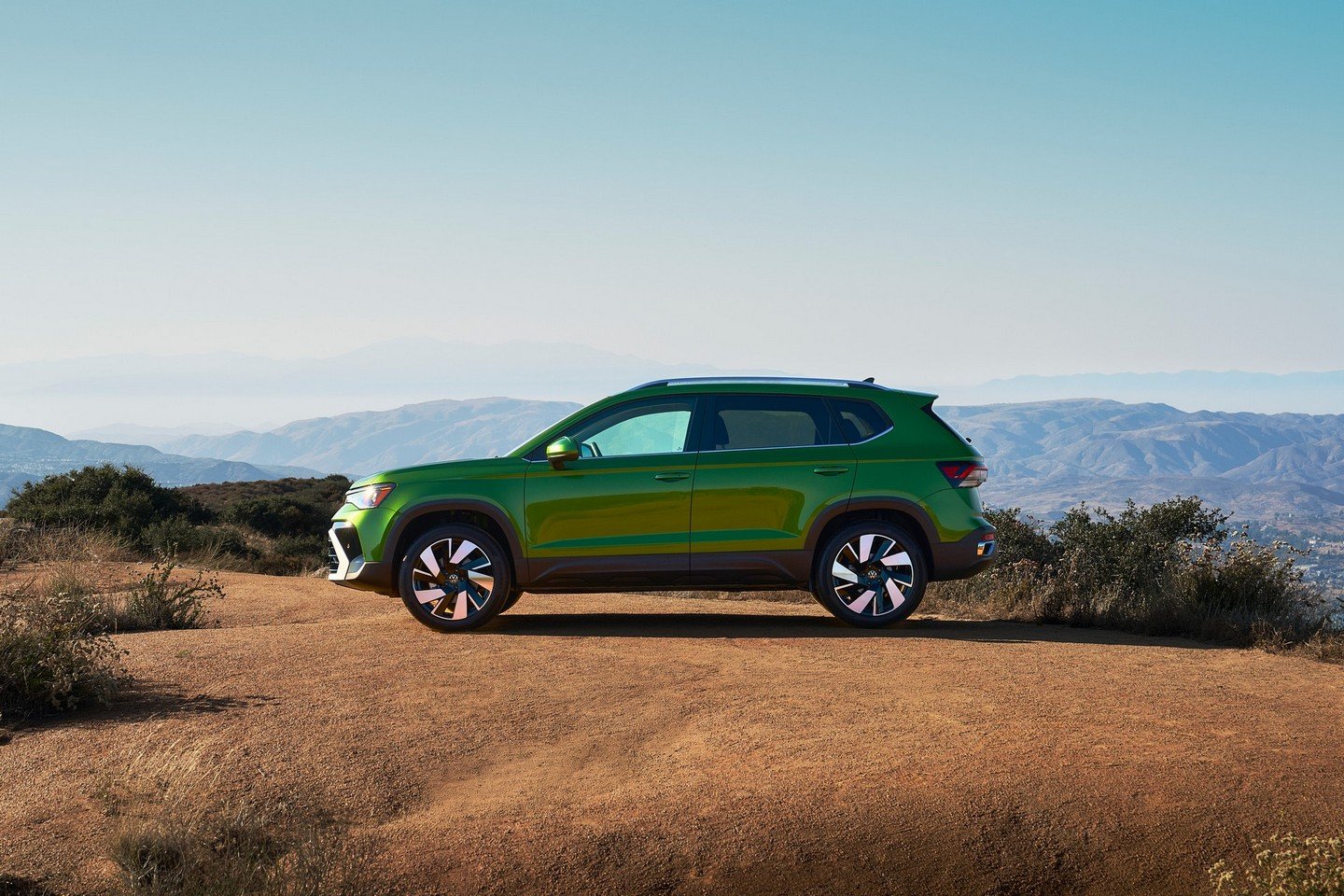 2025 Volkswagen Taos | Photo: Volkswagen
Those looking for a 2025 Volkswagen Taos will need to spend at least $29,795 for an entry-level Trendline front-wheel drive model. Adding all-wheel drive is also a $2,000 extra. The Comfortline version brings features such as electronic climate control, a power driver’s seat, and keyless entry and start, among others, for $35,295, with standard 4Motion AWD. Moving up to the $36,995 Comfortline Black Edition adds a few more features and numerous black accents around the outside for a sportier look. Finally, the Taos Highline justifies its $38,995 price tag with exclusivities like a Beats Audio premium sound system and larger alloy wheels.
Conclusion
 2025 Nissan Kicks SR Premium | Photo: Anthony Lemonde
Choosing between the 2025 Nissan Kicks and Volkswagen Taos can be a difficult task given that both models have a lot to offer. In addition to personal design preference, buyers’ choice should be impacted by their intended use of the vehicle. For example, those who prioritize efficiency, style, modernity and technology will be better served by the new Nissan Kicks while those who want more passenger space and better driving dynamics might want to take a look at the Taos. No matter which one you end up buying, rest assured that you will get behind the wheel of a competent small SUV.

