

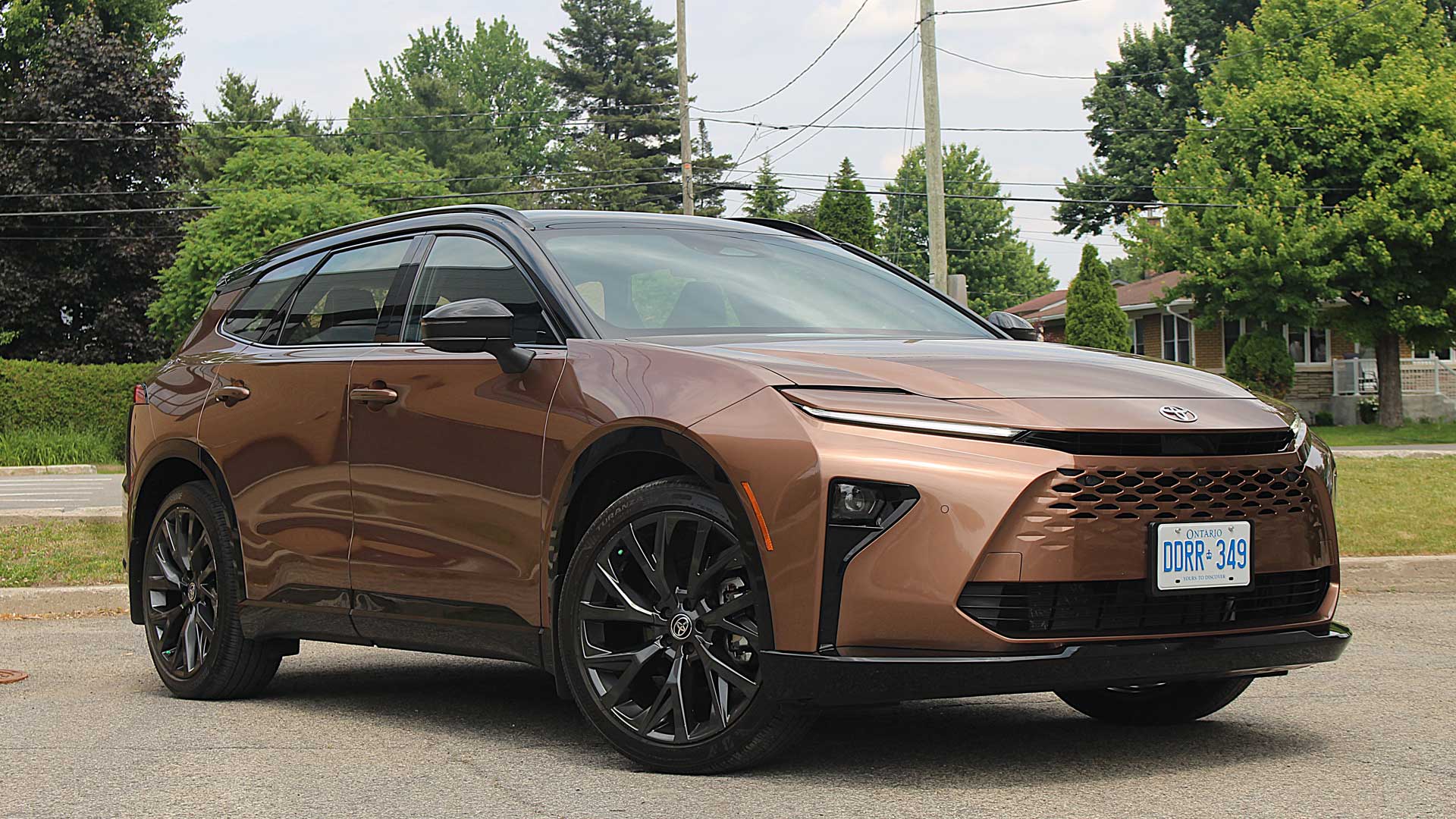
The 2025 Toyota Crown Signia offers a serene driving experience and low fuel consumption, but might be a little too discreet for its own good, and its market positioning may confuse shoppers.
Midsize two-row crossovers have been losing ground to the slightly bigger, three-row models recently. However, that doesn’t mean the segment is doomed, at least not yet. The 2025 Toyota Crown Signia falls into said category, but the brand’s lineup is already chock full of utility vehicles big and small, each trying to appeal to its own specific target audience.

In Toyota’s North American portfolio, the five-passenger Crown Signia indirectly replaces the Toyota Venza. It’s bigger than the Toyota RAV4, but smaller than the three-row Toyota Highlander and Toyota Grand Highlander. It’s equipped with a hybrid powertrain unlike the fully electric Toyota bZ4X. And its focuses more on on-road luxury than the off-road-focused Toyota 4Runner. The brand offers something for everyone, but that much segmentation obviously leads to small sales volume for each model—save for the wildly popular RAV4.
The Crown Signia competes with other two-row midsize crossovers such as the Chevrolet Blazer, the Honda Passport, the Hyundai Santa Fe (yes, it has three rows, but it’s smaller than the Palisade), the Kia Sorento (yes, it has three rows, but it’s smaller than the Telluride), the Mazda CX-70, the Nissan Murano, the Subaru Outback, the Volkswagen Atlas Cross Sport and Toyota’s own 4Runner. Shoppers who see the Crown’s penchant for luxury might also consider models from Buick, Cadillac, Infiniti, Jeep and Lexus.

But wait—is the Crown Signia really a crossover? Its low and flat roofline makes it look more like a station wagon. In addition, both the EPA and Transport Canada classify it as a wagon, though Toyota says it’s a sport utility vehicle, likely to appeal to a wider audience. We’ll let you figure it out, but truthfully, it doesn’t necessarily need to be classified. It is what it is.
To further set itself apart, the 2025 Toyota Crown Signia is equipped with a hybrid powertrain consisting of a 2.5L four-cylinder engine, two electric motors, a 1.1 kWh battery and an electronically controlled continuously variable automatic transmission, creating an all-wheel drivetrain and producing a combined 240 horsepower. The manufacturer claims a 0-to-60 mph (0-96 km/h) time of 7.1 seconds using 91-octane fuel, though the system runs fine on 87-octane regular.

Speaking of which, the Signia boasts city/highway/combined fuel economy ratings of 6.0 / 6.3 / 6.2 L/100 km. In its competitive set, it’s the most efficient overall, beating the Santa Fe Hybrid (6.9 L/100 km combined), the Sorento Hybrid (7.0 L/100 km) and the Outback (8.3 L/100 km). Only the Sorento PHEV (3.2 Le/100 km) and the CX-70 PHEV (4.2 Le/100 km) can be more efficient on shorter, daily driving situations, but not when their batteries are depleted.
In Canada, the 2025 Toyota Crown Signia is available in a single, well-equipped Limited trim level. Standard features include a 21-inch alloy wheels, LED exterior lighting, power-folding outside mirrors, a windshield wiper de-icer, rain-sensing wipers, a hands-free power liftgate, a panoramic fixed glass roof, an intelligent key, dual-zone climate control, leather upholstery, 8-way power-adjustable front seats, heated and ventilated front seats, heated rear seats, a heated steering wheel, a 12.3-inch digital driver instrument cluster, an 11-speaker JBL sound system, a 12.3-inch infotainment system touchscreen, wireless Apple CarPlay/Android Auto, wireless phone charging, digital key compatibility and blind-spot monitoring.

The Advanced Technology Package is the only factory option, which adds reverse auto tilt mirrors and puddle lamps, driver distraction monitoring, a surround-view camera system, Traffic Jam Assist, Lane Change Assist, Front Cross Traffic Alert, and Intuitive Parking Assist with Auto Braking.
Pricing starts at $59,380 including destination and delivery charges, while the Advanced Technology Package costs an extra $2,075. Toyota Canada also mentions $899 in dealer fees on its website. In the United States, the Crown Signia is offered in XLE and Limited trim levels, while prices range from $45,585 to $49,985.

Why You Should Buy a 2025 Toyota Crown Signia
- The crossover slash station wagon delivers excellent fuel economy. During out test, we actually recorded an average of 5.8 L/100 km (that’s 40.5 US MPG), beating the official ratings. For shoppers who don’t want to take the EV plunge or don’t want to deal with having to plug their vehicle in, the Crown Signia is a good solution for saving money at the pump.
- We appreciate the vehicle’s comfortable ride, despite being fitted with 21-inch wheels wrapped in low-profile 235/45R21 tires. The cabin is also quiet, adding to the serene driving experience, except when we’re at wide-open throttle—which normally shouldn’t happen too frequently.

- The Crown Signia is focused on luxury, interior fit and finish is pretty good, and the standard feature list is quite long as well. We can ride in a posh Toyota-branded vehicle without needing to pay more for a Lexus badge.
- The vehicle’s on-board tech is sophisticated, and yet Toyota resisted the temptation to eliminate physical climate controls in favour of on-screen button zones, which is good news for shoppers who aren’t very tech-savvy or easily distracted while driving. Overall, the dashboard switchgear is straightforward, while the infotainment system interface isn’t too complex, with a left-side row of main menu buttons.

Why You Shouldn’t Buy a 2025 Toyota Crown Signia
- Whether we consider it a crossover or a station wagon, the Crown Signia isn’t the most spacious in its category. Its midsize utility vehicle rivals generally boast more headroom, shoulder room and hip room, in addition to more cargo volume with the rear seatbacks in place. For the record, the Toyota’s cargo area is rated at 702 litres, or 1,872 with the rear seats folded down.
- The Crown Signia may offer decent performance with its 240-horsepower powertrain, the latter doesn’t feel very energetic. It’s slow to react to throttle inputs, and much prefers being driven at a relaxed pace. The slightly vague steering feel also doesn’t entice sporty driving. Simply put, it’s lean, but not mean, and if we like driving fast or are always in a hurry, this may not be the best choice.

- With only five paint colors and two interior color schemes to choose from, there’s not much on offer for those who would like to further personalize their Crown Signia. For now, we’re seeing very few of these on the road, so it’s already a rare sight in itself. But as they say, variety is the spice of life, and the Crown Signia isn’t spicy at all.
- In its segment, the Toyota costs more than its rivals, even when decked out in their top trim levels. True, the Crown Signia is pretty much fully loaded and luxurious, but its entry price might entice shoppers to dish out a few dollars a month for a vehicle wearing a luxury badge.

Should You Buy a 2025 Toyota Crown Signia?
It’s pretty obvious that this vehicle doesn’t target consumers who embrace an active lifestyle and want a rugged-looking ride to match it. Toyota has the 4Runner for that anyway. It’s also not a very exciting car to drive.
On the other hand, we think the Crown Signia and its Toyota Crown sedan counterpart target an older audience, that appreciates good ride comfort and cabin quietness, with room for adults in the back on occasional road trips, and despise spending their hard-earned money on fuel. Is this target audience wide enough to make the Crown Signia profitable? Maybe, maybe not. At least we can’t blame Toyota for offering a little something for everyone.



| Specifications | |  |  |  |  |  |  |  |
|---|---|---|---|---|---|---|---|---|
| 2025 Toyota Crown Signia | 2025 Chevrolet Blazer | 2025 Honda Passport | 2025 Hyundai Santa Fe | 2025 Kia Sorento | 2025 Mazda CX-70 | 2025 Nissan Murano | 2025 Subaru Outback | |
| Price Range Before Options ($CAD) | $59,380 to $61,455 | $46,299 to $55,999 | $52,480 to $58,940 | $44,549 to $56,849 | $41,095 to $62,365 | $51,945 to $64,495 | $48,878 to $56,528 | $36,990 to $50,390 |
| Base Output (hp) | 240 | 228 (Opt. 308) | 280 | 277 (Opt. 178) | 191 (Opt. 227 to 261) | 280 (Opt. 319 to 340) | 241 | 182 (Opt. 260 |
| Base Torque (lb-ft) | 178 (engine only) | 258 (Opt. 270) | 262 | 311 (Opt. 195) | 195 (Opt. 258 to 311) | 332 (Opt. 369) | 260 | 176 (Opt. 277) |
| Base City/Highway/Combined (L/100 km) | 6.0 / 6.3 / 6.2 | 10.8 / 8.7 / 9.9 | 12.5 / 9.8 / 11.3 | 12.1 / 8.8 / 10.6 | 10.2 / 8.5 / 9.4 | 9.9 / 8.4 / 9.3 | 10.6 / 8.6 / 9.7 | 9.2 / 7.3 / 8.3 |
| Wheelbase (mm) | 2,850 | 2,863 | 2,817 | 2,815 | 2,815 | 3,120 | 2,825 | 2,745 |
| Length (mm) | 4,930 | 4,874 | 4,803 | 4,830 | 4,815 | 5,100 | 4,901 | 4,875 |
| Width (mm) | 1,880 | 1,948 | 1,996 | 1,900 | 1,900 | 1,971 | 1,981 | 1,885 |
| Height (mm) | 1,625 | 1,702 | 1,834 | 1,770 | 1,700 | 1,736 | 1,724 | 1,680 |
| Headroom 1st/2nd/3rd (mm) | 958 / 968 | 1,011 / 980 | 1,003 / 1,016 | 1,045 / 1,030 / 958 | 1,024 / 994 / 935 | 996 / 981 | 1,043 / 1,008 | 1,019 / 993 |
| Legroom 1st/2nd/3rd (mm) | 1,124 / 922 | 1,041 / 1,006 | 1,039 / 1,006 | 1,052 / 1,075 / 761 | 1,052 / 1,060 / 752 | 1,058 / 1,000 | 1,124 / 922 | 1,087 / 1,004 |
| Cargo Volume Behind 1st/2nd/3rd Rows (L) | 1,872/ 702 | 1,818 / 864 | 2,200 / 1,167 | 2,267 / 1,148 / 413 | 2,139 / 1,274 / 357 | 2,147 / 1,131 | 1,798 / 932 | 2,141 / 923 |
| Max Towing Capacity (kg) | 1,225 | 2,041 | 2,268 | 2,041 | 1,588 | 2,268 | 680 | 1,588 |
