

Every automaker strives to give its electric vehicles a distinct personality. With the Nissan Ariya, the brand isn’t chasing the sportiness of the Z but rather the comforting simplicity reminiscent of the now-defunct Altima, aimed at winning over families looking for practicality and ease.
The tested version delivers 389 hp and 442 lb-ft of torque
Real-world range observed: 360 km
DC fast charging capped at 130 kW
A Murano Reborn in Electric Form
The Ariya’s story began in 2019 when Nissan unveiled the concept of the same name. The bold styling echoed the Murano, known for its distinctive design cues. Fortunately, when the production version arrived, the design stayed faithful to the original concept.
Up front, the Ariya features sleek, high-mounted LED headlights connected by a hockey-stick-shaped light bar, one of Nissan’s signature EV touches. The grille isn’t really a grille but a closed black panel with subtle 3D detailing, though it’s easy to miss at first glance.
 2025 Nissan Ariya Evolve+ e-4ORCE
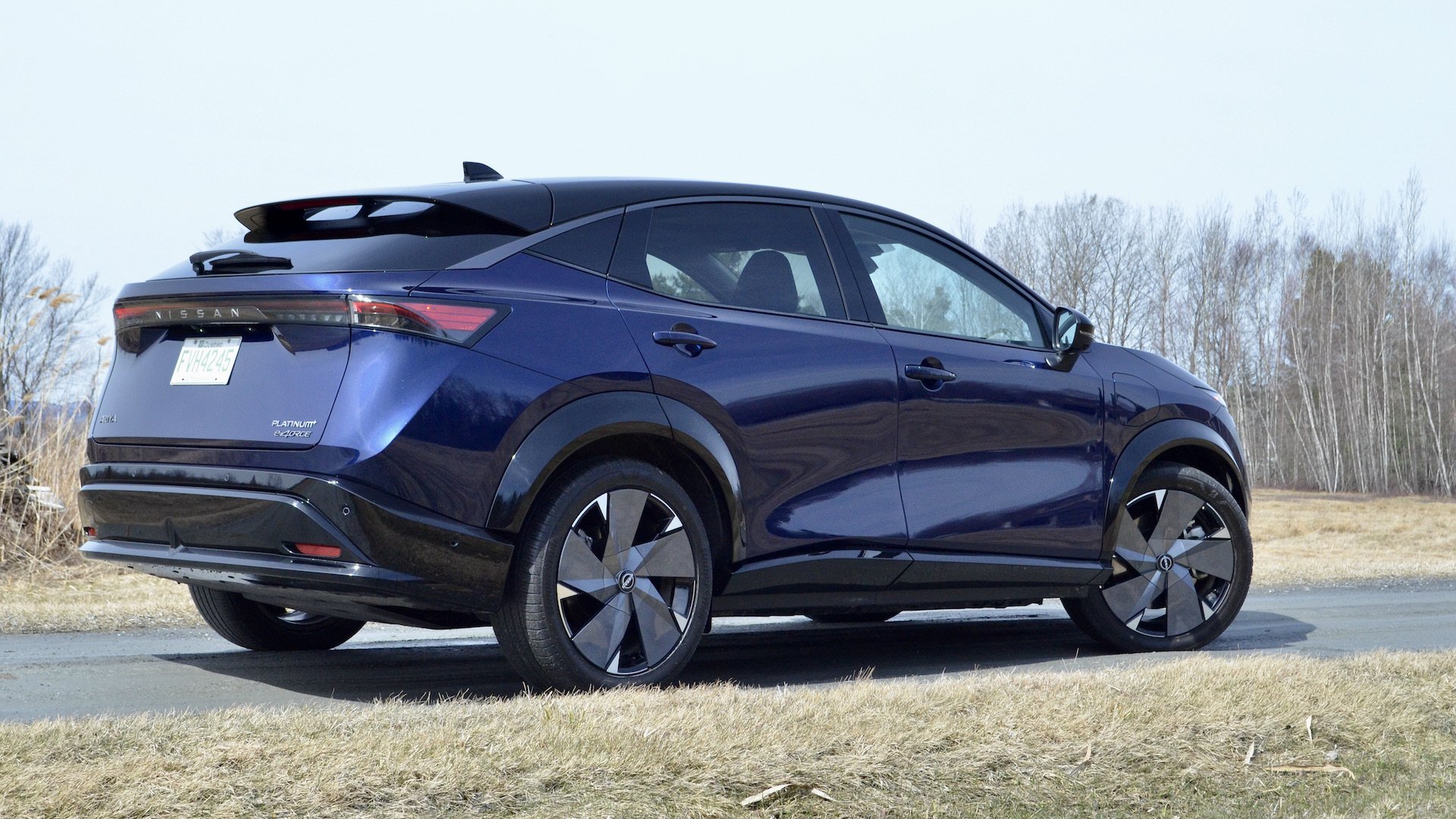
From the side, the tester sported an optional $950 two-tone paint job. Gloss black trim on bumpers, sills, and wheel arches elevated the look compared to matte plastic. Completing the package, the Evolve+ version came with stylish 20-inch geometric alloy wheels.
At the rear, a full-width light bar gives the Ariya a clean, timeless finish. It’s a design direction echoed by the new Murano and Infiniti QX80.
 2025 Nissan Ariya Evolve+ e-4ORCE
A Functional, Family-Oriented Cabin
Step inside, and space is immediately generous. The dashboard seems to float, with no bulky centre console cluttering the floor. Instead, a backlit mesh panel creates an intriguing glow, especially at night, though its artistic purpose remains unclear.
Bronze accents and suede-like trim on the dash and doors add refinement, while blue Nappa leather seats deliver a unique premium presentation.
 2025 Nissan Ariya Evolve+ e-4ORCE
A pair of 12.3-inch displays handle instrumentation and infotainment. They’re easy to use but lack deep customization. Nissan’s system isn’t cutting-edge but a clear step up from previous efforts, with standard Apple CarPlay and Android Auto.
Haptic Controls: More Style Than Substance
The climate controls are haptic and embedded in a faux wood panel. While they look sleek when stationary, using them on the move is awkward, even with the physical feedback, drivers often hit the wrong touch area, taking their eyes off the road.
 2025 Nissan Ariya Evolve+ e-4ORCE
The motorized centre console feels like an unnecessary gadget. Once adjusted, you rarely touch it again, and it introduces another potential failure point. It does house the shifter, cupholders, wireless charger, and the one-pedal drive mode selector.
Nissan’s famed “Zero Gravity” NASA-inspired seats remain. Comfort is good thanks to reduced pressure points, but thigh and back support could be better.
Space and Comfort for Families
In the back, the Ariya shines with generous legroom and space for three adults. Kids will be even more comfortable. Rear heated seats, USB-C ports, and a panoramic sunroof boost family friendliness. Cargo space is competitive: 646 litres with seats up and 1,691 litres with them folded flat.
 2025 Nissan Ariya Evolve+ e-4ORCE
Conservative EV Technology
A pioneer with the LEAF back in 2011, Nissan fell behind afterward. The Ariya, launched in 2021, modernized the lineup but didn’t leapfrog competitors.
The 2025 Ariya Evolve+ uses a 400V architecture with two battery options: 66 kWh (63 usable) and 91 kWh (87 usable). Liquid cooling improves longevity and stability.
But charging is a weak point. DC fast charging tops out at just 130 kW, well below rivals. Worse, the battery must be preconditioned manually, whereas most competitors do it automatically. That’s annoying.
At home, Level 2 charging is limited to 7.2 kW, taking around 14 hours for a full charge. Unlike competitors, you can’t set the charge to stop at 80%, a feature many EV owners appreciate.
 2025 Nissan Ariya Evolve+ e-4ORCE
389 Horses, But Tame Delivery
Despite 389 hp and 442 lb-ft, performance feels subdued. Acceleration is brisk, but the experience lacks excitement. Torque mainly shows up as steering column twist, not driving thrill.
Steering feels overly assisted and disconnected, regardless of drive mode. The suspension soaks up bumps effectively but leans heavily in corners, trading comfort for agility.
Nissan seems to have left room for a potential Nismo variant that could bring sharper dynamics. Nissan haven’t yet announced the Nismo version for North America.
 2025 Nissan Ariya Evolve+ e-4ORCE
Energy Use and Range
Nissan claims 414 km of range with 20-inch wheels. In real-world testing, consumption averaged 24.2 kWh/100 km, yielding about 360 km of range under ideal conditions. That’s higher than segment leaders and somewhat disappointing.
Reliability Watch
The Ariya already has four recalls, all tied to the 2023 model year. The most significant affected 994 units due to temporary motor overcurrent, which could reduce or cut power.
These aren’t catastrophic, but they underline areas to monitor. Winter use is also compromised by the need to manually preheat the battery, while highway trips suffer from slow charging.
 2025 Nissan Ariya Evolve+ e-4ORCE
Verdict: Comfortable but Conservative
The 2025 Nissan Ariya Evolve+ e-4ORCE isn’t a bad EV, it’s a comfortable, family-friendly crossover. But when stacked against rivals like the Hyundai IONIQ 5 and Volkswagen ID.4, it lags with slow charging, higher consumption, and uninspiring driving dynamics.
The tested model came in at $69,318. Dropping the $4,200 Premium Package lowers the bill, but the overall value is still questionable.
In short, the Ariya offers peace of mind and reliability, but it lacks the efficiency and spark needed to stand out. Best suited for city driving families prioritizing comfort over excitement.


 |  |  | |
|---|---|---|---|
| Model | Nissan Ariya Evolve+ e-4ORCE | Hyundai IONIQ 5 Pref. TI LP | VW ID.4 Pro S AWD |
| Price range | 59 921$ à 62 920$ | 55 766$ à 60 266$ | 51 310$ à 66 810 $ |
| Max power | 290 kW (389 ch) | 239 kW (320 ch) | 250 kW (335 ch) |
| Max torque | 442 lb-pi | 446 lb-pi | 402 lb-pi |
| Max battery capacity | 91 kWh (87 utilisables) | 84 kWh | 82 kWh (77 utilisable) |
| Range | 414 km | 425 km | 423 km |
| Max charging (Level 2) | 7,2 kW | 10,9 kW | 11 kW |
| Max charging (Level 3) | 130 kW | 238 kW | 175 kW |
| Combined consumption | 24.1 kWh/100km | 21.5 kWh/100km | 20.5 kWh/100km |
| Trunk volume | 646/1 691 L. | 770/1 680 L. | 858/1 818 L |
| Towing capacity | 680 kg (1 500 lb) | 907 kg (2 000 lb) | 1 225 kg (2 700 lb) |
